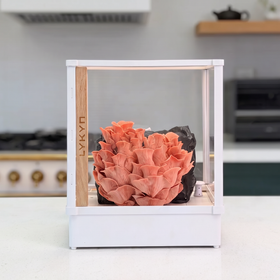



A DIY mushroom fruiting chamber is a drilled plastic tote (also called a shotgun fruiting chamber or SGFC) that uses perlite for passive humidity, costs $30 to $50 to build, and requires twice-daily misting and fanning. A smart fruiting chamber is a sealed appliance with active humidity control, automated airflow, and species presets. Smart costs $299 to $499 upfront, runs autonomously, and delivers 95%+ first-grow success vs 50 to 65% for DIY.
"Mushroom fruiting chamber" sells 480 searches a month in the US (Semrush, VERIFIED). The split among those searchers is roughly half-and-half: half want to build one for $40 over a Saturday afternoon, half want to buy a finished smart appliance. This guide covers both paths in detail so you can pick honestly.
Lykyn is a small California company that designs smart mushroom fruiting chambers. We sell the smart path. We will tell you when DIY is the better fit and exactly how to build one if it is.
What Is a Mushroom Fruiting Chamber?
A mushroom fruiting chamber is any sealed environment that holds high humidity (80 to 92%) and provides regular fresh air exchange so a colonized fruiting block can pin and produce mushrooms. The chamber's job is to do the things a forest floor or rotting log does naturally: trap moisture, allow gas exchange, filter contaminants.
The two real options for a home grower:
- DIY shotgun fruiting chamber (SGFC): a clear plastic tote drilled with hundreds of holes, lined with damp perlite. Passive humidity from the perlite. Manual misting and fanning.
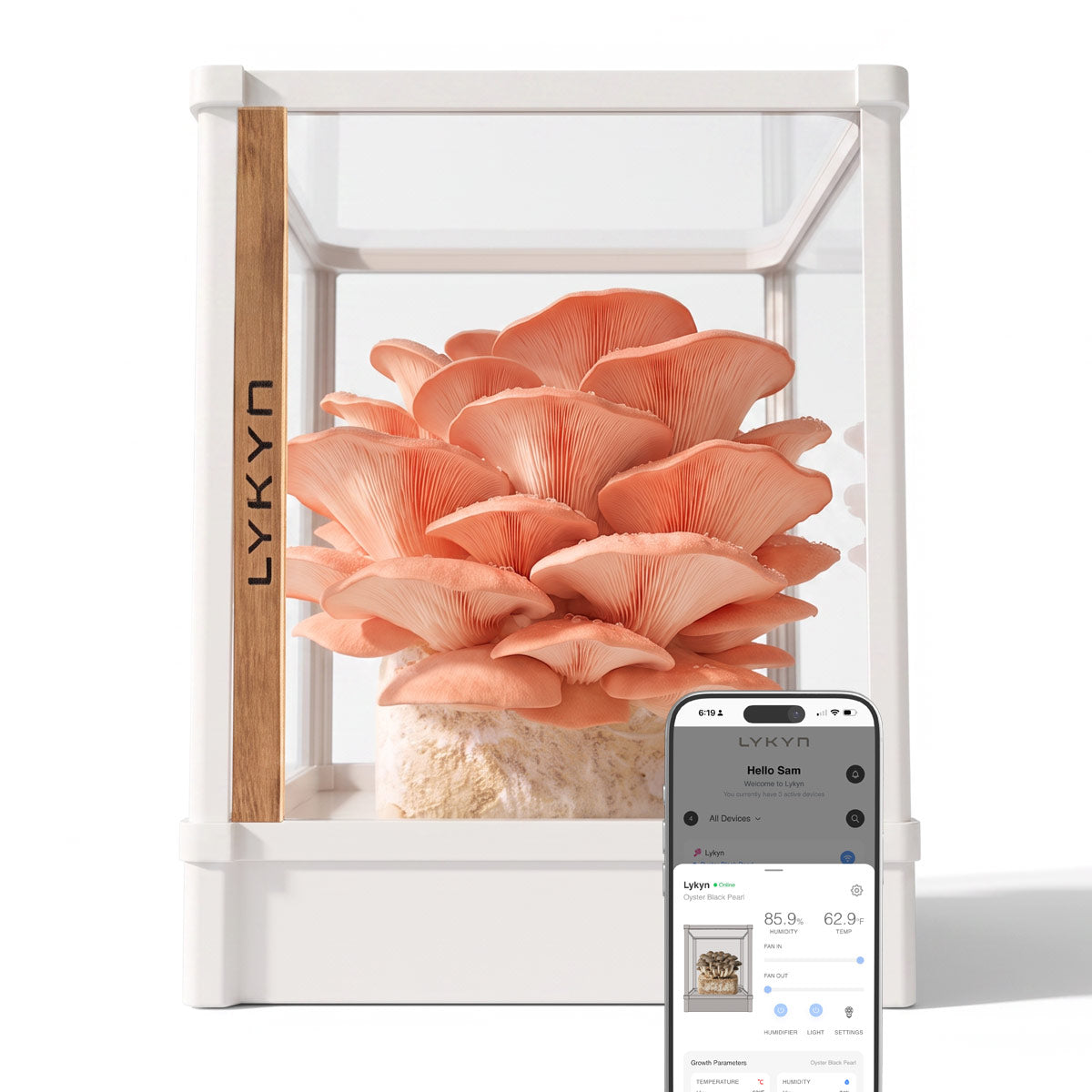
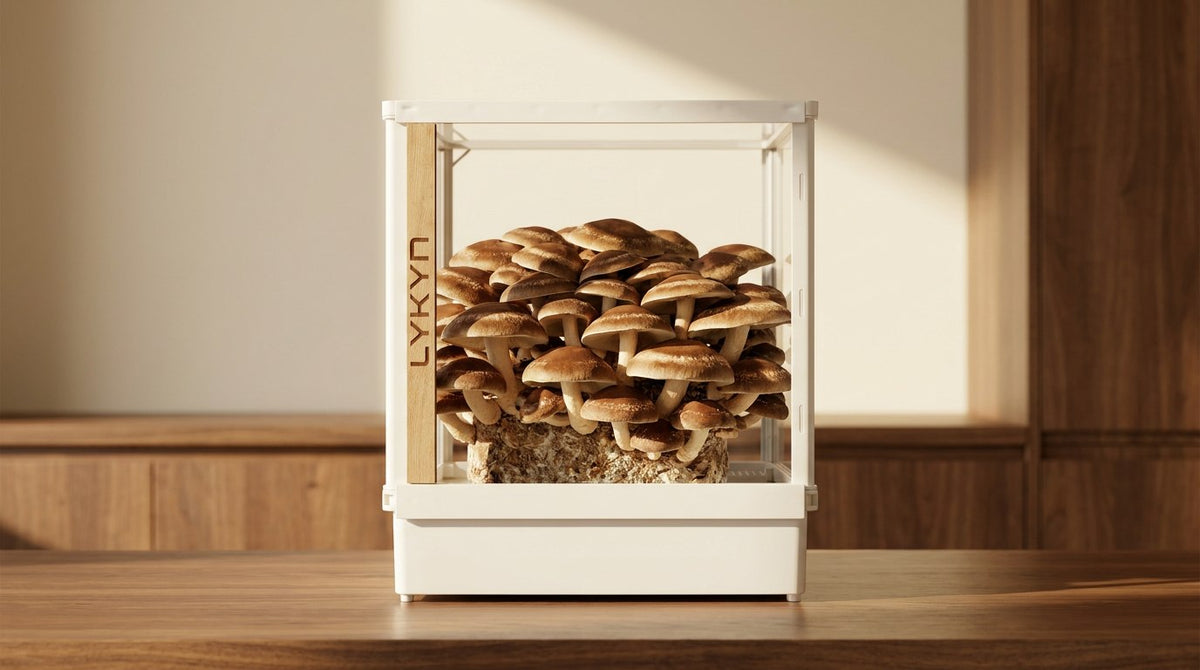
- Smart fruiting chamber: a sealed appliance with an ultrasonic humidifier, variable-speed fans, built-in filter, and species presets. Active humidity within +/- 3% of setpoint.
How to Build a DIY Mushroom Fruiting Chamber (Shotgun)
If you have a Saturday and $40, you can build a working SGFC. Here is the honest condensed version. The full Reddit r/MushroomGrowers thread on shotgun chambers covers a hundred edge cases.

Materials
- Clear plastic storage tote, 54 to 66 quart, transparent (not frosted) - $15 to $25
- Drill with 1/4 inch bit. Already own or borrow
- Coarse horticultural perlite, 8 to 10 quart bag - $10 to $15
- Spray bottle - $3 to $5
- Digital hygrometer with remote probe - $10 to $15
- Optional: small clip fan on smart plug timer for fresh air exchange - $20 to $30
Build Steps
- Drill holes. Mark the tote with a 2-inch grid on all four sides plus the lid. Drill a 1/4 inch hole at every grid intersection. Aim for 200 to 300 holes total. The dense pattern is what makes it a "shotgun" chamber.
- Wash and dry the perlite. Run hot water through it in a colander. This removes dust that can clog mushroom pores.
- Layer perlite at the bottom. 2 to 3 inches deep. Saturate with clean water until it stops absorbing.
- Place a small grid or mesh shelf over the perlite. Your fruiting block sits on the shelf, not in the wet perlite directly.
- Place the colonized fruiting block on the shelf. Cut the bag open according to species (top for lion's mane, sides for oysters).
- Hygrometer probe at block level. Not at the lid. Lid humidity reads 5 to 10% higher than what the block actually sees.
- Mist 2 to 3 times daily. Light passes over the inside walls. Do not mist the fruiting block directly.
- Fan twice daily for fresh air exchange. Open the lid for 30 seconds and wave it. Or run a clip fan on a smart plug timer for 5 minutes every hour.
Total build time: 1 to 2 hours. Total cost: $30 to $50 not counting the optional fan setup.
The Honest Limits of a DIY Fruiting Chamber
An SGFC works. It also has real failure modes:
- Humidity swings 20 to 30%. Perlite-based passive humidity drops fast when you open the lid. A real-world SGFC sees 60 to 92% over a single day. That is wider than what most species want.
- Contamination risk every time you open it. Every misting and fanning event introduces airborne spores. After 2 to 3 cycles, most SGFCs accumulate visible mold somewhere.
- Aesthetics. A perlite-lined plastic tote in your kitchen is not the look most people want. SGFCs live in basements and garages.
- First-grow success rate 50 to 65%. The mushroom community average. Better with practice.
What a Smart Fruiting Chamber Does Differently
A smart fruiting chamber replaces three things a SGFC does manually:
- Active humidity. An ultrasonic humidifier with a closed-loop sensor holds humidity within 3 percentage points of setpoint, all day.
- Programmed airflow. Variable-speed fans cycle on a schedule that matches the species. Lion's mane gets gentle fans (low CO2 tolerance). Oyster gets stronger fans (high CO2 tolerance).
- built-in filtration. Every air exchange runs through a built-in filter. Contamination risk drops dramatically.

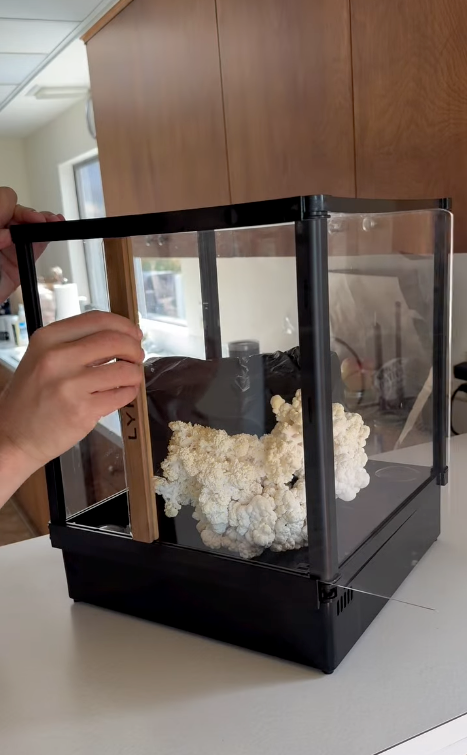
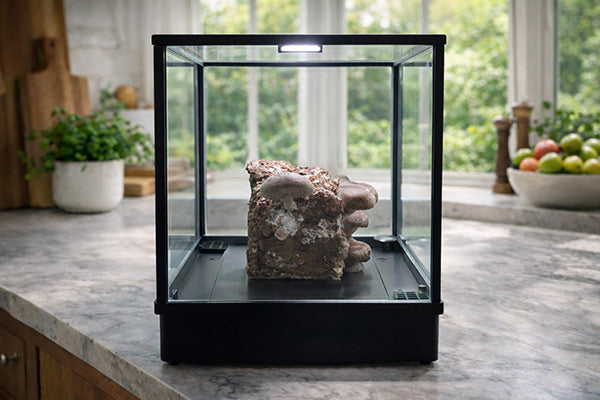
The Lykyn Smart Mushroom Grow Box is $299, holds a 6 lb fruiting block, runs 28+ species presets on-board, and works without an internet connection. See the full grow box comparison for alternatives.
DIY vs Smart: Side-by-Side
| Factor | DIY Shotgun Fruiting Chamber | Smart Fruiting Chamber |
|---|---|---|
| Upfront cost | $30 to $50 | $299 to $499 |
| Build time | 1 to 2 hours | 5 minutes (unbox) |
| Daily effort | 10 to 15 min (mist + fan) | 1 minute (water refill every 4 days) |
| Humidity precision | +/- 15% (passive) | +/- 3% (active) |
| Contamination risk | Medium-high | Low () |
| First-grow success | 50 to 65% | 95%+ |
| Block capacity | 1 to 2 small blocks | 1 large block (6 lb) |
| Aesthetic | Workshop / basement | Kitchen counter |
| Sound | Silent (or fan: 25 dB) | Under 35 dB |
| Reusable across species | Yes (sanitize between) | Yes (preset switch) |

Fuel Your Mushroom Journey
Smart Mushroom Grow Chamber
Plug-and-play smart chamber with humidity, light, and airflow dialed in for every species. Beginners harvest their first flush in days, not months.
Add to cart $299When DIY Wins
- Total spend has to be under $50
- You enjoy the build and the daily ritual
- You have a basement, garage, or dedicated grow room
- You plan to grow multiple species side by side and want isolated chambers
- You will iterate (pdiameter holes, perlite vs lava rock, fan placement) for fun
When Smart Wins
- You want fresh mushrooms in your kitchen rotation, not a hobby
- Your kitchen counter is the only available real estate
- You travel for work and need 4 to 5 day unattended runtime
- You hate failure - 95%+ first-grow success matters
- You have kids or pets and want a sealed unit
- You are growing for cooking, not for the process
For the broader manual-vs-automated framing, see our automatic vs manual mushroom grow kits comparison.
Frequently Asked Questions
What is a mushroom fruiting chamber?
A mushroom fruiting chamber is a sealed environment that holds 80 to 92% humidity and provides regular fresh air exchange so a colonized mushroom fruiting block can pin and fruit. Two real options exist: a DIY shotgun fruiting chamber (drilled plastic tote with perlite, $30 to $50) or a smart fruiting chamber appliance ($299 to $499).
How do you build a DIY mushroom fruiting chamber?
Build a DIY mushroom fruiting chamber by drilling 200 to 300 quarter-inch holes in a clear 54 quart plastic tote, lining the bottom with 2 to 3 inches of saturated coarse perlite, placing a mesh shelf over the perlite, and putting your colonized fruiting block on the shelf. Mist 2 to 3 times daily and fan twice daily for fresh air exchange.
What humidity does a fruiting chamber need?
A mushroom fruiting chamber needs 80 to 92% relative humidity during fruiting. Oyster mushrooms tolerate 80 to 85%. Lion's mane and shiitake prefer 88 to 92%. Drop humidity 5 to 10 points in the final 24 hours before harvest to firm up the cluster.
Is a smart fruiting chamber worth it over DIY?
A smart fruiting chamber is worth it if you cook with mushrooms weekly, value 95%+ first-grow success, and want zero daily effort. It pays for itself in year 2 versus equivalent fresh gourmet mushrooms at Whole Foods. DIY wins if total spend has to stay under $50 or if you enjoy the daily ritual.
How long does a fruiting chamber cycle take?
A fruiting chamber cycle takes 10 to 28 days depending on species. Pink oyster fruits in 8 to 12 days. Pearl, blue, and gold oyster in 10 to 14 days. Lion's mane in 10 to 14 days. Shiitake in 21 to 28 days. King trumpet in 14 to 18 days.
Can I use a fruiting chamber for any mushroom species?
Yes, but the humidity, airflow, and light schedule needs to match the species. A DIY shotgun chamber requires you to adjust manually. A smart chamber stores presets per species and switches automatically. Lion's mane, oyster, shiitake, king trumpet, and pioppino all run different optimal cycles.
Can a fruiting chamber be used indoors?
A smart fruiting chamber is designed for indoor kitchen counter use, runs under 35 dB, and uses built-in filtration to minimize spore release. A DIY shotgun chamber can be used indoors but is messier (perlite, condensation runoff) and louder if a fan is added. Most hobbyists keep them in a basement, garage, or closet.
Bottom Line
A DIY mushroom fruiting chamber is the cheapest entry into mushroom cultivation. A smart fruiting chamber is the cleanest path from block to harvest. Pick based on your kitchen real estate, your tolerance for daily ritual, and your honest answer to the question: do I want to grow mushrooms, or do I want to grow as a hobby?
If the answer is grow mushrooms, the Lykyn Smart Mushroom Grow Box at $299 is the most capable smart chamber on the market. Pair it with a fresh block from the mushroom fruiting blocks collection.
If the answer is hobby, build the SGFC. We will not try to talk you out of it.
We answer our own email. If a chamber or block fails, we replace it. That is the deal.
Related reading
Ready to grow?
Skip the substrate guesswork. Start with the smart fruiting chamber that handles humidity, airflow, and lighting for you.
Start with the Lykyn Grow Box →Fuel Your Mushroom Journey

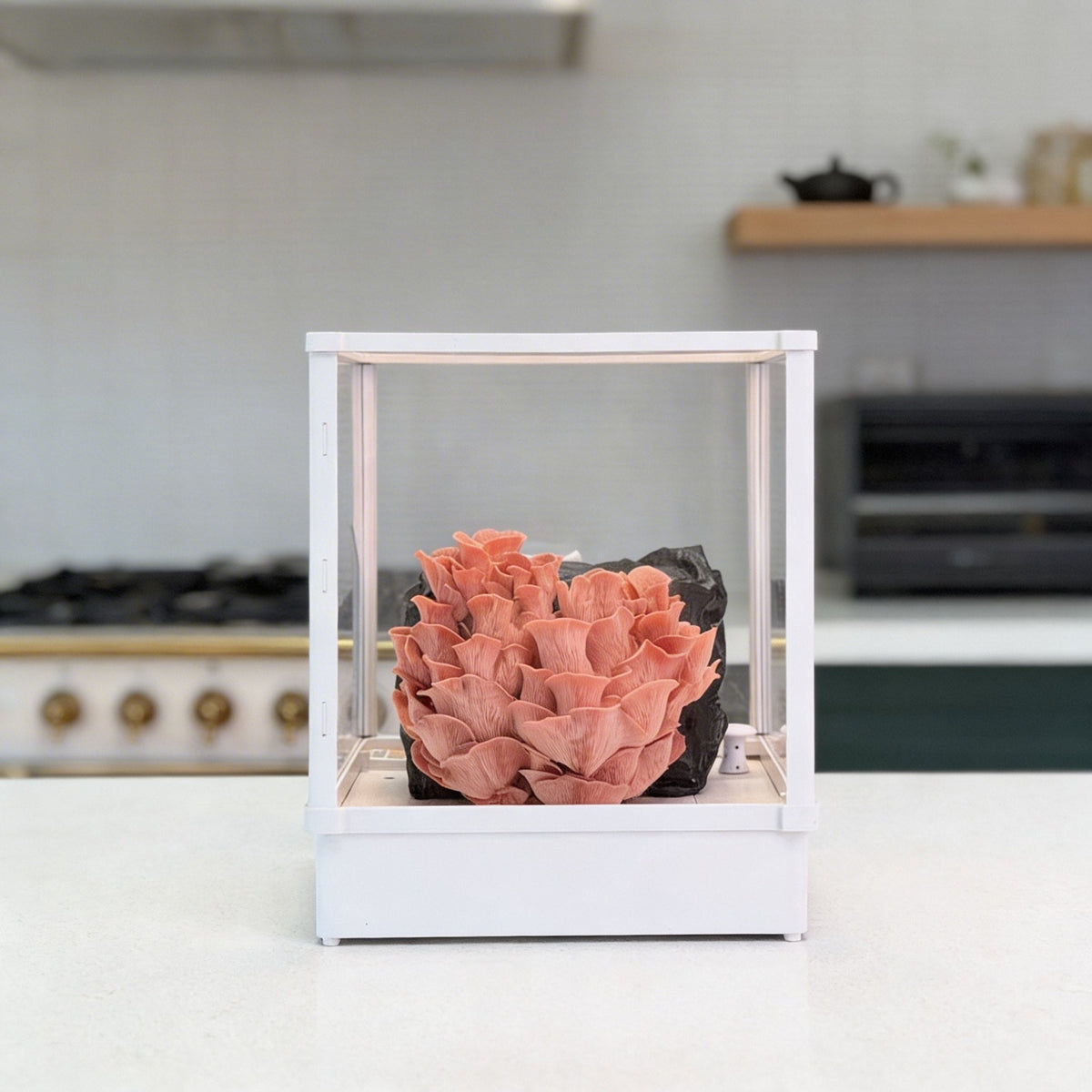
Smart Chamber. Bone White Single
- 2.8L tank, 90% humidity automatic
- App-controlled, plug-and-play
- 6 lb block ceiling, in stock

Smart Chamber. Obsidian Black Single
- Same hardware as Bone White
- Matte black premium finish
- Pairs with any kitchen palette




Share:
Automatic vs Manual Mushroom Grow Kits: Which Is Right for You?
Automatic vs Manual Mushroom Grow Kits: Which Is Right for You?