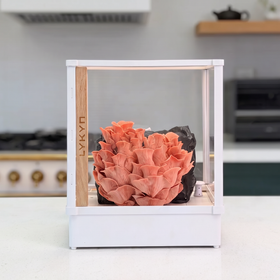
Eight species, one chamber, one science-backed growing method. Pick the species that fits your kitchen and skill level, then follow the dedicated growing guide that takes you from block-open to first harvest in 5 to 35 days.
Beginner friendly8 species covered28+ species supported
✓Grow guarantee: if your first block does not pin, we replace it.
28+
Gourmet species supported in the chamber
5 to 35
Days to first harvest, species-dependent
85-95%
Optimal relative humidity during fruiting
2 to 4
Typical flushes per 5lb fully colonized block
Choose your species
The eight species below are the ones we ship as 5lb fully colonized blocks. Each card links to that species' dedicated guide, where you will find cultivar variants, exact temperature ranges, flush-by-flush yield expectations, and species-specific troubleshooting.
Lion's Mane
Hericium erinaceus
for the focus-and-flavor crowd
Cognitive support + lobster-like texture
The flagship species. First harvest in 7 to 14 days at 61 to 70°F and 87 to 92% relative humidity. Mild seafood-forward flavor that sears like meat, plus the most-researched gourmet mushroom for cognitive support. Pearl Pom is the cultivar most beginners pick.
The fastest fruiter we ship. Pins form on day 2 to 3, and a full first flush usually lands in 5 to 7 days. Tolerates warmer kitchens (65 to 80°F) and forgives humidity dips. Best species for someone who wants a quick win in their first week.
Shiitake needs a cold shock to trigger fruiting, then 14 to 21 days at 55 to 75°F and 80 to 90% humidity. Slower than oysters, but the umami payoff is the deepest of any home-growable species. Donko (winter-harvest) caps fetch premium prices at specialty grocers.
The cool-weather oyster. Best results in apartments that sit 55 to 70°F (basements, north-facing rooms, winter heating off). First flush in 7 to 10 days, and the caps darken to a deep blue when grown at the lower end of that range. Faster than shiitake, more flavorful than pearl oyster.
The species you slice into 1-inch coins and sear like scallops. Fruits in 10 to 14 days at 55 to 70°F with low-frequency, high-volume misting. Lykyn block produces 3 to 6 fat clusters with stems thick enough to plate as a vegetarian centerpiece.
An autumn-tasting Italian species with grape-like cluster habit. Fruits in 12 to 18 days at 60 to 72°F. Pioppino tolerates the widest humidity swing of any species we ship, which makes it a good second-block choice for anyone who lost a block to dry air on their first try.
Maitake ("hen of the woods") fruits as a single rosette weighing 8 to 24 oz off a 5lb block. 21 to 35 day cycle at 55 to 65°F. The longest-cycle species we ship, but the rosette holds shape better than any other and the beta-glucan content per gram is the highest in the home-growable line.
A criminally underrated cluster mushroom. Caps look hand-glazed (the Latin epithet adiposa means "fatty," referencing the cap sheen). Fruits in 10 to 16 days at 55 to 70°F. The stems stay crunchy after stir-frying, which is uncommon and exactly why chestnut shows up on high-end ramen menus.
Every species in the list above wants the same four things, just dialed to different settings. Get these right and the species-specific stuff becomes much easier.
1
Humidity (85 to 95% relative humidity)
Every gourmet mushroom on this page wants 85 to 95% RH during fruiting. Below 80%, pins abort and primordia crust over. Above 95% for long stretches, bacterial blotch sets in. The Smart Chamber holds 92% by default and the Block + Bag method gets you there with 3 to 4 mistings a day. Beginners almost always undershoot humidity, never overshoot.
Humidity is the difference between a pinning block and a crust-over block.
2
Fresh air exchange (FAE)
Mushrooms breathe oxygen and exhale CO2. Without fresh air exchange, CO2 builds up inside the fruiting environment and the mushrooms grow tall, thin, and aborted (the classic "stretch and die"). Open a sealed bag 4 times a day for 30 seconds, or let the chamber's automated FAE cycle handle it for you.
Stretched, leggy mushrooms = not enough FAE.
3
Light (low to medium indirect)
Mushrooms are not plants. They do not photosynthesize. But they do use light as a directional cue. With low-to-medium indirect light (a north-facing windowsill or a 12-hour soft LED), caps form on the side of the cluster pointing toward the brightest source. With no light at all, mushrooms form on every side of the cluster, which is fine but produces oddly shaped harvests.
4
Temperature (species-specific)
This is the one variable that changes per species. Tropical-warm species (pink oyster, chestnut) want 65 to 80°F. Temperate species (lion's mane, blue oyster, king trumpet, pioppino) want 55 to 72°F. Cool-shock species (shiitake, maitake) need a 24-hour fridge stint before fruiting. Match your room temperature to the species and you have done most of the work.
Manual misting vs the Smart Chamber
You can grow every species on this page without any device, by misting blocks 3 to 4 times a day. The numbers below are what changes when the chamber does that for you. Source: 12 months of Lykyn customer surveys plus our internal block-replacement data.
Manual misting
Daily attention5 to 8 min, 3 times a day
Humidity precisionDrifts 10 to 20% between mists
First-flush success60 to 75% (humidity miss is #1 failure)
Total yield, 5lb block1.0 to 1.5 lb across 2 flushes
vs
Smart Chamber
Daily attentionZero. Chamber holds the cycle.
Humidity precisionHolds 92% within +/- 2%
First-flush successAbove 95% in customer surveys
Total yield, 5lb block1.5 to 2.0 lb across 3 flushes
How much will you harvest?
A quick year-one yield estimate. Pick the species and method and the math runs live.
Year-one harvest estimate
Based on per-species first + second + third flush averages.
Annual yield
9.0 to 12.0 lb
First harvest
~10 days
Flushes / block
2 flushes
Mushroom growing is one of the most accessible food crafts on the planet. If you can keep a houseplant alive, you can grow gourmet mushrooms.
The chamber, the blocks, and the guides are designed around that belief. You bring the kitchen. We bring everything else.
Frequently asked growing questions
Which mushroom species is easiest to grow at home for a complete beginner?
Pink Oyster, in the Smart Chamber. The cycle is 5 to 7 days from block-open to first harvest, the species tolerates warmer kitchen temperatures (65 to 80°F), and pink oyster forgives humidity dips that would kill a Lion's Mane block. If you are starting on a windowsill with no chamber, Pink Oyster is still the most resilient choice.
How long does it take to grow mushrooms from a kit?
Between 5 and 35 days depending on species. Pink Oyster fruits in 5 to 7 days. Lion's Mane and Blue Oyster in 7 to 14. Shiitake and King Trumpet in 10 to 21. Maitake takes the longest at 21 to 35 days because it forms one large rosette rather than many small clusters.
Do I need a special room or grow tent to grow mushrooms?
No. Every species on this page fruits at normal indoor temperatures in a kitchen, living room, or closet. What you actually need is a small enclosed environment that holds 85 to 95% humidity, exchanges air a few times a day, and has indirect light. That can be the Smart Chamber, a sealed bag with hole-punches, or a clear tub with a misting routine.
How many harvests can I get from one block?
Two to four flushes per 5lb block. The first flush is the largest, usually 60 to 70% of total yield. Each subsequent flush is smaller and comes 10 to 14 days after the previous one. After the block stops fruiting, it is spent and can be composted or used as garden mulch.
What's the difference between a grow kit and a fruiting chamber?
A grow kit is the substrate that the mushrooms grow out of, a 5lb fully colonized hardwood block. A fruiting chamber is the environment the kit sits in. You need both, but a single chamber can be reused for dozens of consecutive blocks. The Smart Chamber automates humidity, airflow, and lighting so you do not have to mist by hand.
Can I grow mushrooms without a chamber?
Yes, with manual misting. The trade-offs are real: lower first-flush success rate (60 to 75% vs 95%+ in the chamber), tighter daily attention, and 25 to 35% less total yield per block. We sell blocks separately for growers who already have a humidity-controlled setup or who like the hands-on cycle.
What humidity do mushrooms need to grow?
85 to 95% relative humidity during fruiting, species-dependent. Pink Oyster tolerates the low end (82 to 90%), Lion's Mane wants the high end (87 to 95%). Below 80%, pins abort. Above 95% for long stretches, bacterial blotch and trichoderma contamination become risks. The Smart Chamber holds 92% by default, which sits in the safe zone for every species we ship.
Why are my mushrooms growing long, thin, and weak?
Carbon dioxide buildup, almost always. Mushrooms use FAE (fresh air exchange) to regulate growth. When CO2 stays high, the fruiting body stretches in search of fresh air and the caps stay tiny. The fix is to open the chamber or bag 4 times a day for 30 seconds, or let the chamber's automated FAE cycle handle it. This is the most common beginner failure mode after humidity miss.
Do I need to sterilize anything before growing mushrooms?
No, not with a fully colonized commercial kit. The 5lb hardwood block we ship is already inoculated, incubated, and sealed in a sterile growing bag. The sterile lab work is done before the block leaves us. Your job is to cut a slit at the right time and manage the fruiting environment. Sterile technique only matters if you are growing your own spawn from scratch.
What temperature do mushrooms need?
Species-dependent. Most home-growable gourmet species fruit between 55 and 75°F, which is normal indoor temperature in most heated or air-conditioned homes. Tropical species like Pink Oyster tolerate up to 80°F. Shiitake and Maitake need a brief cold shock (24 hours at 38 to 50°F) to trigger fruiting. Match your kitchen temperature to the species and you have already done most of the work.
Ready to grow your first species?
Get the Smart Chamber once. Run any block through it. Pick the species that fits your kitchen, today and a year from now.