



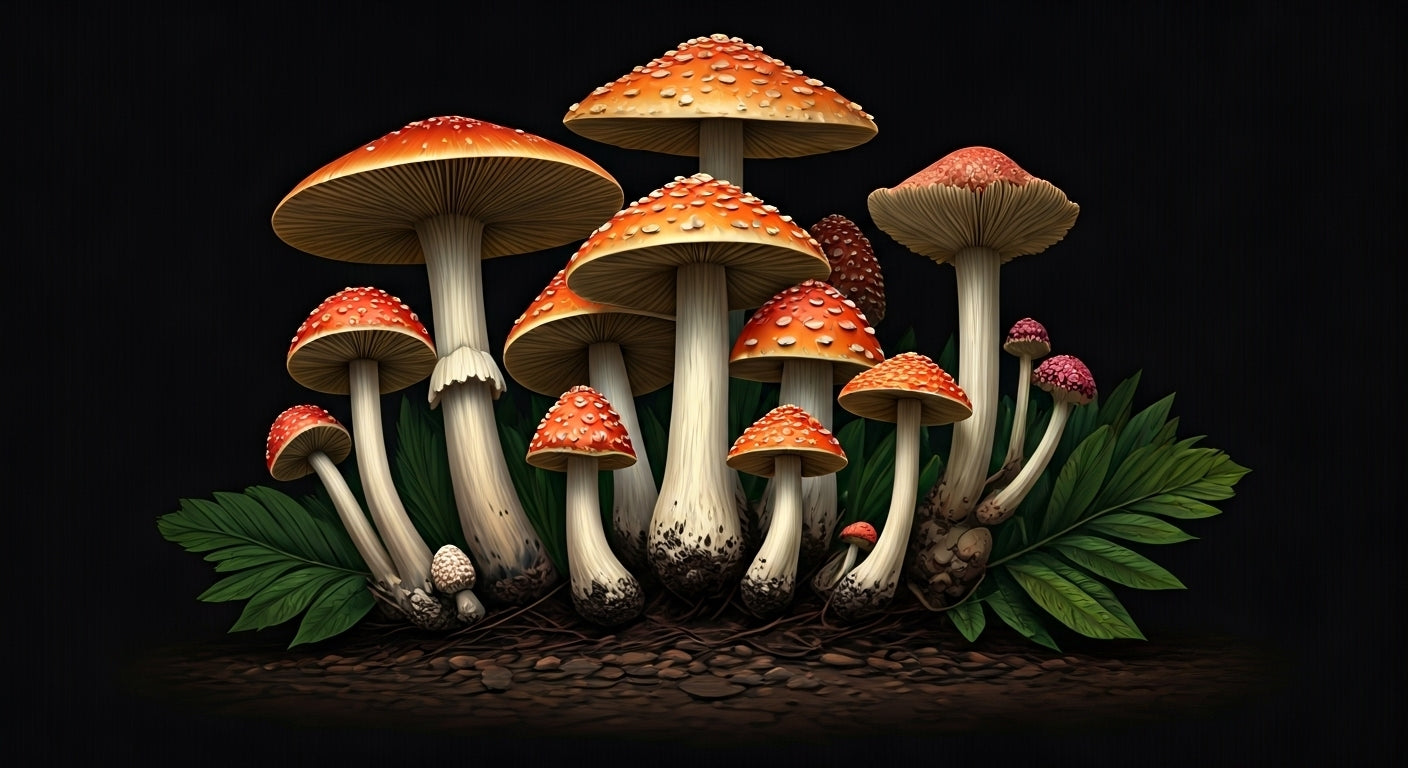
Colorado's Rocky Mountains offer some of the world's most spectacular mushroom hunting opportunities. From prized porcini mushrooms growing at high elevations to colorful chanterelles hidden in conifer forests, the Centennial State hosts an incredible diversity of fungi. Whether you're a beginner learning Colorado mushrooms identification or an experienced forager seeking new species, this comprehensive Colorado mushroom guide covers the most common Colorado mushrooms by elevation, habitat, and season so you can safely explore the fascinating world of wild fungi.
Quick Answer: Colorado features over 15 common mushroom species including edible varieties like porcini (king boletes), golden chanterelles, and morels, alongside toxic species like destroying angels and amanita muscaria. Most edible mushrooms grow above 9,000 feet in mixed conifer forests during summer and fall.

Prime Edible Mushrooms Found in Colorado
Porcini Mushrooms (Boletus edulis): The Unofficial Colorado State Mushroom
If you ask local foragers what the Colorado state mushroom should be, the porcini wins almost every poll. These magnificent fungi, also known as king boletes, represent the crown jewel of Colorado mushroom hunting and the species most experienced foragers chase across the high country every summer.
Identification Features:
-
Large brown caps (6-10 inches wide)
-
Thick, bulbous white stems
-
Sponge-like pores instead of gills underneath
-
No color change when cut
-
Found above 9,000 feet elevation
Due to its large size and great taste, this edible mushroom is one of the most commonly hunted species in Colorado. Porcini mushrooms fruit between mid-July through September, particularly thriving during monsoon seasons with warm nights.
Where to Find Them: Look near spruce trees, fir forests, and stream areas at high elevations. The Lykyn Smart Mushroom Grow Chamber can help you grow your own king oyster mushrooms at home while you're learning to identify wild varieties.
Golden Chanterelles (Cantharellus cibarius)
Golden chanterelles are among the tastiest and most hunted mushrooms in Colorado. They exude a fruity odor similar to apricots and are famously and frustratingly elusive. These golden treasures make mushroom hunting an exciting treasure hunt.
Key Characteristics:
-
Bright golden-orange color
-
Forked ridges (not true gills)
-
Apricot-like fragrance
-
Funnel-shaped caps
-
Solid stems
Foraging Tips: Chanterelles prefer moist conifer forests and often grow in the same areas year after year. They're excellent in soups, pasta dishes, and sautéed as side dishes.
Morel Mushrooms (Morchella esculenta): Colorado Morels and Where to Find Them
Yellow morels fall under the "choice" category of edibility, which means they're considered to be among the most delicious mushrooms on the planet. Colorado morels are a true spring delicacy, and morels Colorado foragers chase typically appear from late April through June at lower elevations near rivers, cottonwoods, and aspen groves.
Distinctive Features:
-
Honeycomb-like caps with deep pits
-
Hollow stems and caps
-
Spring emergence (April-June)
-
Found at elevations below 8,000 feet
-
Prefer cottonwood and aspen areas
Safety Warning: Morels can be confused with toxic false morels. Always verify identification with experienced foragers or refer to detailed guides like those found in our edible mushrooms guide.

Common Colorado Mushrooms by Habitat and Elevation
High Elevation Specialists (Above 9,000 feet)
Amanita Muscaria (Fly Agaric) Abundant in high altitudes above 9,000 feet in the Rocky Mountains, these beautiful mushrooms are always an exciting find on the trail. Their iconic red caps with white spots make them instantly recognizable.
Warning: Highly toxic and hallucinogenic. Never consume.
Hawk's Wing Mushrooms (Sarcodon imbricatus) Due to its strange appearance, it's far safer than others to eat because it's not easily mistaken for anything poisonous. These distinctive fungi offer beginner foragers a relatively safe identification challenge.
Features:
-
Overlapping brown scales resembling hawk feathers
-
White to cream-colored spines underneath
-
Large size (up to 8 inches across)
-
Excellent when harvested young
Mid-Elevation Forests (7,000-9,000 feet)
Oyster Mushrooms (Pleurotus ostreatus) These versatile fungi grow on dead hardwood trees and remain available even during winter months. Learn more about their identification in our comprehensive oyster mushroom identification guide.
Puffball Mushroom Colorado Identification
Western giant puffballs are one of the most rewarding edible species in Colorado. They are well-known, fairly easy to identify, and they can grow to the size of a volleyball. Some creative foragers even slice them crosswise for pizza crusts. The puffball mushroom Colorado foragers most often encounter is the giant puffball (Calvatia gigantea), found in meadows, pastures, and along forest edges from mid-summer through fall.
Safety Check: Cut puffballs in half. The interior should be pure white throughout with no visible gills, stems, or chambers inside. Any internal structures, yellowing, or brown patches mean the mushroom is past its prime or is not a true puffball.
Lawn Mushrooms in Colorado
Lawn mushrooms in Colorado pop up after summer monsoon rains in almost every yard along the Front Range and in mountain communities. Most are harmless saprotrophs feeding on dead grass, mulch, or buried wood, but a handful are toxic, so identification matters before children or pets get curious. The most common Colorado lawn mushrooms include:
Marasmius oreades (fairy ring mushrooms): Small tan caps in concentric rings on lawns. Edible but easy to confuse with toxic lookalikes.
Chlorophyllum molybdites (false parasol): Large white-capped mushroom that turns green when bruised. Toxic. The most common cause of mushroom poisoning calls in Colorado.
Agaricus species (meadow mushrooms): Brown-capped, gilled lawn mushrooms similar to commercial buttons. Some edible, some toxic. Confirmation by an expert is required before any consumption.
Coprinus comatus (shaggy mane): Tall white shaggy-capped mushrooms in disturbed lawn soil. Edible when young but inedible after the cap blackens.
If lawn mushrooms keep appearing after rain, they are decomposing organic matter under the surface and rarely indicate a problem. Removing the visible fruiting bodies has no effect on the underlying mycelium. Mowing or raking is the practical answer for households with curious pets or kids.
Poisonous Mushrooms in Colorado: The Dangerous Species to Avoid
Destroying Angel (Amanita ocreata)
The Destroying Angel is one of the most poisonous mushrooms in the world. These deadly white mushrooms contain amatoxins that cause severe liver and kidney damage.
Fatal Characteristics:
-
Pure white appearance
-
Bulbous stem base
-
White ring around stem
-
Found in forested areas and meadows
Critical Warning: Symptoms of poisoning can take hours to manifest, making it extremely dangerous for those who may unknowingly eat it.
False Parasol (Chlorophyllum molybdites)
Cases of mistaken identity involving this mushroom are extremely common. It may be the most common cause of mushroom poisoning in the United States. This species won't typically kill you but causes severe gastrointestinal distress.
Deadly Galerina (Galerina marginata)
Small brown mushrooms that grow near popular edible species, making them particularly dangerous. Never eat a little brown mushroom unless it was cultivated at home or harvested by a true expert.

Best Practices for Safe Mushroom Foraging in Colorado
Essential Safety Guidelines
-
Never eat unidentified mushrooms. The recommendation is don't eat anything you have not positively identified
-
Start with experienced guides. Join the Colorado Mycological Society or take guided forays
-
Use multiple identification resources. Field guides, apps, and expert consultation
-
Learn one species at a time. Master identification before moving to new varieties
-
Take spore prints. Essential for accurate identification
Recommended Learning Resources
Field Guides:
-
Mushrooms and Other Fungi of North America by Roger Phillips
-
Mushrooms Demystified by David Arora
-
National Audubon Society Field Guide to Mushrooms
Educational Opportunities:
-
Colorado Mycological Society meetings at Denver Botanic Gardens
-
Telluride Mushroom Festival (August)
-
Eagle Mushroom and Wild Food Festival
-
Modern Forager online courses
Equipment for Successful Foraging
Essential Gear:
-
Sharp knife for clean cutting
-
Wicker basket or mesh bag
-
Field guide and identification apps
-
Camera for documentation
-
GPS device for relocating productive spots
Advanced Tools: Consider investing in a mushroom grow kit for beginners to practice identification skills with known species while learning wild varieties.
Mushroom Hunting Colorado: When and Where to Forage
Seasonal Timing
Spring (April-June):
-
Morel mushrooms peak season
-
Look in lower elevations near rivers
-
Check cottonwood and aspen groves
Summer (July-September):
-
Prime porcini and chanterelle season
-
High elevation hunting above 9,000 feet
-
Mixed conifer forests produce best results
Fall (September-November):
-
Extended porcini season
-
Oyster mushrooms become more common
-
Prepare for earlier snow at high elevations
Winter (December-March):
-
Limited species available
-
Oyster mushrooms on dead trees
-
Chaga and medicinal fungi
Habitat Requirements
In Colorado, mushrooms mainly appear in mixed conifer forest (spruce and fir) above a certain elevation, usually around 9,000 feet and above. The state's unique geography creates perfect conditions for diverse fungi.
Prime Locations:
-
Mixed spruce and fir forests
-
Areas with consistent moisture
-
North-facing slopes retain moisture longer
-
Stream valleys and drainage areas
-
Healthy, living forest ecosystems
Growing Your Own Colorado-Style Mushrooms
While foraging wild mushrooms provides adventure and connection to nature, growing your own mushrooms offers year-round access to fresh fungi. The Lykyn Smart Mushroom Grow Box provides an excellent starting point for beginners interested in mushroom cultivation.
Benefits of Home Growing:
-
Safe, known species identification
-
Year-round fresh mushroom harvest
-
Practice identifying mushroom features
-
Supplement wild foraging with reliable production
Explore related cultivation topics in our Lion's Mane liquid culture guide for advanced growing techniques.
Frequently Asked Questions
Q: What are the most common edible mushrooms in Colorado? A: The most popular edible species include porcini (king boletes), golden chanterelles, morel mushrooms, oyster mushrooms, and various puffball species. Porcini and chanterelles are considered "choice" edibles prized by chefs worldwide.
Q: When is mushroom season in Colorado? A: Peak mushroom season runs from July through September for most species, with morels appearing in spring (April-June) and some varieties like oyster mushrooms available year-round. High elevation species fruit primarily during summer months.
Q: Do I need permits to forage mushrooms in Colorado? A: Foraging regulations vary by land ownership. National Forests typically allow personal use collection without permits, but check specific forest regulations. State parks and private lands require permission. Always verify current regulations before foraging.
Q: How do I safely identify edible mushrooms? A: Safe identification requires multiple verification methods: detailed field guides, spore prints, expert consultation, and extensive practice. Never consume any mushroom without 100% positive identification. Consider joining local mycological societies for hands-on learning.
Q: What's the biggest danger when mushroom hunting in Colorado? A: The destroying angel and other amatoxin-containing mushrooms pose the greatest threat, causing potentially fatal liver and kidney damage. False identification of edible species with toxic lookalikes represents the primary risk for foragers.
Q: Can I find psychedelic mushrooms in Colorado? A: While psilocybin mushrooms do grow in Colorado, their possession and use remain federally illegal despite Denver's decriminalization. This guide focuses on edible and medicinal species for safe, legal foraging.
Summary
Colorado offers exceptional mushroom foraging opportunities with species like porcini, chanterelles, and morels thriving in the state's high-elevation conifer forests. Safe identification requires proper education, field guides, and expert guidance. Always prioritize safety by never consuming unidentified mushrooms and learning from experienced foragers through organizations like the Colorado Mycological Society.
Start Your Mushroom Journey Today
Ready to begin your mushroom adventure? Whether you're interested in wild foraging or home cultivation, proper preparation ensures success and safety. Browse the Lykyn Smart Mushroom Grow Box and start your indoor farming journey today. Your first harvest awaits, and the satisfaction of growing your own food will complement your wild foraging experiences perfectly.
Transform your kitchen into a productive growing space while you develop wild identification skills. The Lykyn Smart Mushroom Grow Box automatically maintains perfect growing conditions, making it virtually impossible to fail on your first attempt. Combined with the knowledge from this guide, you'll develop comprehensive mushroom expertise from forest to table.
Related reading
Ready to grow?
Skip the substrate guesswork. Start with the smart fruiting chamber that handles humidity, airflow, and lighting for you.
Start with the Lykyn Grow Box →


Share:
Black King Mushrooms: Your Complete Guide to Nature's Dark Royalty
White Fuzzy Mushroom: Your Complete Safety and Identification Guide