



Quick answer: Pink oyster (Pleurotus djamor) is the fastest-fruiting gourmet mushroom you can grow at home. Pre-colonized fruiting blocks pin in 3 to 5 days, produce vibrant magenta-pink clusters, and yield 1 to 1.5 pounds per block. They love warm rooms (65 to 75 degrees Fahrenheit) where other oysters stall, prefer 85 to 95 percent humidity, and fade quickly above 80 degrees, so timing matters. Cooked crisp, the flavor is meaty and slightly seafood-like.

How to grow pink oyster mushrooms in 7 steps
- Acclimate the block at 65 to 75 degrees Fahrenheit for 24 hours. Most pre-colonized pink oyster blocks ship cold and need to warm up before fruiting begins.
- Cut a 4 to 6 inch X in the bag at the spot where you see the most aggressive white mycelium, or open the block fully if your kit instructs you to.
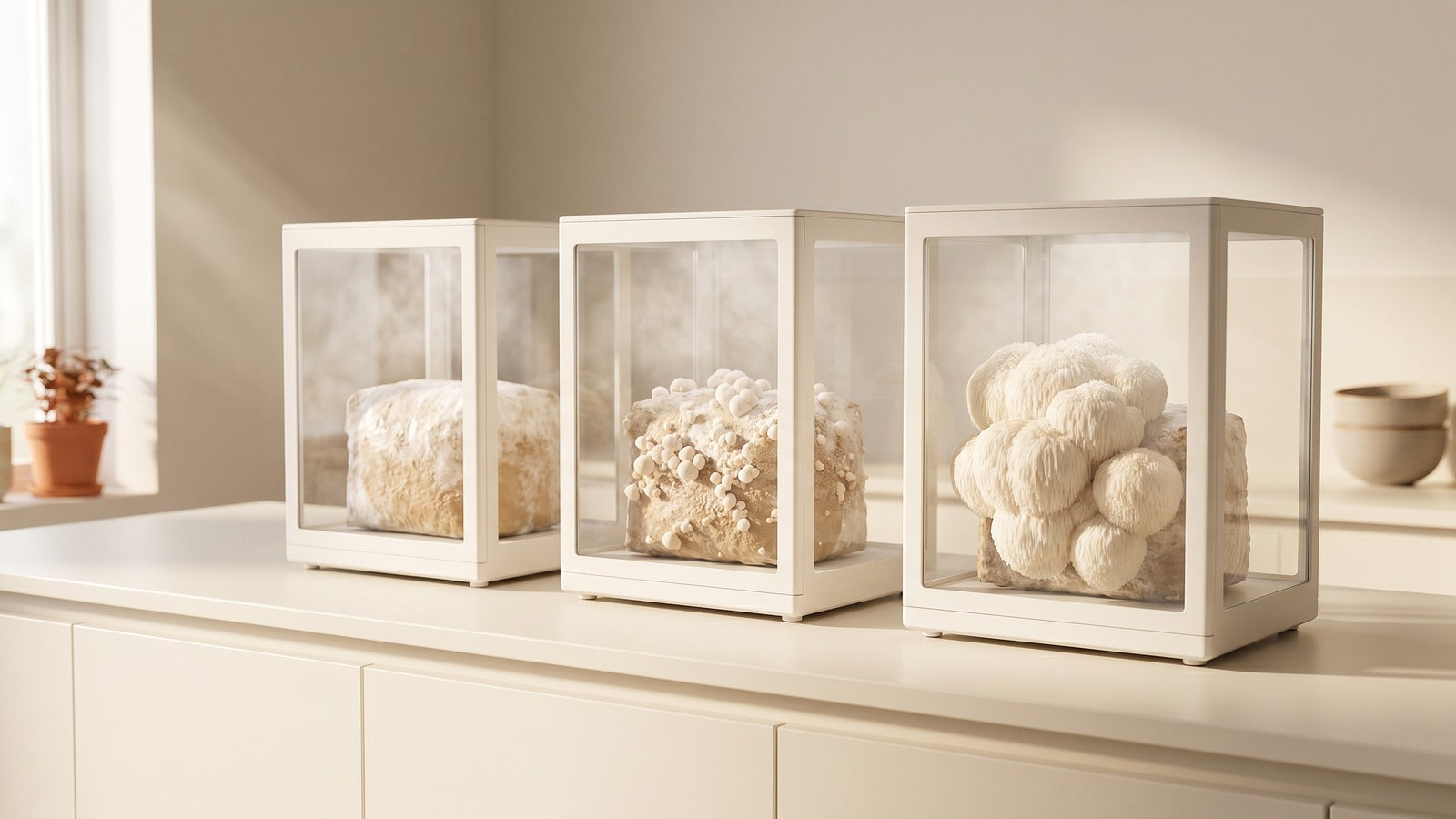
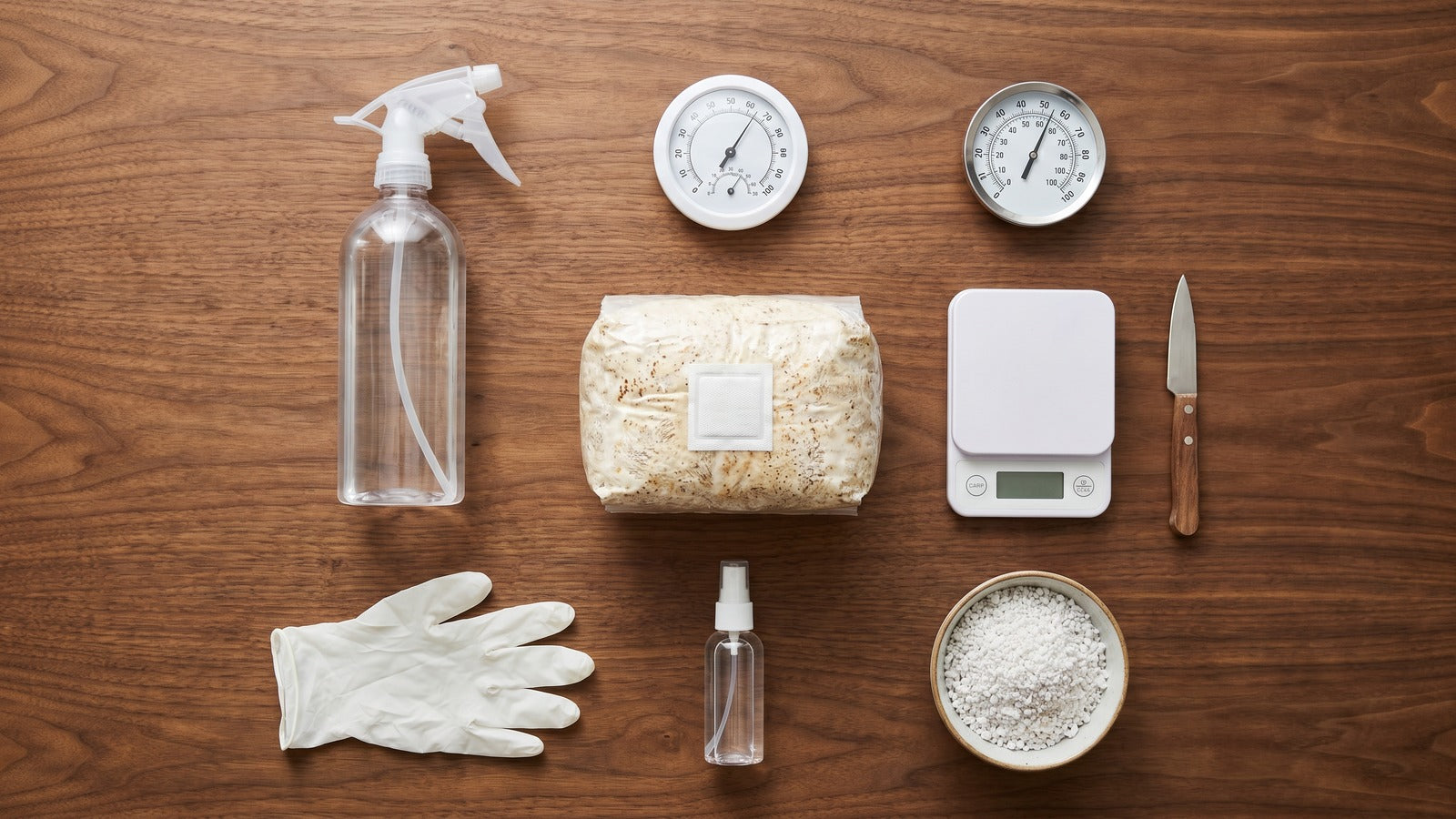
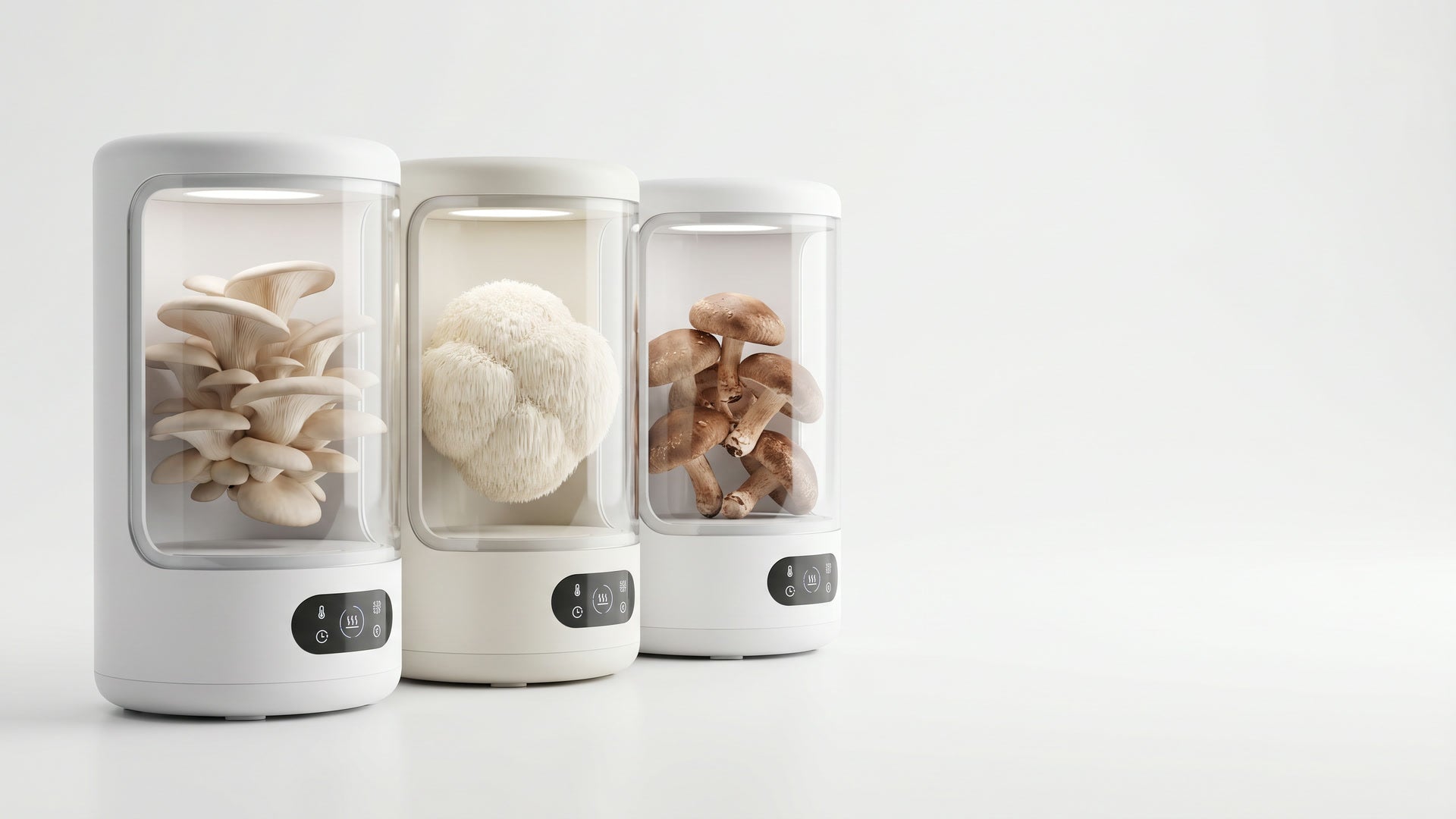
- Place the block in a growing environment that holds 85 to 95 percent relative humidity and 65 to 75 degrees Fahrenheit. A Lykyn Smart Mushroom Grow Box automates both; a humidity tent with twice-daily misting is the manual alternative.
- Provide indirect light (a normal lit room works, no special grow light needed). Pink oysters use light to orient pin formation.
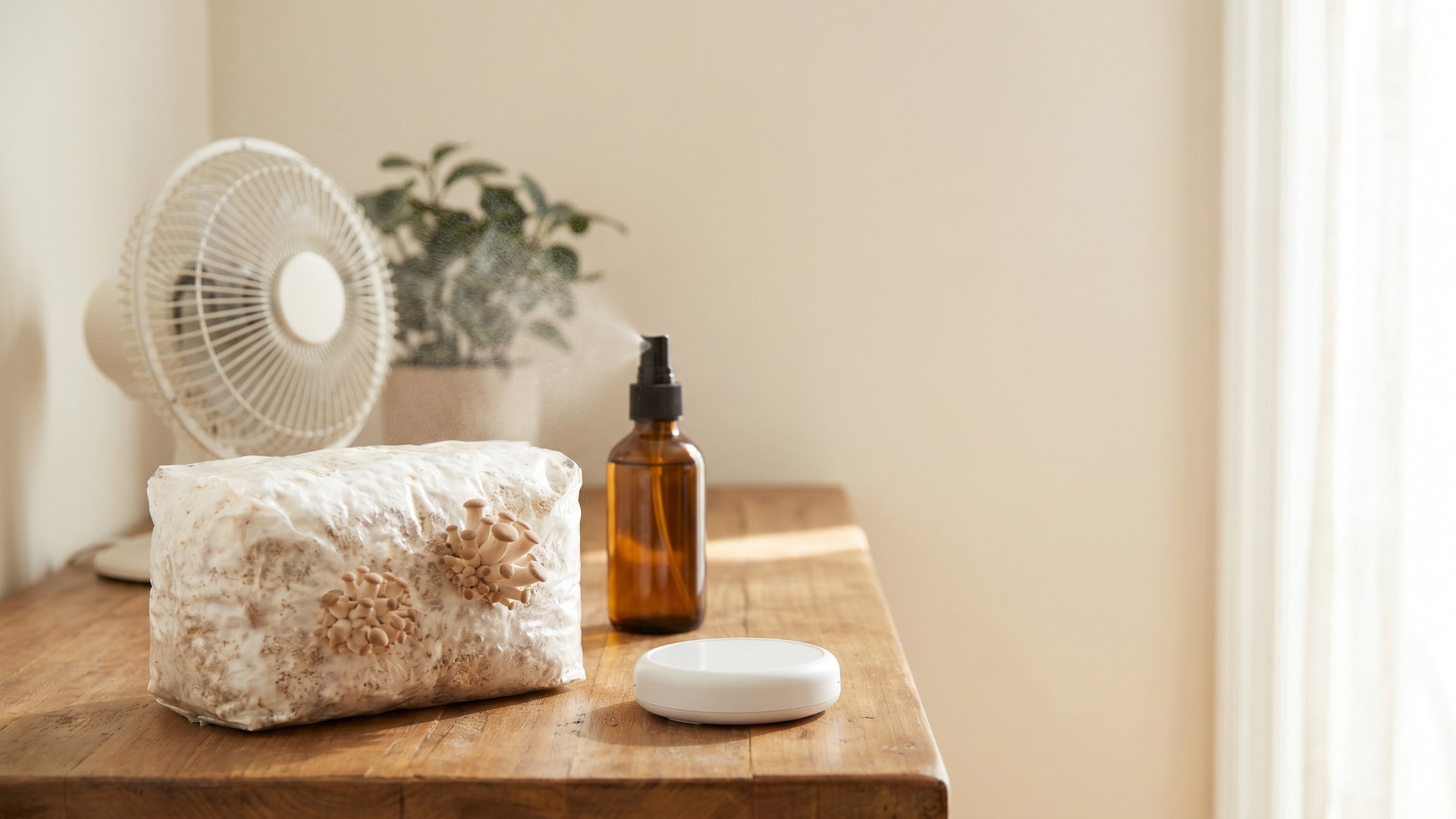
- Watch for pins on day 3 to 5. Tiny coral-pink bumps appear in clusters. Do not mist directly onto pins, fan around them to refresh CO2 instead.
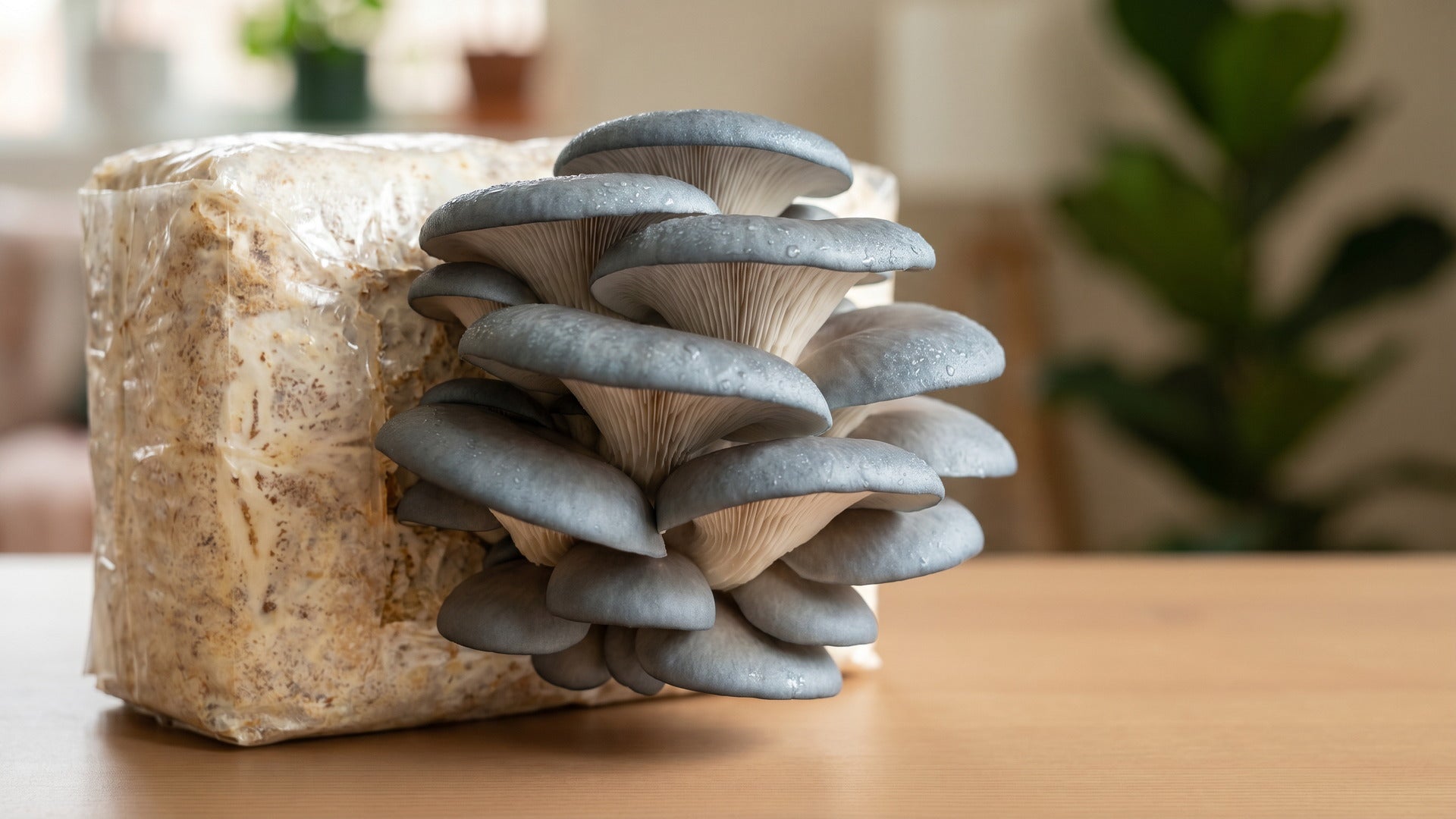
- Harvest on day 5 to 7, before the caps start to flatten or curl upward. Twist the entire cluster off at the base.
- Rest the block 7 to 10 days, soak it in cold water for 4 hours, and a second smaller flush often appears.
Why pink oyster is the best beginner mushroom

Pink oyster (Pleurotus djamor) earns its beginner reputation in three ways. First, it is the fastest gourmet mushroom commercially available, from pin to harvest can be five days, sometimes faster. Second, it tolerates warmer rooms than blue oyster or shiitake, which makes it forgiving for first-time growers who do not have a temperature-controlled grow space. Third, the pink color makes pinning impossible to miss, which builds confidence early.
The trade-off: pink oysters fade fast. Caps brown within hours of harvest, and the fruiting window closes quickly if you miss the harvest by a day. Treat them like asparagus, pick at peak, eat the same week, dehydrate the rest.
According to Cornell University's Small Farms Program, pink oyster is one of the most reliably aggressive Pleurotus species, colonizing supplemented sawdust substrates within 14 to 21 days at 75 to 80 degrees Fahrenheit. That same aggression carries into fruiting, which is why home grow kits can promise five-day harvests with a straight face.
What pink oyster mushrooms need to fruit well

Temperature: 65 to 75 degrees Fahrenheit
Pink oyster is a tropical Pleurotus, native to Southeast Asia and Pacific Mexico. It will fruit at room temperature in most American kitchens. Below 60 degrees Fahrenheit, pinning slows and clusters get spindly. Above 80 degrees Fahrenheit, mushrooms abort or fruit thin and watery.
If your home runs cold in winter, a seedling heat mat under the chamber lifts ambient temperature by about 8 to 10 degrees Fahrenheit. The Lykyn Smart Mushroom Grow Box does not include active heating, so cold rooms are the one environment where you will want to add a heat mat.
Humidity: 85 to 95 percent relative humidity
Pink oyster pins desiccate fast. The first 48 hours after pinning are the most sensitive window, sudden drops below 70 percent humidity will cause pins to crisp and abort. An automated chamber holding 90 percent humidity within plus or minus 2 percent removes this failure mode entirely. The manual alternative is misting three to five times per day plus a humidity tent, which works but punishes a missed morning.
Fresh air exchange (FAE)
Mushrooms exhale CO2. In a sealed container CO2 builds up, and pink oyster caps respond by growing long stems with tiny caps (the classic "trumpet" deformity). A grow chamber needs fresh air exchanged 4 to 8 times per hour during fruiting. The Lykyn chamber's variable-speed fans handle this automatically; a humidity tent needs to be opened and fanned for 60 seconds, two to three times per day.
Light: ambient indirect is fine
Pink oysters need light to set pin orientation, but they do not need full sun or a grow light. A normal lit room, or even reflected daylight, is enough. The Lykyn chamber's internal LEDs run on a 12-on / 12-off schedule by default, which matches what pink oyster wants without any tuning.
The fruiting block method (what we recommend)

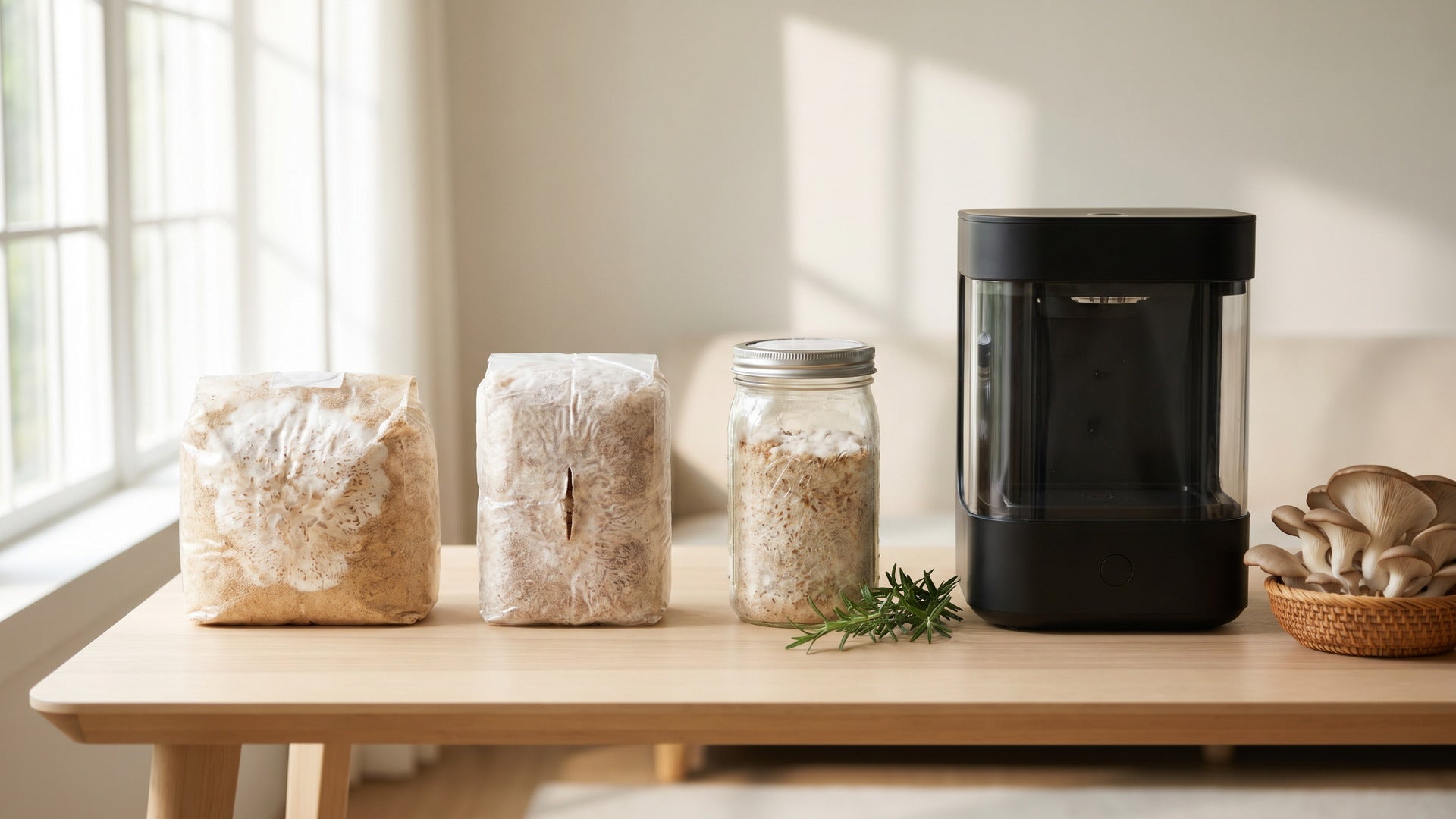
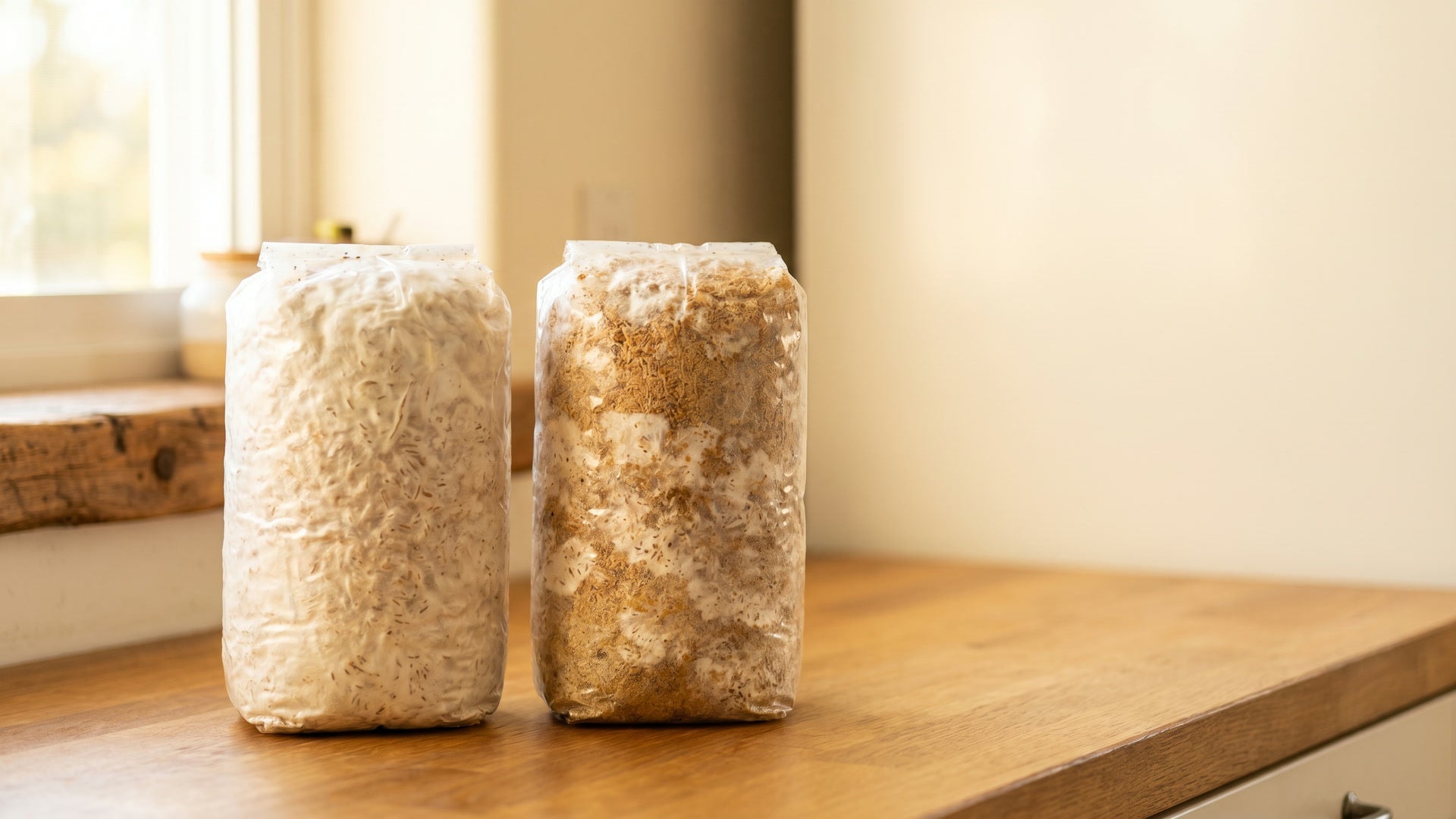
Most home growers use a pre-colonized hardwood sawdust block, a 5-pound bag of supplemented substrate that is already fully colonized with pink oyster mycelium. You do not have to inoculate, sterilize, or wait three weeks for the block to grow. You just acclimate, open, and fruit.
This is what the Pink Oyster Grow Kit ships with: a pre-colonized 5-pound block ready to fruit out of the bag. It pairs naturally with the Smart Mushroom Grow Box for hands-off humidity and air exchange, but works in any reasonably humid environment.
The fruiting block method is how commercial farms grow pink oyster too. Cornell's commercial cultivation research and USDA mushroom production reports both reference pre-colonized supplemented sawdust as the dominant substrate for Pleurotus djamor. The block format just brings that same proven recipe to a home counter.
If you want to compare the broader oyster family before committing, the Oyster Mushroom Growing Kit hub covers pink, blue, pearl, and golden side by side.
Timeline: what you should see, day by day
Day 0: Block arrives. Place in growing environment at 65 to 75 degrees Fahrenheit. Cut the X or open the bag per kit instructions. No water needed yet.
Day 1 to 2: Mycelium thickens at the cut surface. You may see a white "knot" forming, this is the start of primordia (baby pins).
Day 3 to 4: Pins appear. Tiny coral-pink bumps cluster around the cut. Hold humidity high, do not mist directly on pins.
Lykyn tip: if you see fuzzy white "tomentum" instead of pink pins, that is healthy mycelium recovering from cut shock. Pink pins typically follow within 24 hours.
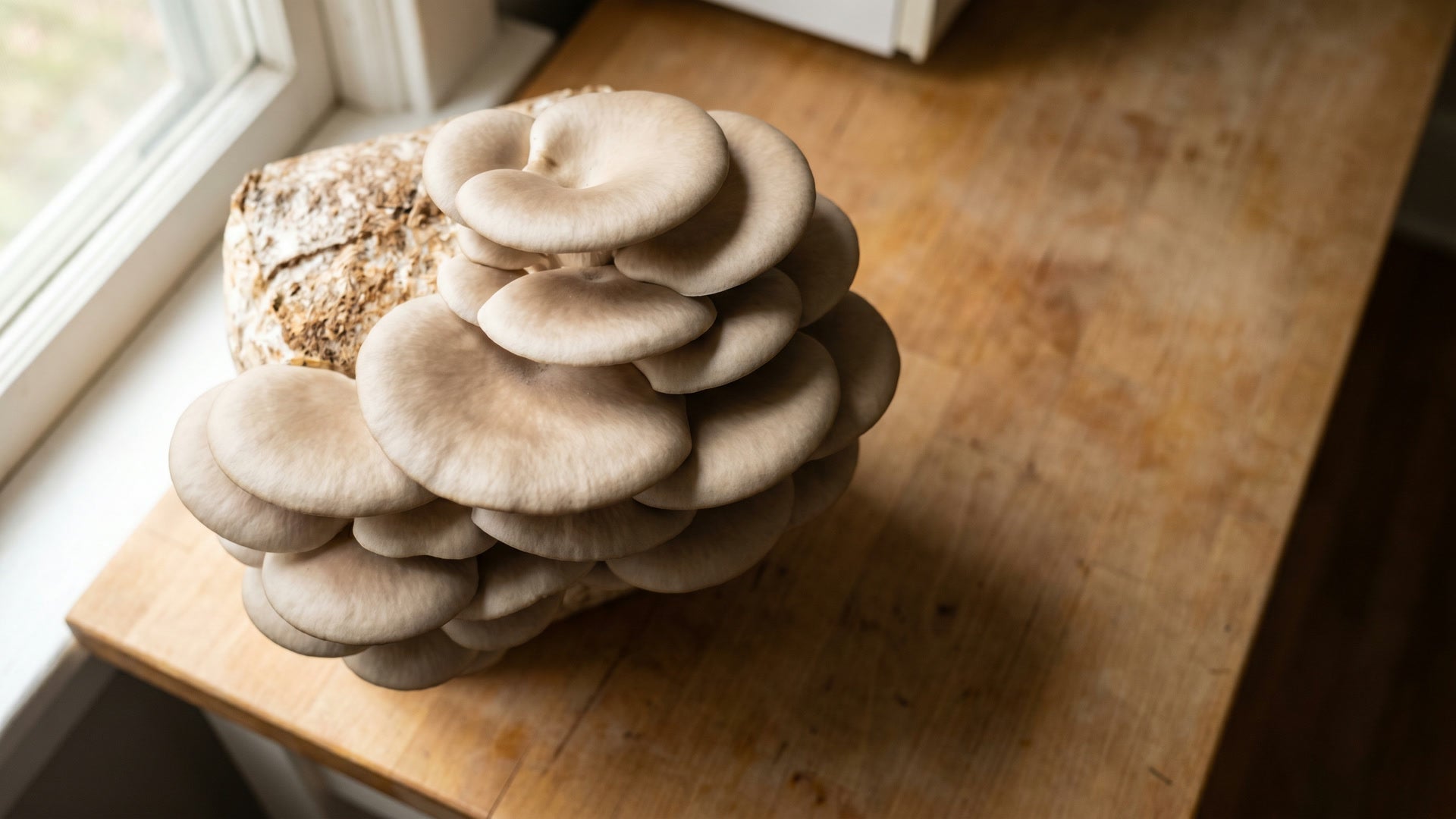
Day 5 to 6: Clusters double in size every 12 hours. Caps go from button-shaped to fluted. Color deepens to magenta-pink.
Day 6 to 7: Harvest window opens. Caps still curl inward at the edge, this is the right time. If caps go flat or upturn, harvest immediately; spore release is starting.
Day 8 to 14: Rest the block. Soak in cold water for 4 hours on day 10. A smaller second flush often appears around day 14.
The full timeline matches what Pleurotus djamor research papers in the journal Mycologia report for laboratory fruiting trials, pink oyster's fruiting cycle is one of the fastest documented in the Pleurotus genus.
When to harvest pink oyster mushrooms
Harvest before the caps fully flatten. The visual cue: cap edges still curl down slightly, not yet upward. Twist the whole cluster off at the base in one motion. Do not cut individual mushrooms, since the stems are tightly fused and the block prefers a clean break.
A clean harvest weighs 1 to 1.5 pounds on a 5-pound block. Cluster diameter usually runs 6 to 10 inches across when fully grown. For a deeper dive on the visual harvest cues, see our pink oyster harvest timing guide.
Once harvested, pink oysters keep 2 to 3 days in the refrigerator (paper bag, not plastic). Sliced and dehydrated, they store for 6 to 12 months and rehydrate beautifully into stir-fries.

Fuel Your Mushroom Journey
Black Oyster Grow Kit
Hardwood-sawdust block colonized with vigorous black oyster mycelium. Drops straight into your Lykyn chamber and starts pinning within days.
Add to cart $29.95Common pink oyster growing problems
Pins formed but never grew
Usually a humidity collapse. Pink oyster pins die fast below 70 percent RH. Re-mist, re-tent, or move the block into an automated chamber. New pins should form within 48 hours.
Long stems, tiny caps
CO2 buildup. Open the chamber or tent for 60 seconds, three times a day, to refresh air. If you are using a sealed bin with no fan, switch to a setup with active fresh air exchange.
White or green mold on the block surface
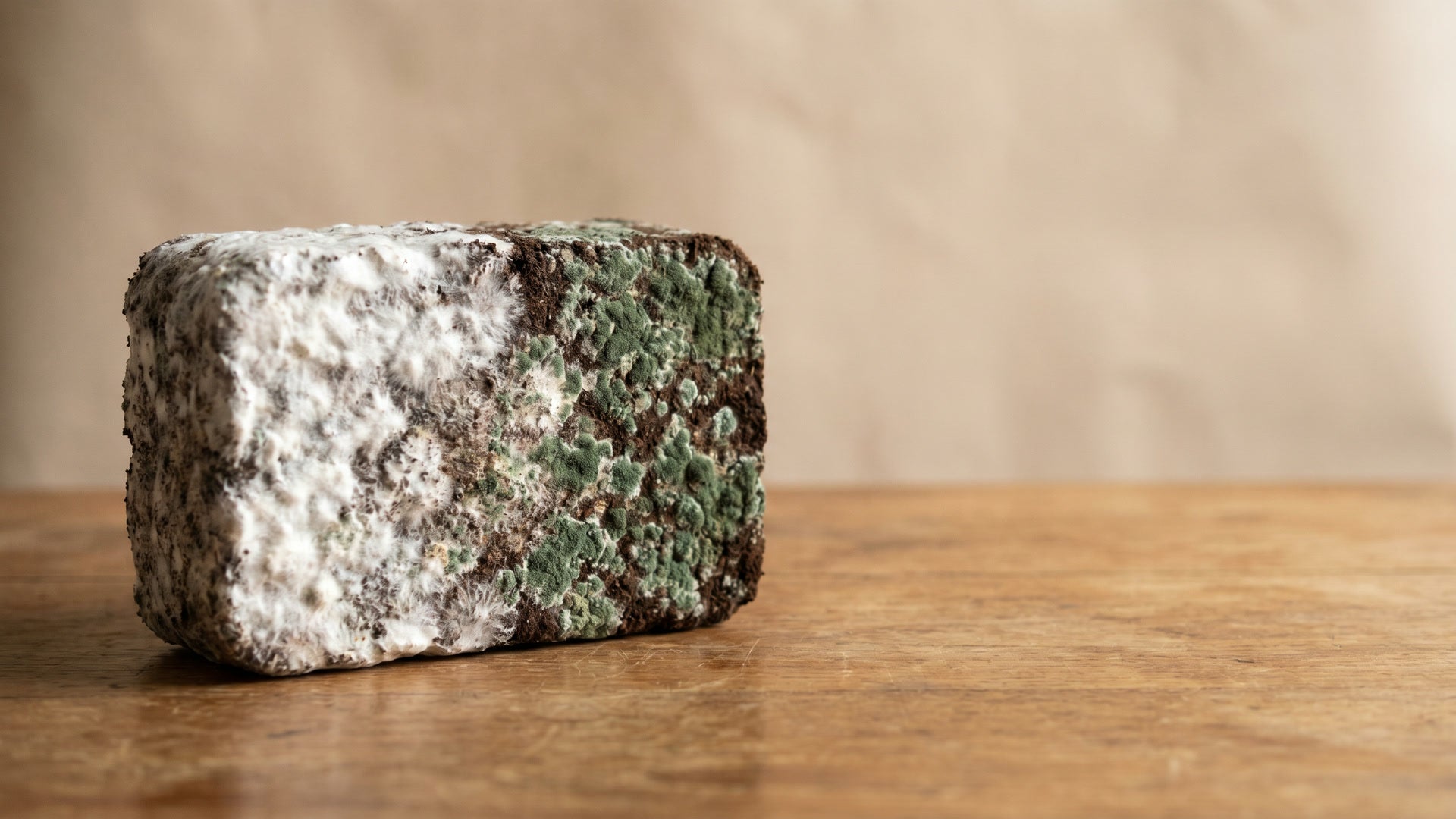
Trichoderma (green) or cobweb (white, fast-spreading) contamination. If the contamination is small and confined to the block surface, scrape it off and continue. If the contamination spreads across the substrate or smells musty or sour, retire the block. Most reputable suppliers warranty pre-colonized blocks against contamination. Lykyn replaces contaminated blocks at no charge.
Yellow ooze or watery beads on the cap
Bacterial blotch from too-wet conditions or stagnant air. Reduce misting frequency, increase fresh air exchange, and harvest sooner. The current flush is still safe to eat once trimmed; the next flush should improve once conditions stabilize.
For a broader troubleshooting walkthrough across all species, see why your mushroom block is not fruiting.
Cooking pink oyster mushrooms
Pink oysters lose most of their pink color when cooked, caps fade to a dusty tan. The trade is flavor: pan-fried in a hot dry skillet (no oil for the first 5 minutes, then butter or olive oil), they develop a chewy, slightly seafood-like texture often compared to crab or lobster. Crispy strips are a popular vegan bacon substitute.
Do not eat them raw. All oyster mushrooms, including pink, contain trace amounts of compounds that can cause GI upset uncooked. A 5-minute hot sear neutralizes those completely. Full recipe ideas are in our pink oyster recipe collection.
A note on flavor variation: pink oyster gets stronger as it ages on the block. Day 5 harvests are mild and slightly sweet. Day 7 harvests are bolder and more umami. Most home cooks prefer the day-6 sweet spot.
Why pink oyster is worth growing at home
You cannot buy fresh pink oyster at most grocery stores. The 2 to 3 day shelf life means commercial distribution mostly fails, supermarket oysters are nearly always pearl or blue. Growing at home is the only way to get pink oyster at peak.
It is also the most visually striking mushroom on a kitchen counter. Customers regularly tell us guests stop and ask what they are looking at. That social-currency factor is real, pink oyster is the mushroom that converts skeptical houseguests into "where do I buy one of these."
And it is the fastest reward in home growing. From the moment you open the block to the moment you harvest is rarely more than a week. Compared to a 14-day Lion's Mane or a 21-day shiitake cycle, pink oyster delivers a quick first-grow win that builds confidence for the species that come next. For a broader culinary deep-dive, see our pink oyster culinary delicacy guide.
Frequently asked questions
How long does it take to grow pink oyster mushrooms?
5 to 7 days from opening a pre-colonized block. Pins appear on day 3 to 4, clusters fully develop by day 6, and harvest happens day 5 to 7. From spawn to harvest using grain spawn on fresh substrate is longer, 21 to 28 days, which is why most home growers start with pre-colonized fruiting blocks.
What temperature do pink oyster mushrooms like?
65 to 75 degrees Fahrenheit for fruiting. They will tolerate up to 80 degrees Fahrenheit but quality drops above that. Below 60 degrees Fahrenheit pinning slows and may stall. They are the most heat-tolerant gourmet oyster species, which is why warm-room growers prefer them.
How much humidity do pink oyster mushrooms need?
85 to 95 percent relative humidity during pinning and fruiting. The first 48 hours after pinning are the most sensitive, dropping below 70 percent humidity kills new pins. An automated humidity chamber removes this failure mode; manual misting works but punishes a missed day.
How many pounds do pink oyster mushrooms yield per block?
1 to 1.5 pounds on a 5-pound block for the first flush. A second flush after a cold-water soak adds another 0.25 to 0.5 pounds. Total biological efficiency for pink oyster on supplemented hardwood substrate is 60 to 100 percent of dry substrate weight, which is high for the Pleurotus genus.
Can I grow pink oyster mushrooms without a grow box?
Yes. Pink oyster fruits in a humidity tent, a clear plastic bin with holes, or an open block placed in a humid bathroom. The trade-off is daily misting (three to five times per day) and manual air exchange. An automated chamber removes both labor steps and the most common failure mode (humidity drop).
Are pink oyster mushrooms safe to eat?
Yes, when cooked. Pink oyster (Pleurotus djamor) is a well-documented edible mushroom recognized in USDA species lists and used commercially worldwide. Do not eat raw, a 5-minute hot sear removes the trace compounds that can cause stomach upset uncooked. Some people are sensitive to oyster mushroom spores during sporulation; harvesting before caps flatten reduces airborne spore load.
Why are my pink oyster caps fading to white?
Pink color is strongest in young, cool-grown caps. As mushrooms mature, or as temperatures rise above 75 degrees Fahrenheit, caps fade toward pale pink or salmon. This is normal and does not affect flavor or safety. For maximum color, harvest on day 5 to 6 and keep the room on the cool end of 65 to 70 degrees Fahrenheit.
What is the difference between pink oyster and pearl oyster mushrooms?
Pink oyster (Pleurotus djamor) is tropical, fast, vibrantly colored, and shelf-life-fragile. Pearl oyster (Pleurotus ostreatus) is temperate, slower, gray-brown, and stores 5 to 7 days fresh. Pink prefers 65 to 75 degrees Fahrenheit; pearl prefers 55 to 70 degrees Fahrenheit. Flavor: pink is meatier and slightly seafood-like; pearl is milder and more savory. The oyster mushroom growing hub compares all four common species side by side.
Ready to grow your first pink oyster? The fastest path is a pre-colonized grow your own pink oyster at home paired with a Smart Mushroom Grow Box. The block is ready to fruit out of the bag; the chamber holds humidity at 90 percent and exchanges air automatically. From unboxing to first harvest is typically under a week.
Sources and further reading: Cornell University Small Farms Program (Pleurotus cultivation reference); USDA Agricultural Research Service specialty mushroom species notes; Royse et al., Pleurotus djamor fruiting cycle studies published in Mycologia; Lykyn grow logs 2024 to 2026, 200+ documented home grows.
Fuel Your Mushroom Journey

Smart Chamber. Bone White Single
- 2.8L tank, 90% humidity automatic
- App-controlled, plug-and-play
- 6 lb block ceiling, in stock

Smart Chamber. Obsidian Black Single
- Same hardware as Bone White
- Matte black premium finish
- Pairs with any kitchen palette
Aktie:
How to Grow Pioppino Mushrooms (Agrocybe aegerita) at Home
How to Grow Pioppino Mushrooms (Agrocybe aegerita) at Home