



Kurze Antwort: Pilzgrünschimmel Trichoderma ist ein schnell wachsender Pilzkontaminant (Trichoderma harzianum und verwandte Arten), der Pilzsubstrate innerhalb von 48 bis 72 Stunden von gesundem weißem Myzel in smaragdgrüne, staubige Sporen verwandelt. Er gedeiht unter warmen, feuchten, schlecht belüfteten Bedingungen und konkurriert mit den meisten Gourmetpilzmyzelien, wenn die sterile Technik nachlässt. Eine Rettung im Frühstadium ist möglich, wenn der Grünspan weniger als 10 Prozent der Blockoberfläche bedeckt und Sie innerhalb von 24 Stunden handeln. Danach entsorgen Sie den Block und desinfizieren Sie die Kammer.
Sie haben Ihren Fruchtkörperblock heute Morgen geöffnet, und wo gestern noch hellweißer Flaum war, ist jetzt ein blassgrüner Fleck. Das ist höchstwahrscheinlich Trichoderma, der häufigste Kontaminant bei der Pilzzucht zu Hause. Das Timing ist wichtig, und die meisten Züchter warten zu lange. Wir haben Tausende von Blöcken in der Lykyn Smart Mushroom Grow Box gezüchtet und Trichoderma auf fast jede erdenkliche Weise gesehen. Hier ist das ehrliche Handbuch.
Wie Trichoderma aussieht

Stufe 1: winzige weiße Büschel
Die visuelle Progression auf einem Pilzblock folgt einer vorhersehbaren Reihenfolge:
- Tag 0 bis 1: Ein kleiner weißer Fleck, der fast identisch mit Pilzmyzel aussieht. Sie werden ihn nicht bemerken.
- Tag 1 bis 2: Der Fleck nimmt einen gelben oder hellgrünen Stich an. Die Textur sieht eher pudrig aus als der baumwollartige Flaum von Gourmet-Myzel.
- Tag 2 bis 3: Volle Sporenbildung. Sattes Waldgrün mit einer staubigen Oberfläche. Das ist der Zeitpunkt, an dem die meisten Züchter ihn bemerken.
- Ab Tag 3: Das Grün breitet sich in konzentrischen Ringen mit einem dünnen gelben Heiligenschein aus. Das umgebende Pilzmyzel vergilbt, zieht sich zurück, stirbt ab. Pinne verkümmern.
Stufe 2-4: blassgrün bis dunkelwaldgrün
Geruch: Gesundes Myzel riecht erdig, leicht süßlich, manchmal schwach nach Anis. Trichoderma riecht muffig, wie ein feuchter Keller. Der Geruch ist oft vor der Farbe wahrnehmbar.
Textur: Gesundes Myzel ist flauschig und dreidimensional. Trichoderma sitzt flach und staubig, eher ein Film als Flaum. Beim Berühren lösen sich Sporen in einer sichtbaren Wolke.
Trichoderma vs. gesundes Myzel und andere Schimmelpilze

Gesundes Myzel vs. frühes Trichoderma. Pilzmyzel entwickelt sich langsam über 7 bis 14 Tage und bleibt weit über die Kolonisierung hinaus strahlend weiß. Trichoderma wächst in dichten kreisförmigen Flecken, entwickelt sich innerhalb von 24 Stunden sichtbar und wird innerhalb von 2 Tagen gelb. Wenn ein Fleck gestern noch nicht da war, aber heute einen halben Quadratzentimeter einnimmt, ist das nicht Ihr Pilz.
Trichoderma vs. Penicillium. Penicillium ist blauer grün (mint- oder türkisfarben), wächst in flauschigeren Kolonien mit einem Heiligenschein und bleibt auf der Oberfläche. Trichoderma ist dunkler waldgrün, liegt flach und kolonisiert durch das Substrat.
Trichoderma vs. Aspergillus. Aspergillus produziert gelbere grüne oder graugrüne Kolonien mit körniger Textur und ist beim Einatmen gefährlich. Wenn Sie unsicher sind, behandeln Sie jeden grünen Schimmelpilz als Aspergillus und folgen Sie dem unten beschriebenen Entsorgungsprotokoll.
Trichoderma vs. Spinnwebenschimmel. Spinnwebenschimmel sieht aus wie graue, fadenscheinige Spinnenseide. Wenn Ihr Fleck grau und faserig statt grün und pudrig ist, handelt es sich um Spinnwebenschimmel.
Warum Trichoderma in Heimanbau-Systemen gewinnt

Trichoderma hat drei biologische Vorteile. Es besiedelt einen Quadratzentimeter in 18 bis 24 Stunden, schneller als jede Gourmetpilzart. Es produziert Chitinase und Glukanase, die konkurrierendes Myzel aktiv auflösen (Mykoparasitismus, nicht nur Konkurrenz). Und seine Sporen sind überall: Der USDA Agricultural Research Service hat Trichoderma in Erde, Pflanzen, Innenluft und unbehandeltem Holz dokumentiert. Sie können die Sporen nicht vermeiden. Sie können nur verhindern, dass sie Fuß fassen.
Die Bedingungen, die Trichoderma liebt (85 bis 95 Prozent Luftfeuchtigkeit, 21 bis 27 °C, stehende Luft), sind genau das, was ein Heimanbau zu schaffen versucht. Der Unterschied zwischen einem gesunden Anbau und einer Katastrophe durch Grünschimmel liegt in der sterilen Technik und der Kammerdisziplin.
Prävention, die tatsächlich funktioniert

Kontrolle von Luftfeuchtigkeit und Frischluftzufuhr (FAE)
Prävention ist 90 Prozent des Spiels.
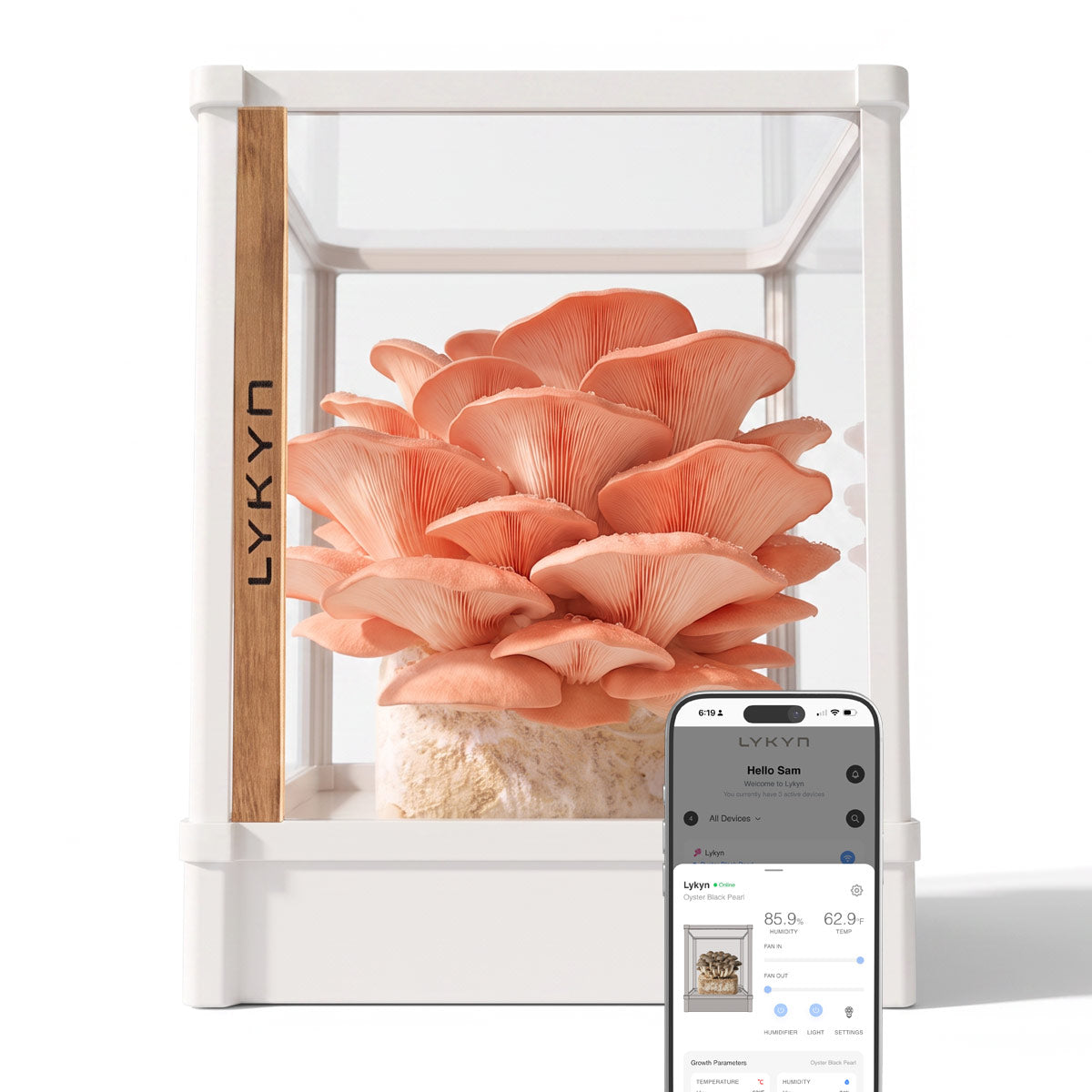
versiegelte und app-gesteuerte Kammerluft
Hände und Oberflächen. Hände 20 Sekunden lang mit Seife waschen. Oberflächen mit 70-prozentigem Isopropylalkohol abwischen (70 Prozent dringt besser in Zellwände ein als 91 Prozent).
Blockhandhabung. Vorkolonisierte Blöcke von Lykyn-Fruchtblöcken werden in einem versiegelten Beutel mit Filterpatch geliefert. Nicht schneiden, bevor Sie bereit sind. Machen Sie einen sauberen X- oder Schlitzschnitt, keine weite Öffnung.
Luftqualität. Trichoderma-Sporen verbreiten sich auf Staub und Luftströmungen. Betreiben Sie Ihren Anbau in einem sauberen Raum, nicht neben Zimmerpflanzen, einem Katzenklo oder Kompost. Eine versiegelte und app-gesteuerte Kammer ist der größte Reduzierer von Kontaminationen, der Heimzüchtern zur Verfügung steht.
Luftfeuchtigkeit und Belüftung im Gleichgewicht. Der größte Fehler ist, über 90 Prozent Luftfeuchtigkeit ohne Frischluftzufuhr zu betreiben. Stehende feuchte Luft ist ein Trichoderma-Inkubator. Führen Sie alle 30 bis 60 Minuten einen Frischluftwechsel durch. Eine intelligente Pilzzuchtkammer erledigt dies automatisch.

Befeuern Sie Ihre Pilzreise
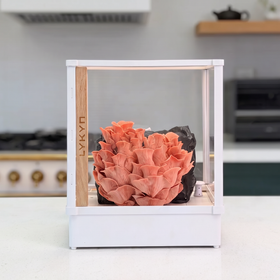
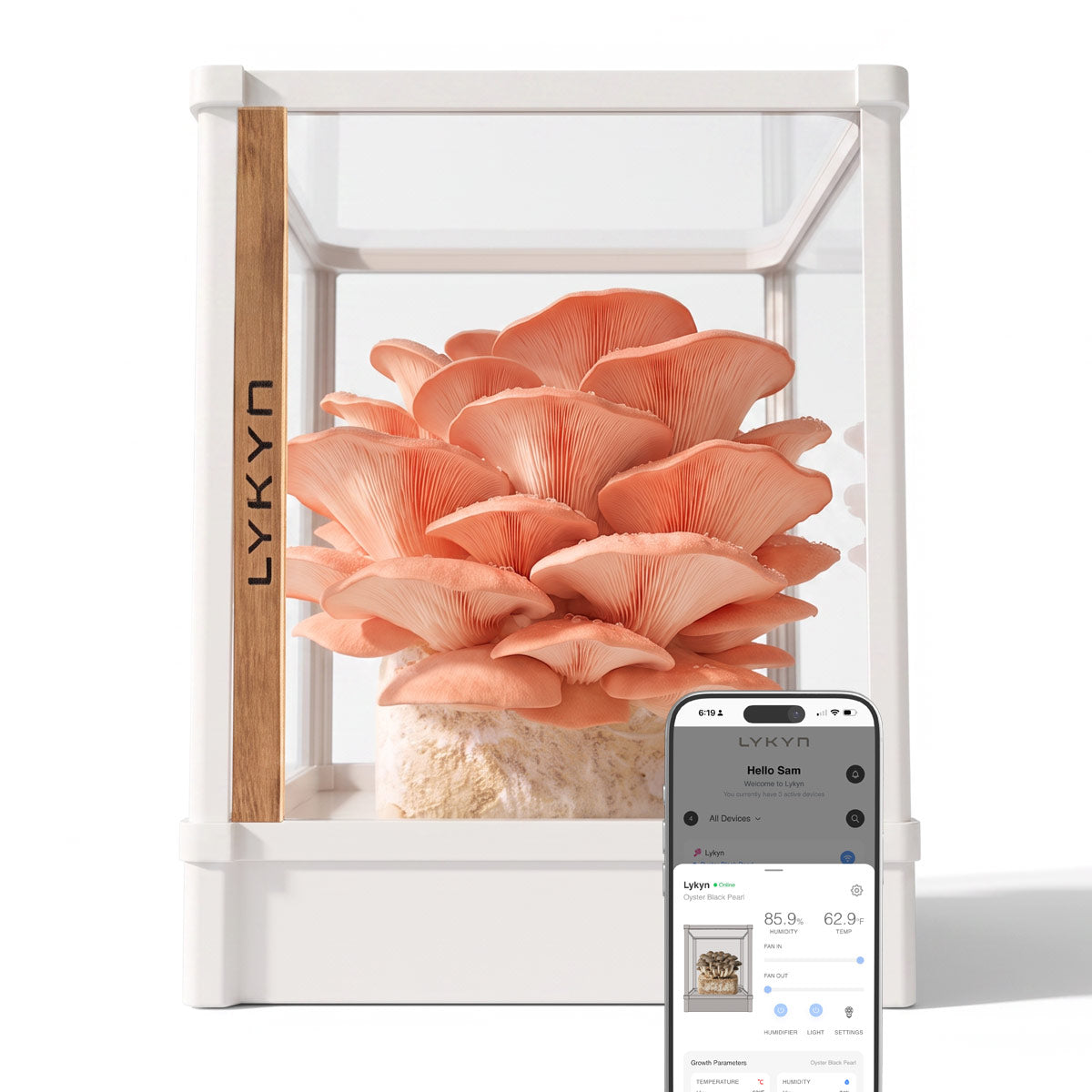
Intelligente Pilz-Anzuchtkammer
Plug-and-Play Smart Chamber mit Feuchtigkeit, Licht und Luftstrom, die für jede Art optimiert sind. Anfänger ernten ihren ersten Flush in Tagen, nicht Monaten.
In den Warenkorb $299Temperatur. Trichoderma liebt 24 bis 29 °C. Die meisten Gourmetpilze fruchten am besten bei 15 bis 24 °C. Arbeiten Sie am kühleren Ende des Bereichs Ihrer Art.
Rettungsprotokoll, wenn Sie Grünspan sehen
Unter 5 Prozent Oberfläche, am Blockrand, weniger als 24 Stunden alt. Sie können es vielleicht retten. Mit Atemschutzmaske und Handschuhen den betroffenen Untergrund plus 2,5 bis 5 cm Rand mit einem sauberen Messer abschneiden. Den Schnitt mit 3-prozentigem Wasserstoffperoxid sterilisieren. Wenn Sie eine haben, in eine separate Rettungskammer umziehen, die Frischluftzufuhr erhöhen, zweimal täglich überwachen. Erfolgsquote: 30 bis 50 Prozent.
5 bis 10 Prozent Oberfläche. Grenzwertig. Die Kammer ist wahrscheinlich bereits kontaminiert. Die meisten erfahrenen Züchter entsorgen in diesem Stadium.
Über 10 Prozent, jedes Grün im Substrat oder Grün in der Nähe der Fruchtkörperzone. Entsorgen.
Entsorgung. Trichoderma-Sporen aerosolieren. Den Block doppelt verpacken (originaler Wachstumsbeutel plus versiegelter äußerer Müllbeutel), fest zubinden, in einen Außenbehälter bringen. Hände waschen und Oberflächen desinfizieren. Keine kontaminierten Blöcke kompostieren, es sei denn, Ihr Kompost erreicht über 71 °C.
Kammerdesinfektion nach einem Vorfall. Vollständig leeren. Jede Innenfläche mit 3-prozentigem Wasserstoffperoxid oder einer 1:10-Bleichlösung abwischen. Ecken, den Befeuchtertank, Lüfterblätter, Silikondichtungen gründlich reinigen. 24 Stunden bei voller Lüfterleistung lufttrocknen lassen. Den eingebauten Filter austauschen, falls Ihre Kammer einen hat. Mit einem frischen Block neu starten.
Substrat-Sanitärrezepte
Wiederkehrende Trichoderma-Probleme sind oft auf das Substrat zurückzuführen.
Kalkpasteurisierung (Stroh oder Heu). 0,5 Prozent gelöschten Kalk (Calciumhydroxid) nach Gewicht in trockenes Stroh mischen. 18 bis 24 Stunden in kühlem Wasser einweichen. Bis zur Feldkapazität abtropfen lassen. Während der pH-Wert erhöht ist, impfen. Kalk verringert den Wettbewerbsvorteil von Trichoderma; Austernmyzel verträgt pH 8 bis 9 besser als fast jeder Kontaminant.
Heißwasserpasteurisierung (universell). 90 Minuten lang in 71 bis 82 °C heißem Wasser tauchen. Ablassen, abkühlen, impfen. Tötet die meisten Kontaminanten, aber nicht alle Sporen. Kombinieren Sie dies mit einer Kammer.
Drucksterilisation (Sägemehl oder ergänzte Substrate). 90 Minuten bei 15 PSI in einem Dampfkochtopf. Goldstandard für stickstoffreiche Substrate, die Trichoderma am liebsten mag.
Wenn Sie die Substratvorbereitung überspringen möchten, kommen vorkolonisierte Blöcke aus Lykins Fruchtblock-Sammlung sterilisiert und beimpft an.
Wie eine Smart Chamber das Risiko reduziert
Ein Anbau, der mit einer konstanten Luftfeuchtigkeit von 88 Prozent, FAE alle 45 Minuten, einer versiegelten und App-gesteuerten Ansaugung und einer versiegelten Umgebung arbeitet, verzeichnet einen Trichoderma-Vorfall in 20 Anbauten. Ein Feuchtigkeitszelt auf einer Küchenarbeitsplatte mit manuellem Besprühen verzeichnet einen in 4 oder 5.
Die Lykyn-Kammer leitet Frischluft durch , hält die Luftfeuchtigkeit innerhalb eines 3-Punkt-Bereichs und versiegelt die Glasfront, sodass Sporen weniger Eintrittspunkte haben als bei einem offenen Zelt. Der Unterschied zwischen einer Kontaminationsrate von 1 zu 4 und 1 zu 20 ist der Unterschied zwischen Pilzanbau als Hobby und Frustration.
Häufig gestellte Fragen
Kann man Pilze von einem Block essen, der Trichoderma hatte?
Nein. Selbst bei einem kleinen sichtbaren Fleck haben sich die Sporen wahrscheinlich im Substrat und im Pilzgewebe ausgebreitet. Einige Stämme produzieren Mykotoxine. Entsorgen Sie jeden Block, der grünen Schimmel zeigte.
Ist grüner Schimmel für Menschen gefährlich?
Trichoderma ist bei gesunden Erwachsenen in der Regel nicht pathogen, aber das Einatmen konzentrierter Sporen kann Atemwegsreizungen auslösen. Das größere Risiko ist die Fehlidentifikation: Ein Fleck, den Sie Trichoderma nennen, könnte Aspergillus sein, der Aflatoxine produziert. Behandeln Sie alle grünen Schimmelpilze als Aspergillus, tragen Sie beim Entsorgen eine Maske und essen Sie niemals befallene Pilze.
Kann Wasserstoffperoxid Trichoderma abtöten?
Dreiprozentiges Peroxid tötet Trichoderma an der Oberfläche ab. Es dringt jedoch nicht tief in das Substrat ein und kann Ihr Pilzmyzel schädigen. Nützlich für die Fleckenbehandlung von sehr frühen Infektionen (unter 24 Stunden, weniger als 5 Prozent Oberfläche) und zur Desinfektion von Kammeroberflächen. Keine Heilung für etablierte Kontaminationen.
Warum bekommt mein Block immer wieder grünen Schimmel?
Wiederkehrende Trichoderma-Probleme bedeuten eines von drei Dingen: eine kontaminierte Kammeroberfläche, kontaminiertes Substrat oder Umweltbedingungen, die Trichoderma begünstigen. Führen Sie die vollständige Kammerdesinfektion durch, wechseln Sie zu einem frischen Block aus einer anderen Charge und überprüfen Sie die Feuchtigkeits- und FAE-Zyklen.
Kann ein eingebauter Filter Trichoderma verhindern?
fängt 99,97 Prozent der Partikel bis zu 0,3 Mikron ab. Trichoderma-Sporen sind 3 bis 5 Mikron groß, also gut im Bereich. reduziert das Risiko erheblich, eliminiert es aber nicht: Sporen können immer noch über Ihre Hände oder aus dem Substrat eindringen.
Wie unterscheidet sich Trichoderma von grün werdendem Austernmyzel?
Einige Austern (insbesondere rosa und goldene) entwickeln im späten Kolonisierungsstadium einen hellgelben Farbton. Dies ist ein metabolisches Pigment, und die Textur bleibt flauschig. Trichoderma ist dunkler, flacher, staubiger und wächst in deutlichen kreisförmigen Flecken.
Bereit, Pilze zu Hause ohne Schimmelkämpfe anzubauen?
Trichoderma ist die Kontamination, die die meisten Heimgärtner auf die harte Tour lernen: ein grüner Fleck, wo eigentlich weißer Flaum sein sollte, ein verschwendeter Block, ein verwirrter Nachmittag der Entsorgung. Die Bedingungen, die es verhindern, sind vollständig kontrollierbar, und eine gut gestaltete Kammer eliminiert die meisten Variablen.
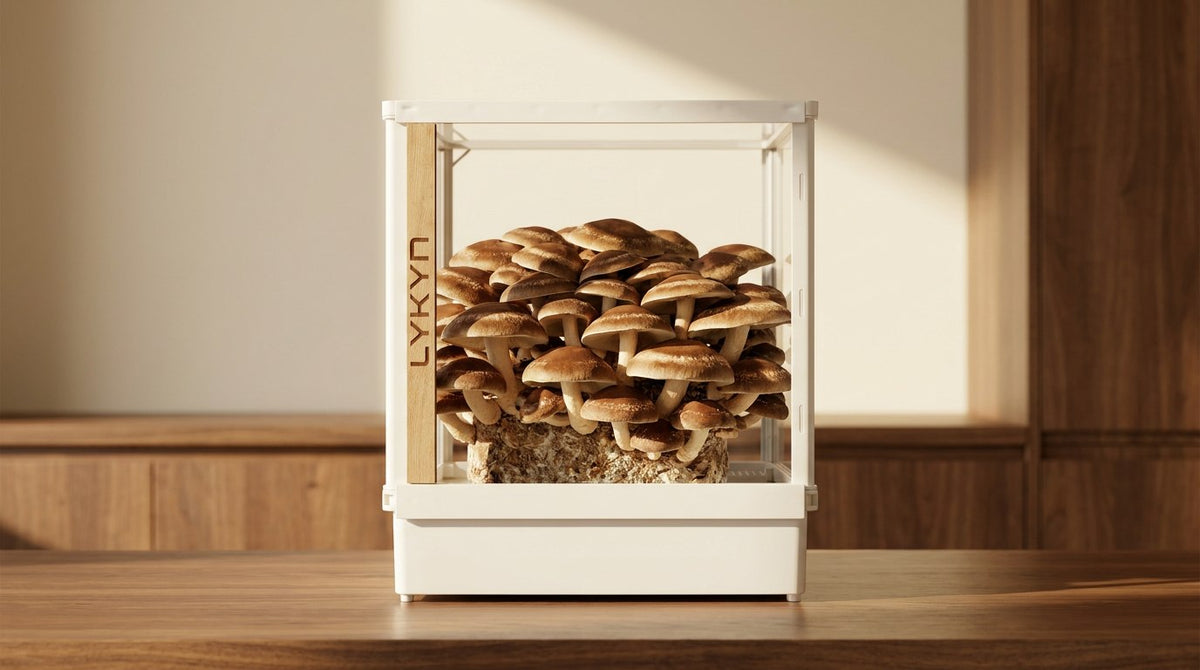
Die Lykyn Smart Mushroom Grow Box betreibt einen versiegelten und App-gesteuerten Frischluftwechsel, eine geschlossene Feuchtigkeitsregelung und eine versiegelte Glasfront, die das Kontaminationsrisiko auf einen Bruchteil einer manuellen Einrichtung reduziert. Kombinieren Sie sie mit einem vorkolonisierten Block aus der Lykyn Fruchtblock-Kollektion, schließen Sie USB-C an, und Sie wachsen von der ersten Minute an in einer kontaminationskontrollierten Umgebung. Die Pilzzucht-Sets bündeln Kammer und Starterblöcke für eine einmalige Einrichtung.
Befeuern Sie Ihre Pilz-Reise

Smart Chamber. Bone White Single
- 2,8L Tank, 90% Luftfeuchtigkeit automatisch
- App-gesteuert, Plug-and-Play
- 6 lb Blockdecke, auf Lager

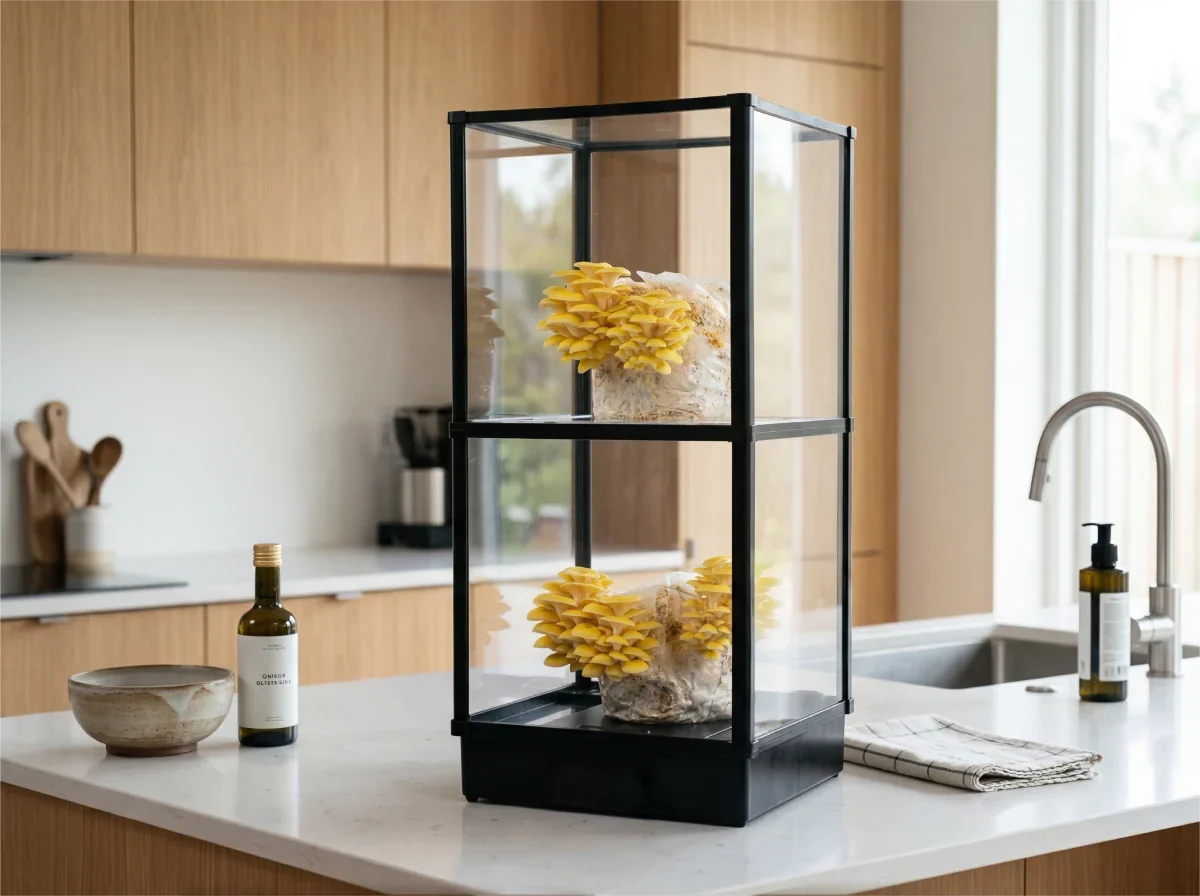
Smart Chamber. Obsidian Black Single
- Gleiche Hardware wie Bone White
- Mattschwarzes Premium-Finish
- Passt zu jeder Küchenpalette

Still Air Box (Anti-Kontamination)
- Steriler Inokulationsarbeitsplatz
- Stoppt Trichoderma am Eintritt
- -kompatibles Setup




Aktie:
Wie man rosa Austernpilze zu Hause anbaut (Anleitung 2026)
Lykyn vs. North Spore: Ein ehrlicher Direktvergleich von jemandem, der beide versendet