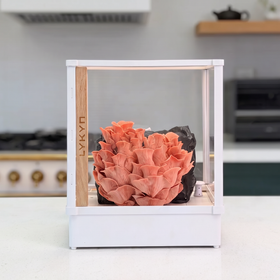



A king trumpet grow kit is a hardwood-sawdust fruiting block inoculated with Pleurotus eryngii that produces thick, ivory-stemmed king oyster mushrooms in 12 to 18 days. Yield per block is roughly 1 pound across 2 flushes. The stems are the prize. Dense, meaty, and uniquely scallop-like when cross-cut and seared. Not the fastest grower in the oyster family, but the most culinary.

King trumpets (also called king oyster, eryngii, or trumpet royale) are the body-builder of the oyster family. Where blue oyster produces delicate shelf clusters and pink oyster gives you crispy bacon-like shelves, king trumpet gives you thick cream-colored stems as dense as scallops. This is the mushroom chefs put on tasting menus. Growing it at home is slower than pink oyster but the payoff in texture and flavor is singular.
This guide walks through picking a king trumpet grow kit, understanding the 12-to-18-day timeline, and getting the dense stems that make this species worth the wait. We build and sell a smart chamber and fresh fruiting blocks. Take our perspective with that context. Lykyn is a small California company making automated grow chambers and fresh mushroom blocks for home kitchens.
What Is a King Trumpet Grow Kit
A king trumpet grow kit is a pre-colonized hardwood-sawdust fruiting block inoculated with Pleurotus eryngii, the Mediterranean native of the oyster family. Unlike other oysters, king trumpet rarely fruits from the sides of a block. It wants a single opening on top, where 3 to 6 thick stems push up together to form what looks like a cluster of pale columns topped by small tan caps.
Culinary Appeal
King trumpet holds more than 20% of the global mushroom growing kit market (Market Report Analytics, 2025). The species is standard on high-end restaurant menus because:
- The stems cross-cut into scallop-like rounds that hold their shape in high-heat searing
- The flavor is mild, savory, and slightly sweet. Lets seasonings dominate rather than competing
- The texture is dense enough to replace meat in stir-fries, braises, and grills
- It keeps well fresh (10 to 14 days), unlike pink oyster
Specialty mushrooms overall are growing at 10.5% CAGR in US foodservice (Mushroom Council, 2024). King trumpet is driving much of that growth because of its versatility.
What's in the Box
Most king trumpet kits include:
- A pre-colonized hardwood sawdust block (3 to 6 pounds)
- A breathable humidity bag
- Instructions for a single-opening fruiting setup
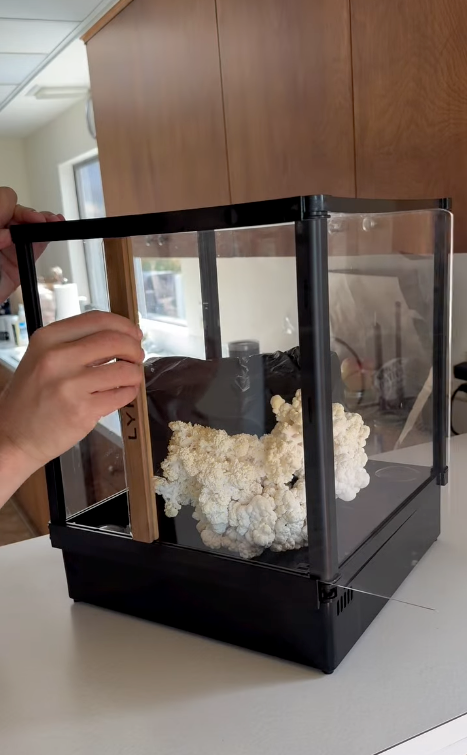
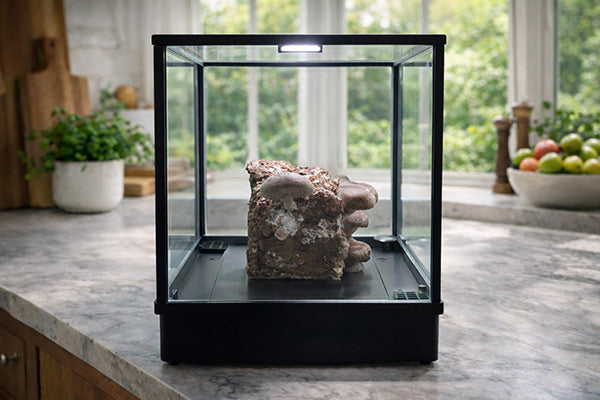
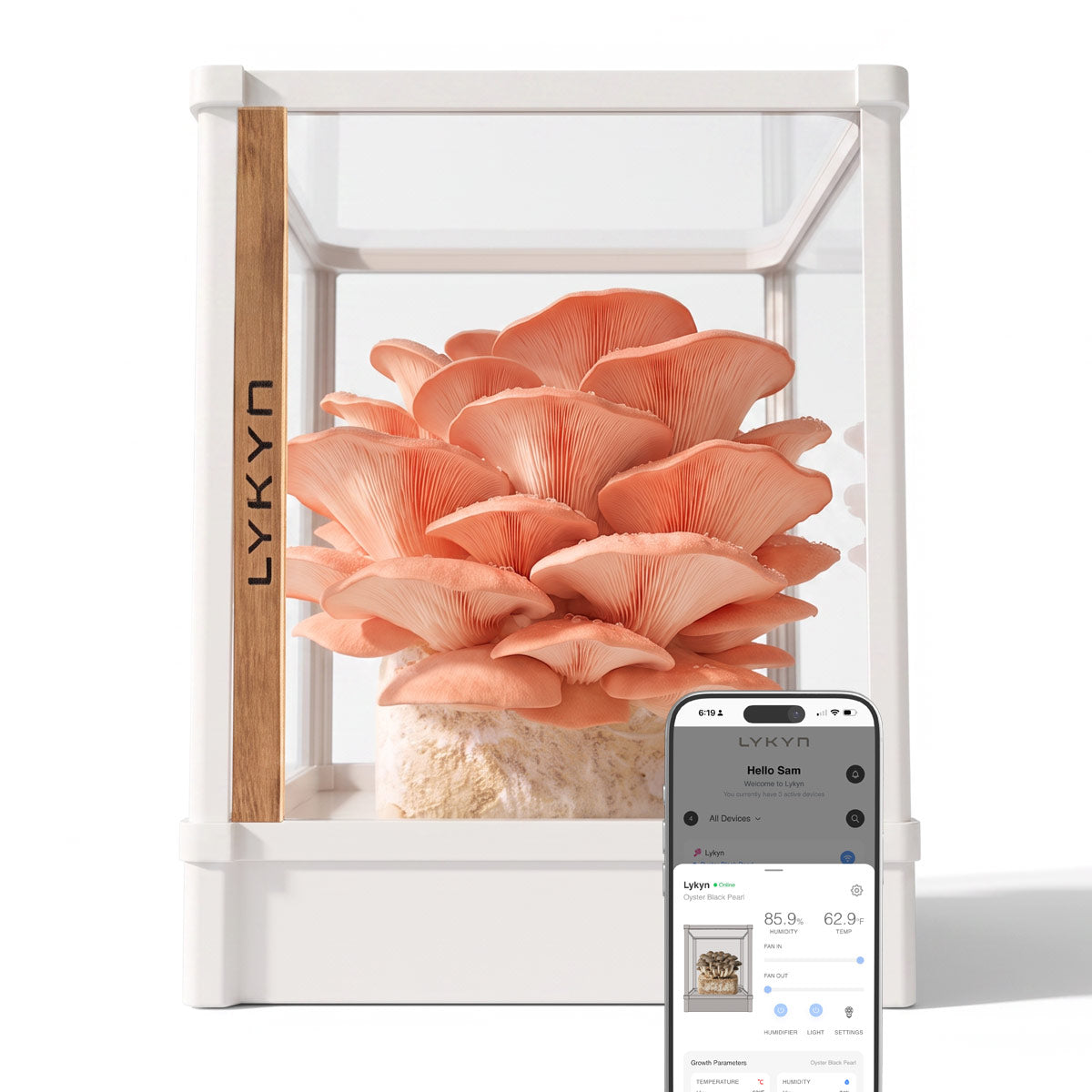
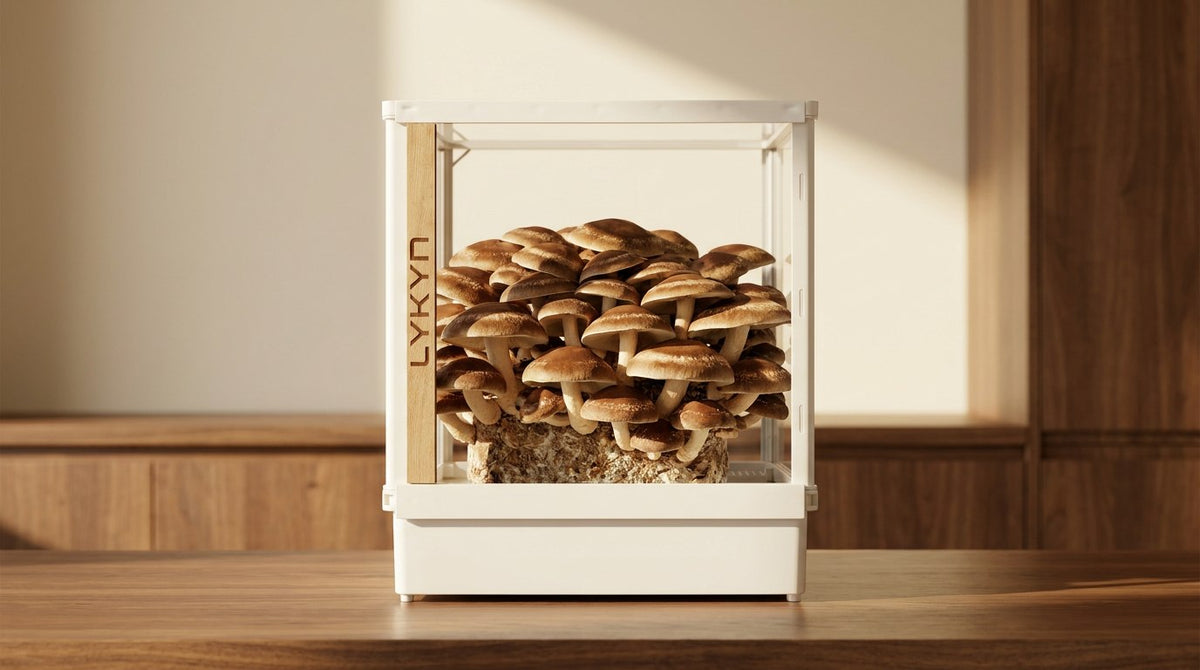
A Lykyn smart fruiting chamber supports up to a 6-pound block and runs the King Trumpet preset on-board. some category alternatives caps at 1.5 pounds. Some other crowdfunded smart grow projects have faced availability issues in this category.
Why Grow King Trumpet Instead of Buy
A fresh king trumpet at a specialty market or Asian grocery runs $12 to $20 per pound when you can find it. A 6-pound block yields 1 pound of fresh king trumpet for the cost of a block. The payback is not fast, but the access is real. Most Whole Foods and regular supermarkets do not stock king trumpet at all.
The freshness advantage is also real. King trumpet from the grocery is often 4 to 6 days old by the time you buy it. The stems start drying at the base and the caps dry out. Home-grown, harvested that morning, gives you stems that are plump and cream-white all the way through.
Customer proof: "Sleek design, clear panels, and easy cleaning between cycles. Guests keep asking what it is!". Marcus H.

How the Lykyn Chamber Runs King Trumpet
King trumpet is less forgiving than pink oyster and more forgiving than shiitake. It likes consistent humidity (90 to 95% early, dropping to 80 to 85% as stems grow), cool air exchange, and low light. A chamber handles all three.
Picking the Preset
Open the Lykyn app, pick "King Trumpet" from the species list. The preset writes to the chamber's on-board memory. That is the only moment the app touches the cloud for the grow cycle.
Autonomous Runtime
Once the preset is saved on-device, the chamber runs autonomously. No daily app open. No cloud heartbeat. If your Wi-Fi drops, your phone dies, or Lykyn's servers go offline, the grow keeps running. The preset lives in the device's own memory. If Lykyn disappeared tomorrow, the unit on your shelf would still finish your grow. Full context in our honest answer on app-dependent hardware.
Why Chamber Beats Manual for This Species
| Method | Stem Thickness | First-Grow Success | Daily Effort |
|---|---|---|---|
| Plastic tote, manual mist | Thin, elongated | ~45% | 15 min, 4x/day |
| Shotgun DIY chamber | Medium | ~60% | 10 min, 2x/day |
| Automated chamber (Lykyn) | Thick, meaty | 90%+ | ~2 min/day |
Thin stems happen when humidity is inconsistent or CO2 is too high. Manual methods produce stems that look like scrawny bean sprouts. Thick stems. The whole point of king trumpet. Require precise, consistent humidity and regular fresh air exchange.
Honest Limits of King Trumpet Grow Kits
Slower than pink or blue oyster. First pins take 7 to 10 days to appear. Full maturity is 12 to 18 days total. If you need a fast win, start with pink oyster, not king trumpet.
CO2 control matters more than other oysters. King trumpet stems stretch when CO2 is too high. You end up with long thin bean-sprout-like stems and tiny caps. The fix is fresh air exchange, not humidity. Our chamber handles this via scheduled fan cycles. Manual methods need you to open the chamber and fan 3 to 4 times a day.
Best yield requires a single fruiting opening. Unlike other oysters that fruit from the sides, king trumpet wants you to cut a single slit on top of the bag and let the cluster push up through it. In a chamber, the whole top surface is the fruiting window.
Temperature range is moderate. King trumpet fruits best between 55 and 70F. Above 75F, stems get spindly and caps open too fast. Our chamber regulates humidity and airflow, not temperature. If your kitchen is warm in summer, yields will be lower and texture lighter.
Step-by-Step: 14-Day Timeline
Day 0: Setup
- Unbox the fruiting block. The block is often already showing a light brown pigmentation on the surface. This is normal for fully colonized king trumpet.
- Cut a single X-shaped slit about 2 inches across on top of the bag (if using manual methods) or remove the top of the bag entirely (if using a chamber).
- Place the block in the chamber. Pick "King Trumpet" preset in the app. Fill water reservoir.
Days 1 to 7: Primordia Formation
Small white-to-pale-tan bumps emerge slowly on the exposed surface. This phase is slow compared to pink oyster. Resist the urge to intervene. Humidity should sit at 90 to 95%. Low indirect light helps stems orient upward.
Days 8 to 14: Stem Extension
Primordia develop into clusters of 3 to 6 thick cream-colored stems pushing upward together, with small tan-brown caps at the tops. Humidity drops to 80 to 85% during this phase to strengthen stem density. Caps stay small intentionally. King trumpet is about the stems, not the caps.
Days 14 to 18: Harvest
Harvest when stems are firm, 4 to 6 inches tall, and caps are still flat with edges just starting to curl upward. Twist the entire cluster off at the base. Do not wait for caps to open fully. Late-harvest king trumpet gets spongy in the stem.
A 6-pound block yields roughly 1 pound of fresh king trumpet across 2 flushes.

Fuel Your Mushroom Journey
Black Oyster Grow Kit
Hardwood-sawdust block colonized with vigorous black oyster mycelium. Drops straight into your Lykyn chamber and starts pinning within days.
Add to cart $29.95Harvesting, Cooking, and Storing King Trumpet
The Scallop Trick
The reason king trumpet matters in a kitchen: cross-cut scallop preparation.
- Slice the stems horizontally into 3/4-inch rounds. They look remarkably like sea scallops.
- Score one face of each round in a light crosshatch pattern (helps seasoning penetrate).
- Sear in a hot dry pan for 2 minutes per side, pressing down with a spatula. Do not move them.
- Finish with butter, a splash of white wine or lemon juice, salt, black pepper, and fresh thyme. Deglaze the pan and spoon the sauce over.
- Serve over risotto, pasta, or grain bowls. The texture is uncanny. Dense, bouncy, and scallop-like.
Vegan and vegetarian cooks love this preparation because the texture hits a note no tofu or tempeh can match.
Stir-Fry and Braise
King trumpet stems hold their shape in high-heat wok cooking better than any other mushroom. Slice into matchsticks or half-moons, sear hot, finish with garlic, ginger, soy, and scallion. Also works in long slow braises with red wine and beef stock for a deep vegetarian main.
How to Store
Fresh king trumpet keeps 10 to 14 days in a paper bag in the fridge. Longer than most oysters. To preserve further, slice into rounds and freeze on a tray before bagging. Thaws with acceptable texture for stir-fries (but not scallop preparations).

Frequently Asked Questions
What is the difference between king trumpet and king oyster mushrooms? There is no difference. King trumpet and king oyster are two common names for the same species, Pleurotus eryngii. Other names include trumpet royale, eryngii, French horn mushroom, and Boletus of the steppes. The species is native to the Mediterranean and grows on the roots of Eryngium (sea holly) plants in the wild.
How long does a king trumpet grow kit take? A king trumpet grow kit produces mushrooms in 12 to 18 days from setup. Primordia appear in 7 to 10 days, and stems mature over the following 5 to 8 days. This is slower than pink or blue oyster but faster than lion's mane second flush. Yield is roughly 1 pound across 2 flushes.
Can I grow king trumpet at home without a chamber? Yes, but success rates and stem quality drop significantly. Manual misting in a plastic tote produces thin, bean-sprout-like stems about 45% of the time. An automated chamber produces thick, meaty, scallop-suitable stems 90%+ of the time. The difference is CO2 management during stem extension.
Why are my king trumpet stems thin and spindly? Thin, elongated king trumpet stems are almost always a CO2 problem, not a humidity problem. When fresh air exchange is inadequate, stems stretch upward looking for fresh air and caps stay tiny. Fix by increasing fan cycle frequency or, if using manual methods, opening the chamber to fan 4 to 6 times a day.
What does king trumpet mushroom taste like? King trumpet has a mild, savory, slightly sweet flavor. Less pronounced than shiitake, less shellfish-like than blue oyster. The texture is where it shines: dense, bouncy, meaty, and uniquely scallop-like when cross-cut and seared. It takes on seasonings and sauces readily without getting lost.
Is king trumpet a good beginner mushroom species? King trumpet is moderately beginner-friendly. It is more forgiving than shiitake (no cold shock required) but slower and more CO2-sensitive than pink or blue oyster. Start with pink oyster for a fast first win, then try king trumpet as your second species.
Bottom Line
A king trumpet grow kit is for anyone who cooks seriously and wants access to a restaurant-quality mushroom most grocery stores never stock. The 12-to-18-day timeline is slower than pink oyster, but the dense, scallop-like stems are singular. There is nothing else in the cultivated mushroom world that cross-cuts and sears the same way.
Start with a single King Trumpet block in the main Lykyn chamber. If you want to rotate species, browse the full mushroom fruiting blocks collection. See how different kits compare in our 2026 grow kits guide. Real first-grow photos are on our reviews page.
We are a small team. We answer our own email. If your block produces spindly stems, we work with you to dial in the environment or send a replacement. That is the deal.
Fuel Your Mushroom Journey

Smart Chamber. Bone White Single
- 2.8L tank, 90% humidity automatic
- App-controlled, plug-and-play
- 6 lb block ceiling, in stock

Smart Chamber. Obsidian Black Single
- Same hardware as Bone White
- Matte black premium finish
- Pairs with any kitchen palette



Share:
Pink Oyster Grow Kit: The Beginner's Tropical Mushroom
Pioppino Grow Kit: Cluster Mushroom for Autumn Cooking