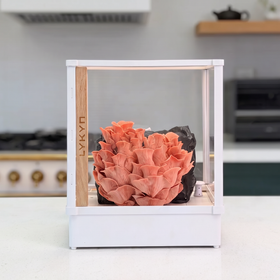




Quick answer: Oyster mushroom yield typically ranges from 75 to 150 percent biological efficiency (BE), meaning a 5 lb dry substrate block produces roughly 3.75 to 7.5 lb of fresh mushrooms across 2 to 3 flushes. A well-tuned 6 lb pre-colonized fruiting block in a controlled smart chamber yields 1.25 to 1.75 lb in the first flush and 0.75 to 1.0 lb in the second, for 2 to 3 lb fresh per block. Strain, humidity, fresh air exchange, and substrate moisture are the four biggest yield variables you can control at home.
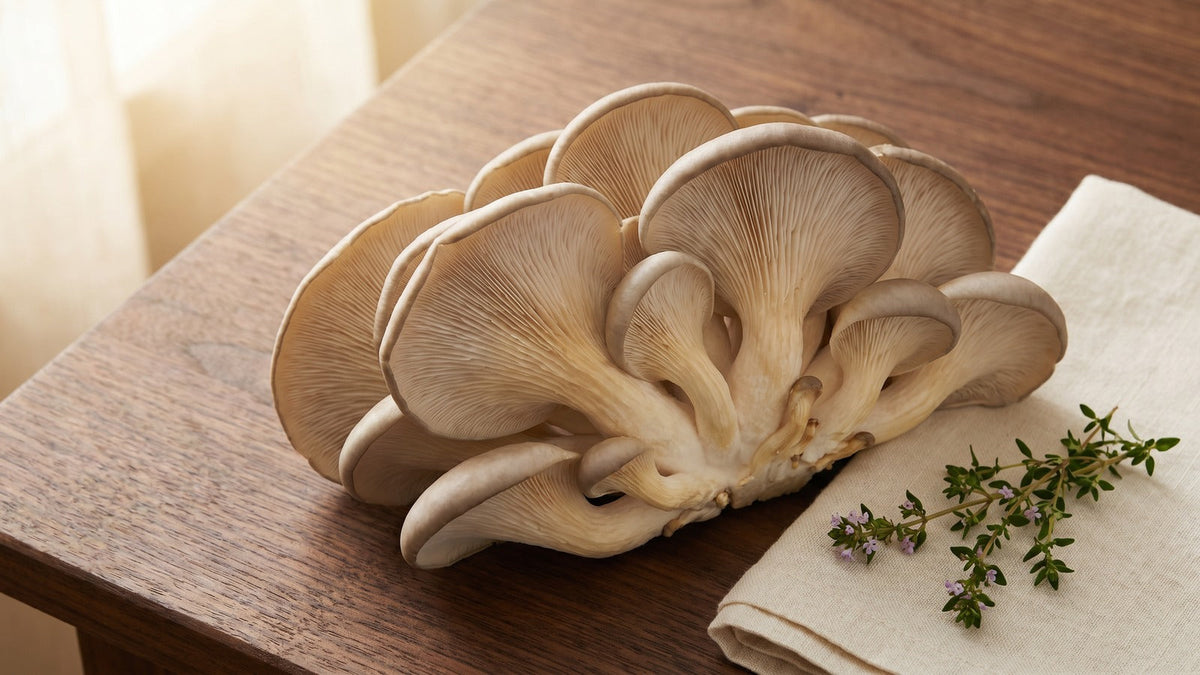
Pink oyster (Pleurotus djamor) typically lands at the high end of that BE range, so the Pink Oyster Grow Kit is one of the easiest ways to see 1 to 1.5 lb on a first flush.
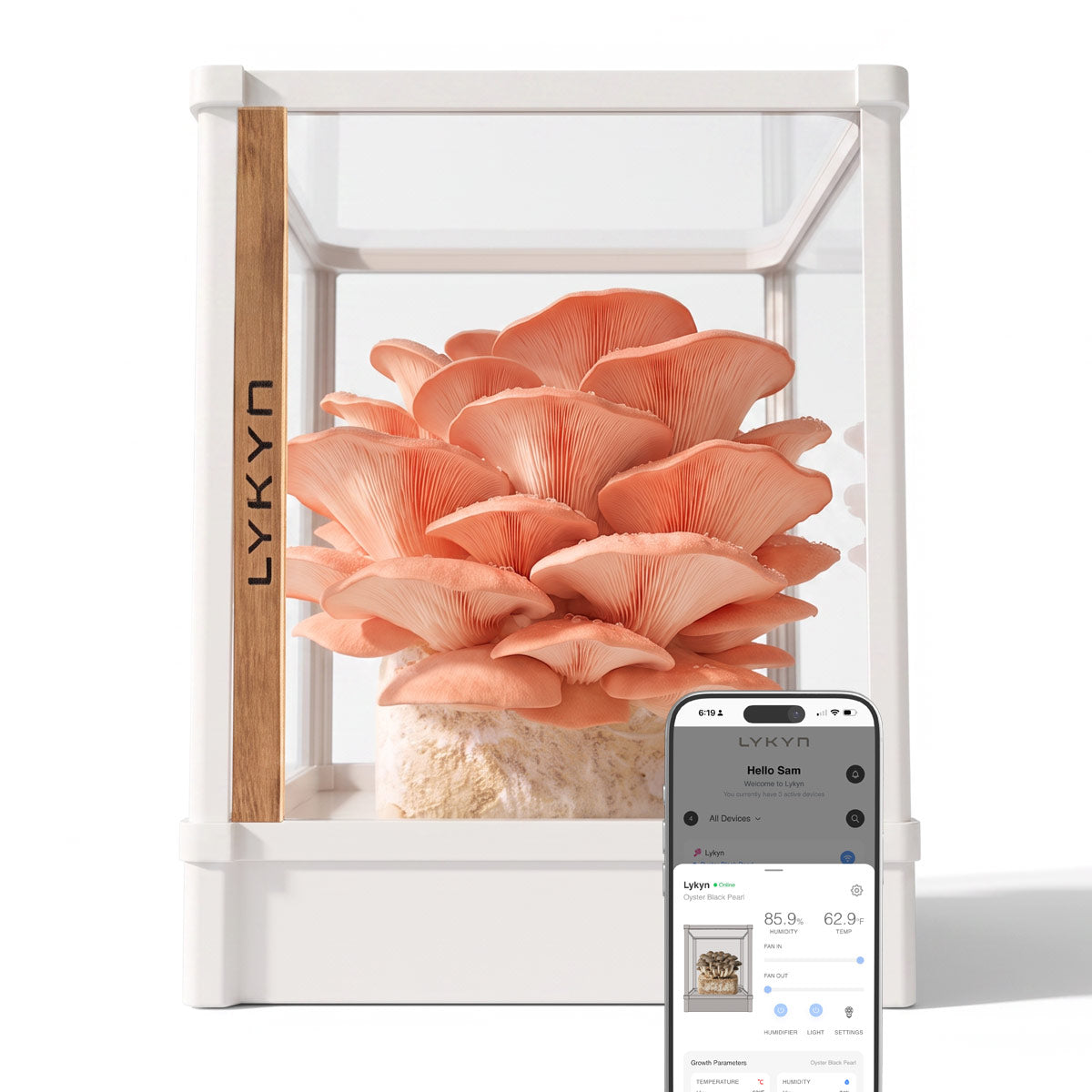
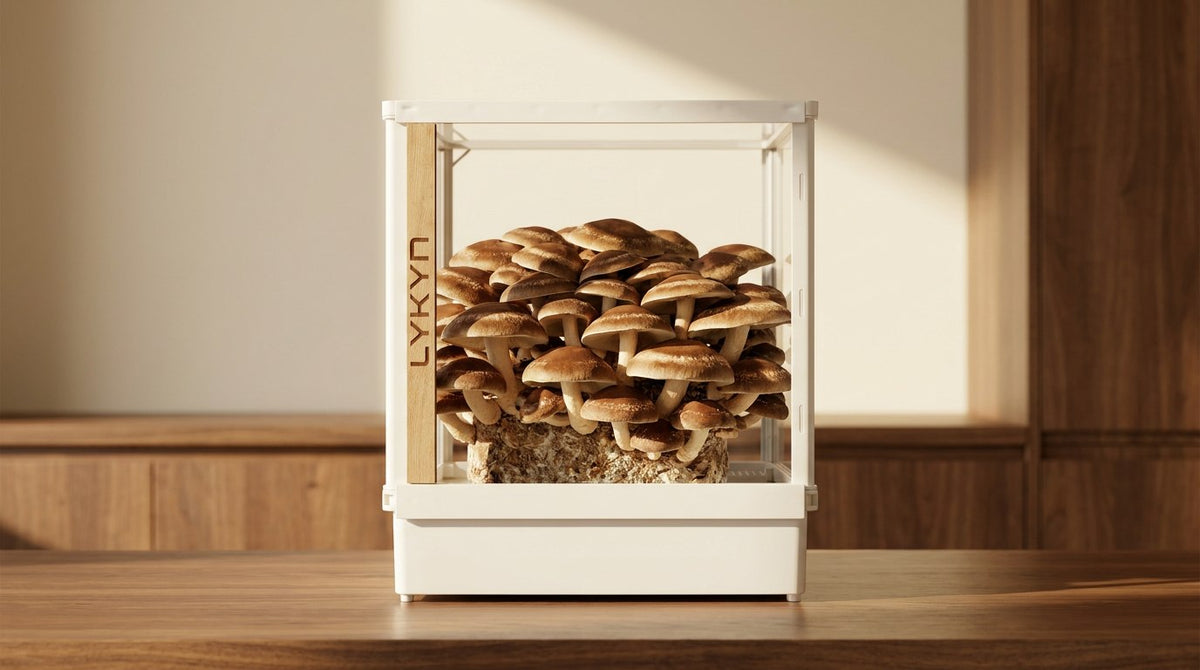
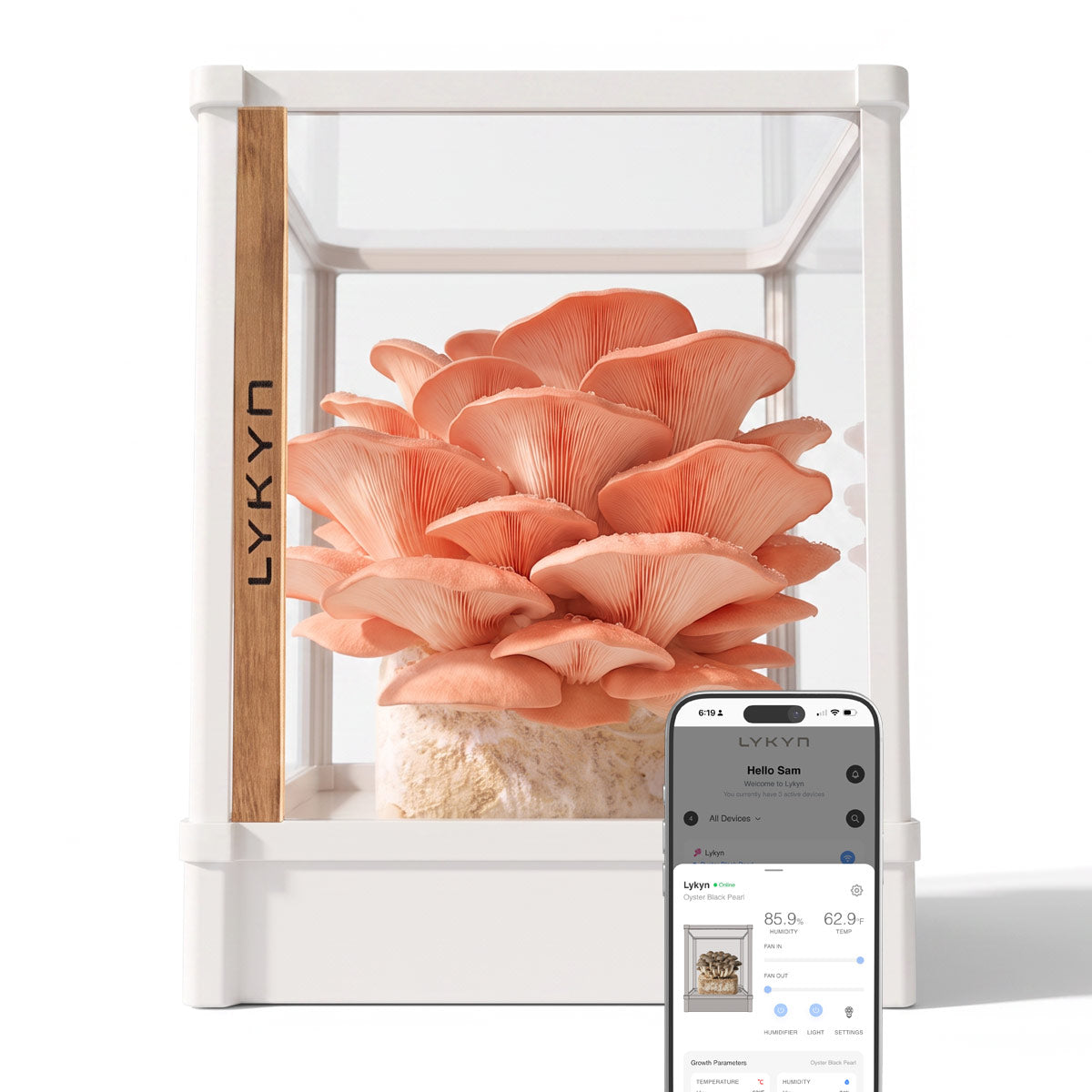
Oyster mushroom yield is one of the most variable numbers in home cultivation, and most of the variance comes from a small set of conditions growers can fix. We have run thousands of oyster grows across pink, blue, king, golden, and grey varieties in the Lykyn Smart Mushroom Grow Box.
What Is Biological Efficiency

Smart Chamber. Bone White Single
- 2.8L tank, 90% humidity automatic
- App-controlled, plug-and-play
- 6 lb block ceiling, in stock

Smart Chamber. Obsidian Black Single
- Same hardware as Bone White
- Matte black premium finish
- Pairs with any kitchen palette


Biological efficiency (BE) is the standard metric for mushroom yield:
BE = (fresh mushroom weight / dry substrate weight) x 100
If you start with 1 kg dry substrate and harvest 1 kg of fresh oysters across all flushes, that is 100 percent BE. Cornell Small Farms Mushroom Program and USDA cultivation research consistently land oyster BE in the 75 to 150 percent range under controlled conditions. A beginner's first oyster grow in a humidity tent might hit 60 percent BE, while a tuned commercial grow on optimized substrate clears 130 percent. Home growers in a smart chamber typically land at 90 to 120 percent BE.
Translation: a 6 lb fruiting block contains roughly 1.4 to 1.6 lb of dry substrate (the rest is water and mycelium). At 100 percent BE, that yields 1.4 to 1.6 lb of fresh oyster mushrooms total across all flushes.
Typical Yield by Oyster Variety

| Variety | Latin name | Typical BE | Fresh yield / 6 lb block | Time to harvest |
|---|---|---|---|---|
| Pink Oyster | Pleurotus djamor | 100-150% | 1.5-3.0 lb total | 5-7 days from pinning |
| Blue Oyster | P. columbinus / ostreatus | 90-130% | 1.5-2.5 lb total | 7-10 days |
| King Trumpet | P. eryngii | 75-120% | 1.0-2.0 lb total | 14-21 days |
| Golden Oyster | P. citrinopileatus | 85-120% | 1.0-2.0 lb total | 7-10 days |
| Grey Oyster | P. ostreatus | 90-140% | 1.5-2.5 lb total | 10-14 days |
| Phoenix Oyster | P. pulmonarius | 90-130% | 1.5-2.5 lb total | 10-14 days |
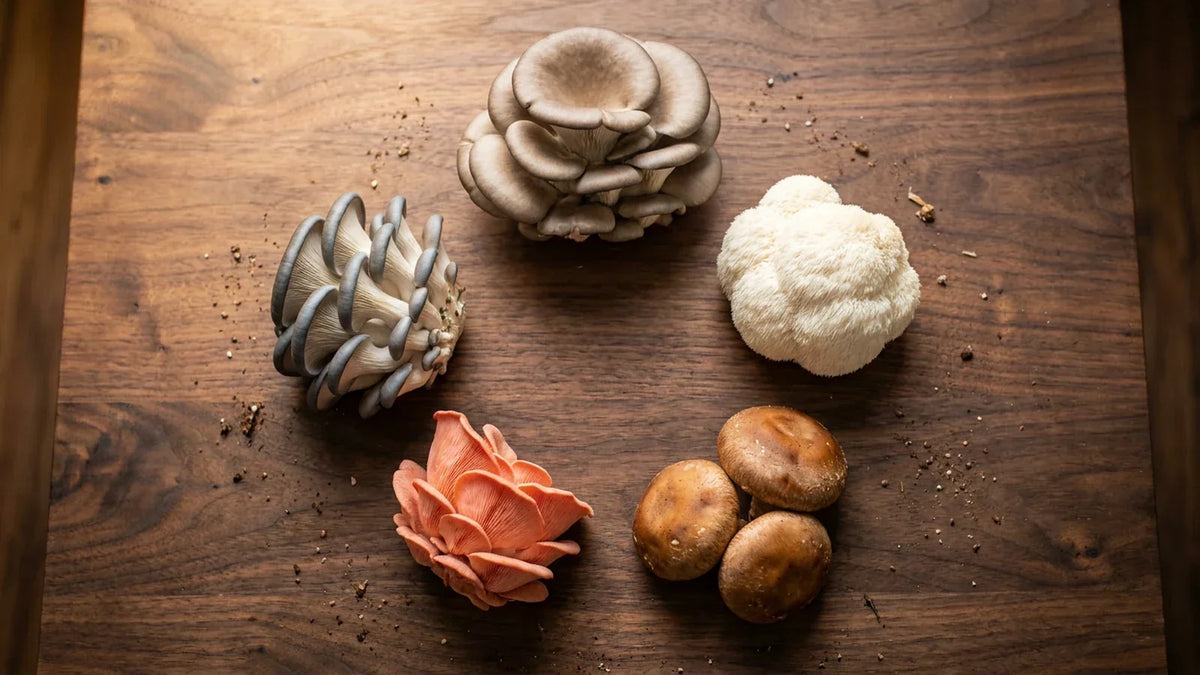
Pink oyster is the yield king. Fast-growing, heat-tolerant (70 to 85 F), the first flush is often the biggest single harvest from any oyster block. Trade-off: 3 to 5 day shelf life and a meaty bacon-adjacent flavor some find assertive. For a fast first grow, the Pink Oyster fruiting block is the most reliable starting point.
Blue oyster is the all-around workhorse. Reliable 90 to 130 percent BE, classic flavor, holds up in storage and cooking. If you only grow one oyster, this is the pick.
King trumpet trades yield for density. Lower BE because mass goes into thick stems. Longer cycle, higher culinary value (sears like a scallop).
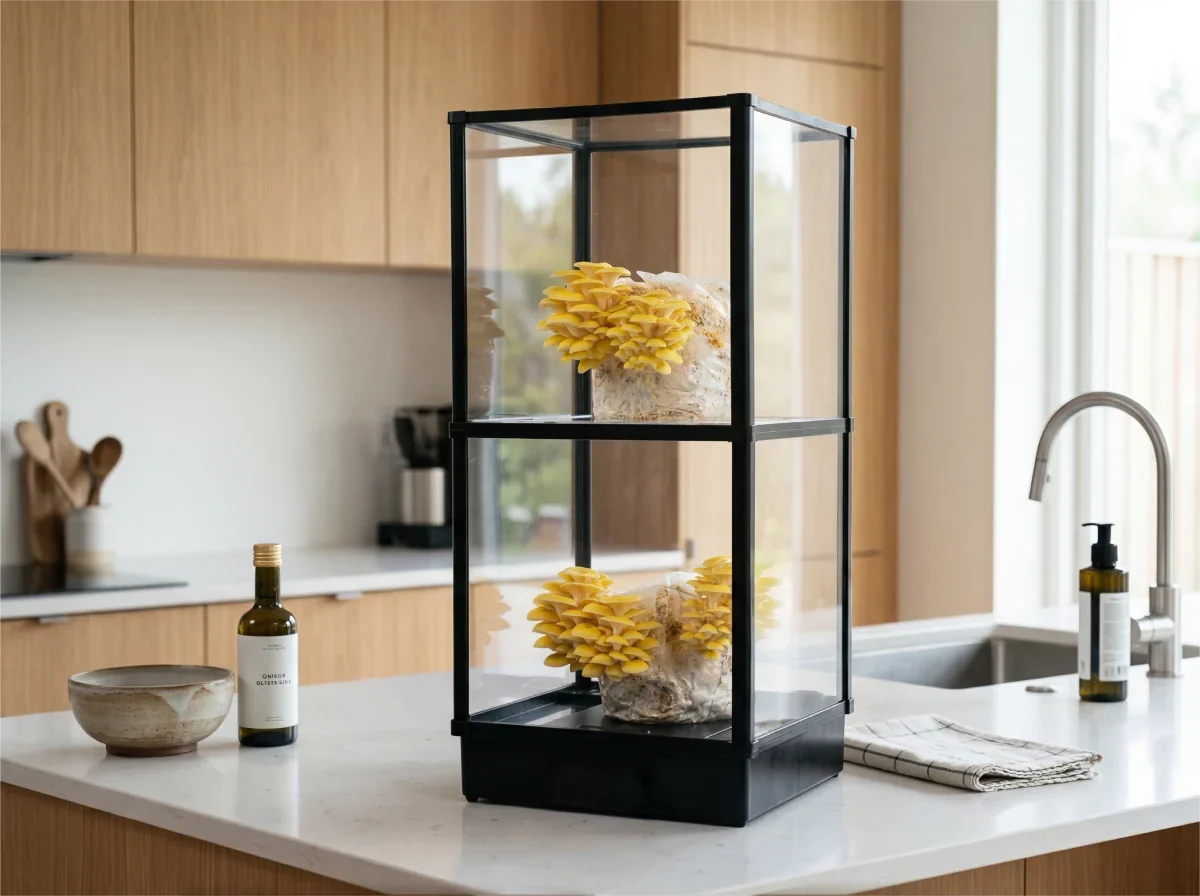
Golden oyster is the visual showstopper: bright yellow clusters, slightly nuttier flavor. Lower yield than blue but the aesthetic premium makes up for it.
Grey oyster is the European-tradition gourmet variety. Grey and blue are functionally interchangeable in the kitchen.
Four Variables That Drive Yield

Four variables explain roughly 80 percent of yield variance at home.
1. Humidity (target: 85-92 percent RH)
Oysters fruit in 85 to 92 percent RH. Below 80 percent, pins abort or develop dry caps. Above 95 percent, surface condensation drowns developing fruits. The critical insight is stability: a grow that holds 88 percent RH steady for 7 days outperforms one that swings 75 to 95 percent twice a day. Closed-loop ultrasonic humidification with an SHT3x-class sensor holds within a 3-point band; manual misting typically swings 10 to 20 points.
2. Fresh Air Exchange (4-6 air changes per hour during fruiting)
Mushrooms exhale CO2 and inhale O2. During pinning and fruiting, oysters need FAE every 10 to 15 minutes to keep CO2 below 1000 ppm. CO2-stressed oysters develop the classic "long-stem, small-cap" deformation: leggy stems with under-developed caps that look more like sea anemones than mushrooms.
The trade-off with FAE is humidity loss: every air exchange drops chamber RH by 2 to 5 points. A well-designed system pulses fans briefly (60 to 90 seconds) every 15 to 20 minutes, then re-humidifies.
3. Substrate Moisture (target: 60-65 percent at inoculation)
The block's internal moisture sets the upper ceiling for yield. Oyster mycelium colonizes at 55 to 70 percent moisture, and fruiting peaks at 60 to 65 percent. Dry substrate produces small, sparse flushes. Wet substrate increases bacterial contamination risk. Pre-colonized blocks from Lykyn fruiting blocks are formulated at 62 percent target moisture.
4. Strain Genetics
Two pink oyster blocks from two suppliers can produce 20 to 30 percent different yields under identical conditions. Commercial mycology suppliers select for high-yielding strains over generations. If your yields are consistently low across many grows, substrate or environment is usually the issue before genetics.
How Substrate Type Affects Yield


Fuel Your Mushroom Journey
Smart Mushroom Grow Chamber
Plug-and-play smart chamber with humidity, light, and airflow dialed in for every species. Beginners harvest their first flush in days, not months.
Add to cart $299- Supplemented hardwood sawdust + bran: Gold standard. Bran (10 to 20 percent of substrate weight) provides nitrogen. BE typically 100 to 150 percent. What most commercial blocks use.
- Pasteurized straw: Cheaper, accessible, lower BE at 75 to 110 percent. Best for pink and blue oyster.
- Coffee grounds: Trendy and works, BE 60 to 90 percent. Better as a partial substitute.
- Cardboard / paper-pulp: Low-yield (50 to 80 percent BE), used in educational grows.
- Cotton hulls and seed hulls: Commercial substrate in Asia. Excellent BE (120 to 160 percent) but hard to source in the US at home scale.
Substrate accounts for 30 to 40 percent of yield variance.
How a Smart Chamber Improves Consistency

Our published numbers (1.25 to 1.75 lb per 6 lb block) reflect chamber-controlled grows. Manual setups typically land 30 to 50 percent lower on the same block. The chamber's contribution is the same four variables, controlled tighter: humidity holds within 3 points instead of swinging 15, FAE happens on a calibrated 15-to-20-minute cycle, and substrate moisture stays stable.
The Lykyn chamber runs closed-loop humidity with SHT3x-DIS sensor (+/- 1.5 percent RH, 88 percent setpoint within 3 points), sealed FAE every 15 to 20 minutes with variable-speed fan control, multi-wavelength LED tuned for primordium initiation and stem morphogenesis, and a sealed glass front. A specific block, on a specific preset, lands within a 15 percent yield window grow after grow.
Troubleshooting Low Yields

1. First flush thin and stringy with small caps. CO2 stress. Increase FAE frequency.
2. Pins formed but dried out and aborted. Humidity too low or unstable. Pins are extremely sensitive to drops below 85 percent. Tighten humidity control.
3. Block colonized but never pinned. Most oysters need a 5 to 10 F temperature drop to trigger pinning, or the bag was not slit. Open the bag, drop ambient temp 5 F overnight, wait 3 to 7 days.
4. First flush good but second tiny. Normal. Soaking the block in cold water for 12 to 24 hours between flushes can recover some yield.
5. Block is moldy or contaminated. See our Trichoderma identification and rescue guide.
Frequently Asked Questions
How many oyster mushrooms per pound of substrate?
At 75 to 150 percent BE, expect 0.75 to 1.5 lb of fresh oysters per pound of dry substrate, across 2 to 3 flushes. A pre-colonized 6 lb block yields 1.5 to 3.0 lb fresh in optimal conditions.
How many flushes from an oyster block?
Most blocks produce 2 to 3 flushes. The first is the largest (60 to 70 percent of total yield), the second is roughly half the first, and a third, if it appears, is small.
Why is my yield lower than the package?
Most package claims reflect best-case lab conditions. Real-home yields land 20 to 40 percent lower under uncontrolled conditions. A smart chamber typically delivers within 10 to 15 percent of published yields.
What is a good biological efficiency for oysters?
90 to 120 percent BE is good for home grows. Below 75 percent suggests environmental or substrate issues. Commercial operations hit 130 to 150 percent.
Which variety yields the most?
Pink oyster typically yields the highest fresh weight at 100 to 150 percent BE, followed by blue and grey oysters at 90 to 140 percent BE. King trumpet yields lower at 75 to 120 percent BE but produces denser fruits.
How long to harvest?
Pink oyster is fastest at 5 to 7 days from pinning. Blue, golden, and grey oysters run 7 to 14 days. King trumpet is slowest at 14 to 21 days. From block opening to first harvest, expect 10 to 21 days total.
Can I increase yield by adding nutrients?
Yes, with caveats. Supplementing blocks with wheat bran solution between flushes can boost flush 2 and flush 3 by 10 to 20 percent. Trade-off: nitrogen-rich supplements feed competing molds. The cold-water soak between flushes is the safest yield-recovery method.
Ready to Grow Oysters With Reliable Yields?
Oyster mushroom yield is one of the most variable numbers in home cultivation, and most of the variance is controllable. Humidity stability, fresh air exchange, substrate moisture, and strain selection are the four levers. Pull all four in the right direction and your grows land in a predictable 1.25 to 1.75 lb-per-block range.
The Lykyn Smart Mushroom Grow Box handles humidity, FAE, and lighting automatically, so the only yield variables left to you are substrate choice and species selection. Pair the chamber with a pre-colonized Pink Oyster fruiting block (fastest yields, biggest first flush), a Blue Oyster block (most reliable all-arounder), or a King Trumpet block (densest harvests), and you are set up for the upper end of the published yield range. The mushroom grow kits collection bundles chamber and starter blocks for a single-checkout setup. For more on the broader family, the oyster mushroom overview covers species selection.



Share:
Best Smart Mushroom Grow Box 2027: Honest Buyer's Guide
Oyster Mushroom Substrate Comparison: Yields, Cost & Effort