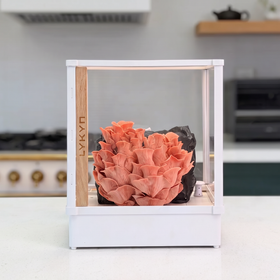



A shiitake grow kit is a hardwood-sawdust fruiting block inoculated with Lentinula edodes that produces fresh shiitake mushrooms in 10 to 14 days. Yield per block is roughly 1 to 1.25 pounds across 2 to 3 flushes. Shiitake needs a cold-shock pin initiation and high humidity, which is why a controlled chamber outperforms manual methods. The caps have a meaty umami depth you cannot buy dried or frozen.

Fresh shiitake is one of those ingredients that changes your cooking permanently. Once you have eaten a cap pulled from the block 20 minutes earlier, seared in butter with a splash of soy, the dried or grocery-store version starts to feel like a compromise. This guide walks you through picking a shiitake grow kit, understanding the 14-day timeline, and getting the most out of each flush.
We build and sell an automated chamber and fresh mushroom blocks. Take our perspective with that context. We also give you the honest limits and cite real data. Lykyn is a small California company making smart grow chambers and fresh fruiting blocks so you can skip the supermarket mushroom aisle entirely.
What Is a Shiitake Grow Kit
A shiitake grow kit is a pre-colonized block of supplemented hardwood sawdust (usually oak, beech, or a mix) inoculated with Lentinula edodes mycelium. The block sits in your grow space, gets humidity and fresh air, and fruits into clusters of meaty umami-heavy shiitake caps. The best kits pair the block with a chamber that handles the humidity work and can run a cold-shock cycle to trigger fruiting.
Market Context
Shiitake makes up about 25% of the global mushroom growing kit market, second only to oyster at 35% (Market Report Analytics, 2025). Specialty mushrooms overall are growing at 10.5% CAGR in US foodservice. Chefs are putting shiitake on menus, and home cooks want to grow what they taste in restaurants (Mushroom Council consumer survey, N=500).
Grocery store barriers confirmed by that same Mushroom Council survey: 26% of consumers say "they go bad too quickly" is their top grocery mushroom complaint, and 23% cite "low quality." A shiitake grow kit eliminates both. You harvest when you are ready to cook.
What's in the Box
Most shiitake kits include:
- A pre-colonized hardwood sawdust fruiting block (3 to 6 pounds)
- A breathable humidity bag
- Basic cold-shock and misting instructions
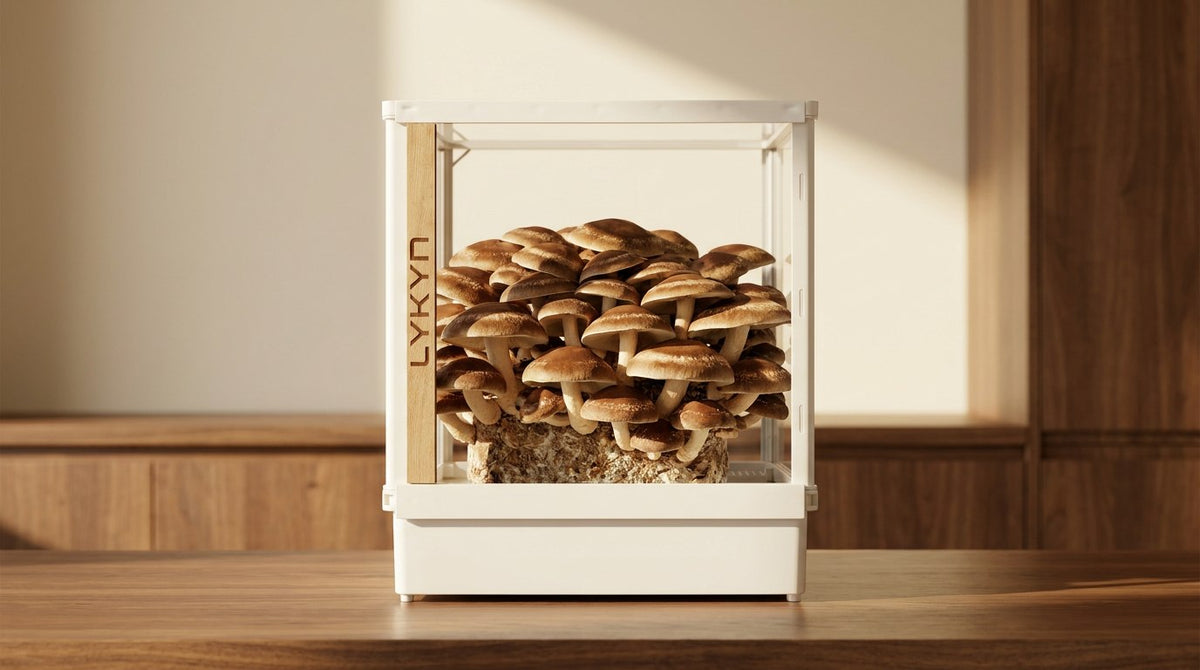
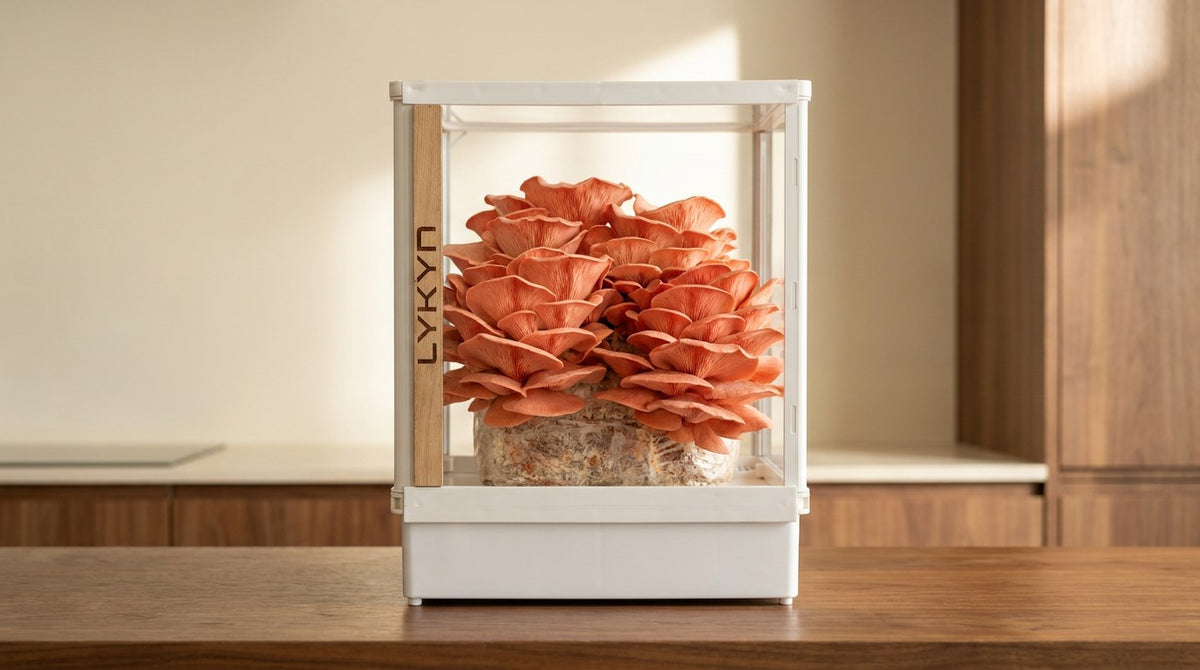
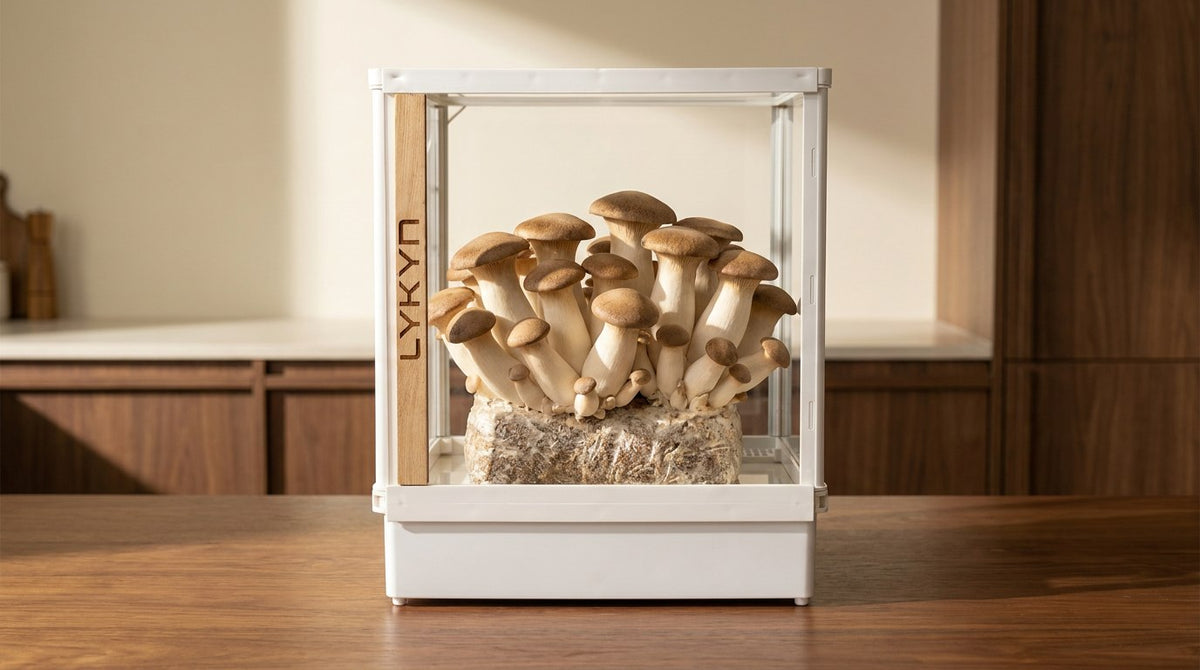
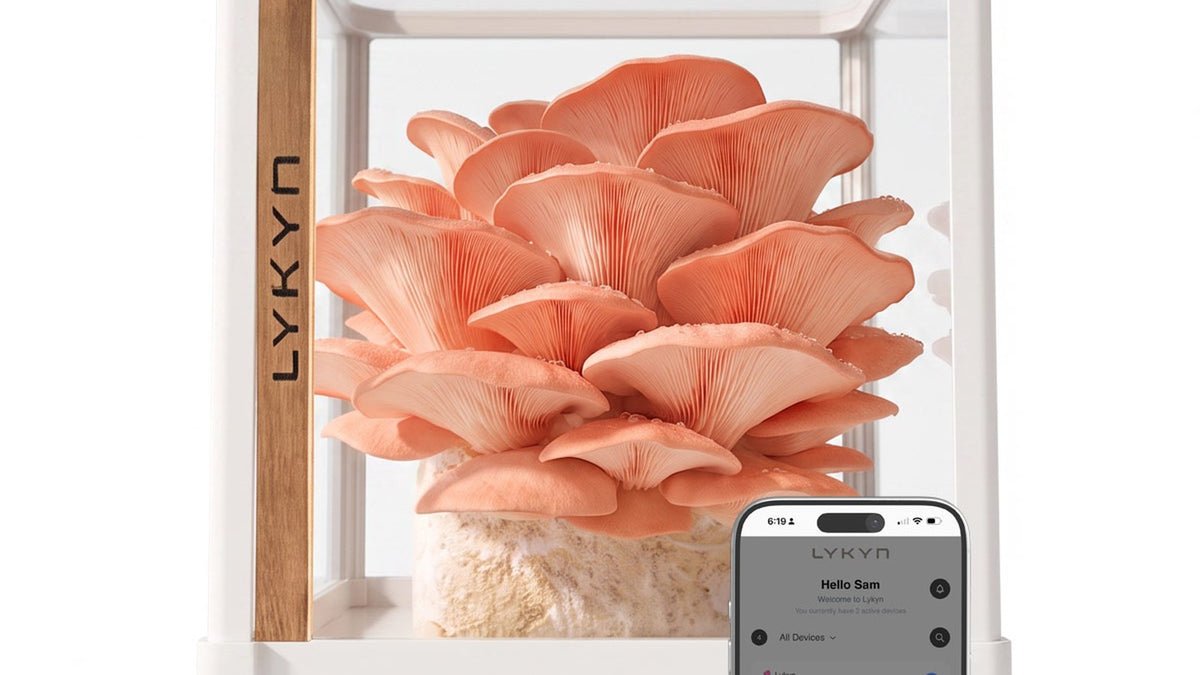
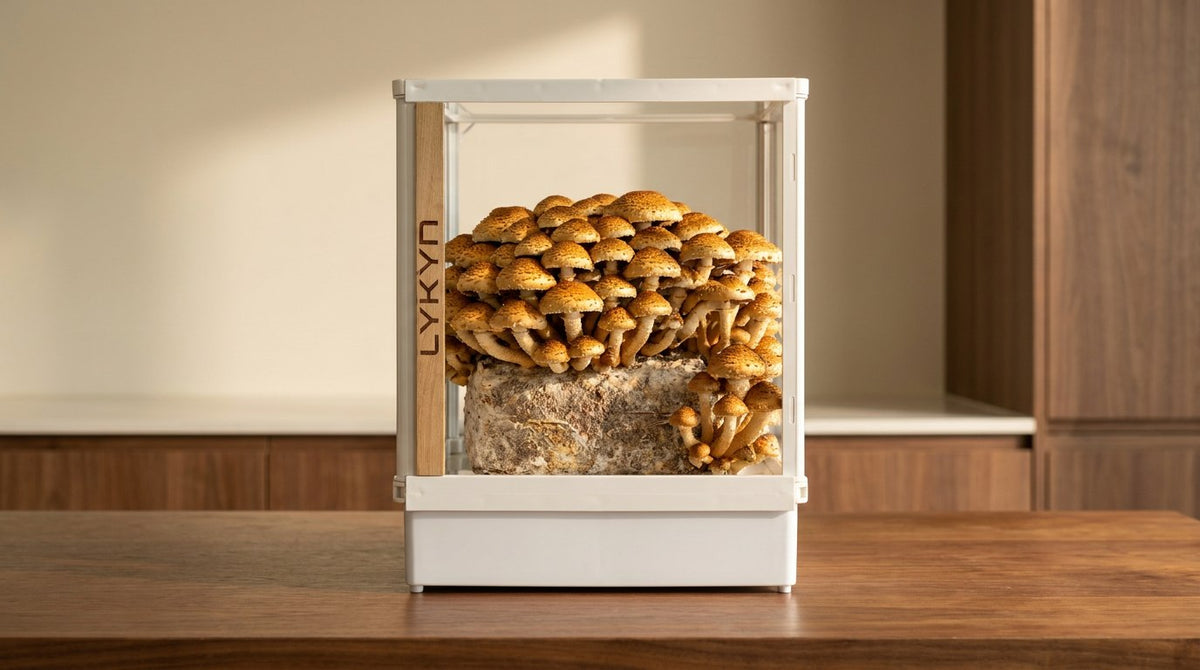
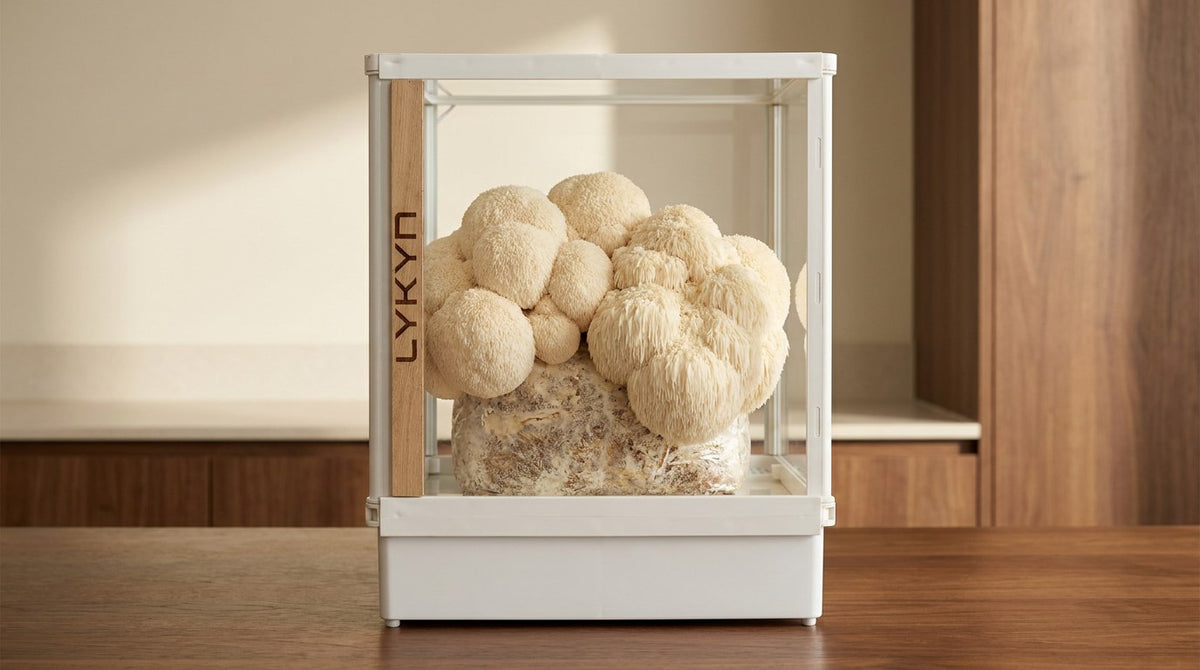
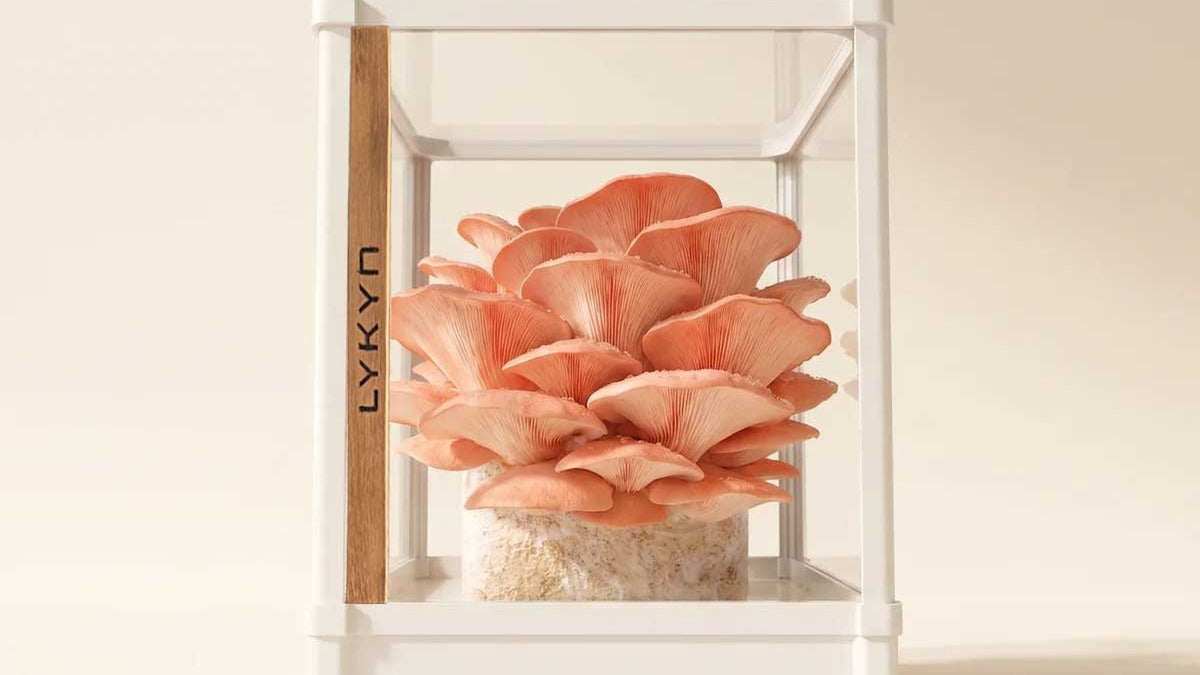
Automated kits skip the manual misting. A Lykyn smart fruiting chamber supports up to a 6-pound shiitake block, runs species presets on-board, and handles the humidity and airflow schedule without you checking on it. Some category alternatives cap at 1.5 pounds. Other crowdfunded smart grow projects in this category have faced availability issues.
Why Shiitake Is Different
Shiitake is not a species you can set-and-forget like oyster. It has specific biological requirements that other species do not.
Cold-Shock Pin Initiation
Shiitake blocks need a "shock". A sudden drop in temperature and a cold-water soak. To trigger fruiting. In nature this mimics autumn rain after a warm season. In a chamber, the shock can be the cold-water soak plus humidity drop for 24 hours, followed by a return to high humidity. Without this step, a colonized shiitake block can sit brown and dormant for weeks.
Cold water soak is key. Do not skip it.
Brown Pigmented Mycelium
After full colonization, shiitake mycelium develops a brown "skin" or pellicle on the block surface. This is normal and required for fruiting. Some growers see the brown color and assume contamination. It is not. Shiitake literally cannot fruit without this pellicle forming first.
Two-Phase Fruiting Cycle
Shiitake fruits in waves with a rest period between flushes. You harvest flush 1, soak the block again in cold water (a second cold shock), wait 7 to 10 days, and flush 2 arrives. This cycle repeats 2 to 3 times per block.

How the Lykyn Chamber Runs Shiitake
Shiitake benefits from a chamber more than almost any other species because the cold-shock and high-humidity requirements are hard to replicate manually.
Picking the Shiitake Preset
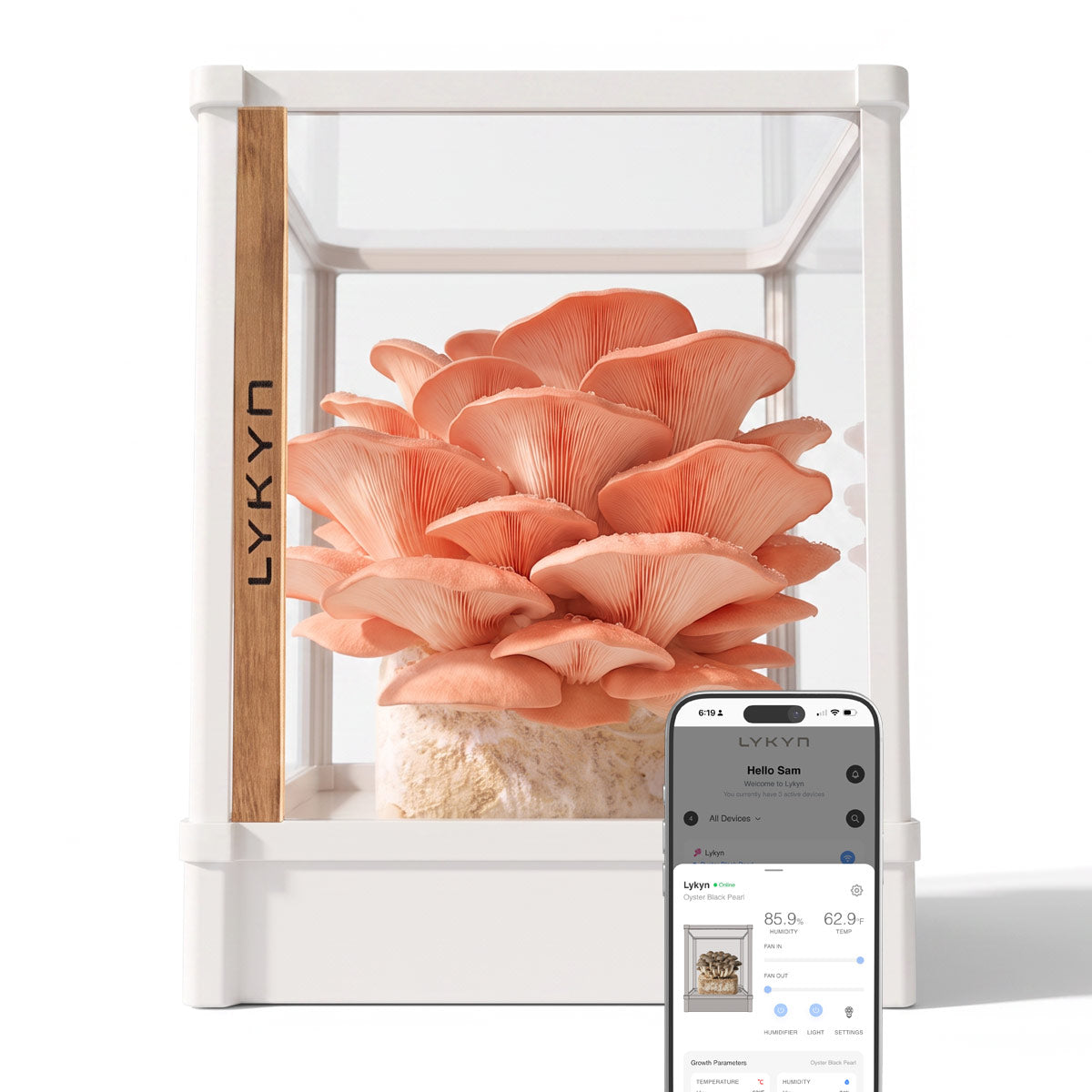
Open the Lykyn app, pick "Shiitake" from the species list. The preset - 85 to 90% relative humidity, specific fan cycle timing, 12-hour indirect light schedule. Writes to the chamber's on-board memory. That is the only moment the app touches the cloud for the entire grow cycle.
Autonomous Runtime
Once the preset is saved on-device, the chamber runs autonomously. Wi-Fi drops, phone dies, servers go offline. The chamber keeps executing the cycle. If Lykyn disappeared tomorrow, the unit on your shelf would still finish your grow. Details in our honest take on app-dependent hardware.
Comparison to Manual Methods
| Method | Humidity Control | Cold Shock | First-Grow Success |
|---|---|---|---|
| Open fruiting in room | Poor, dries out in hours | Manual soak only | ~35% |
| Plastic tote with daily misting | Decent, requires vigilance | Manual soak only | ~55% |
| Shotgun DIY chamber | Good, needs daily fan | Manual soak only | ~70% |
| Automated chamber (Lykyn) | 85-90% automated | Built into preset | 90%+ |
Honest Limits of Shiitake Grow Kits
Temperature range is tighter than oyster. Shiitake fruits best between 55 and 70F. Warm kitchens in summer push caps to open too fast and stems to elongate. Our chamber does not have active heating or cooling; it manages humidity and airflow. If your room is 80F, expect smaller yields and faster cap opening.
First fruiting can take longer than 14 days. If your block arrives slightly under-colonized, or if your ambient temperature is off, pinning can take 18 to 21 days. This is normal biology, not a kit failure.
Flush 1 is the biggest. Plan for it. Flush 1 yields 60 to 70% of total block output. Flush 2 is 20 to 30%. Flush 3 is a small bonus if you get it at all. Budget your cooking plans around flush 1.
Second cold shock timing matters. Wait too long between flushes and the block dries out or contaminates. 7 to 10 days is the sweet spot. Longer than 14 days between soaks and yield drops fast.
Step-by-Step: 14-Day Shiitake Timeline
Day 0: Setup
- Unbox the fruiting block. Inspect for the brown pellicle (good) and reject obvious contamination (fuzzy green or black patches. Rare, but check).
- Cold-water soak the block for 4 to 12 hours in clean water. This is the activation step; do not skip.
- Place the soaked block in the chamber, bag top open.
- Select "Shiitake" preset in the Lykyn app. Fill water reservoir.
Days 1 to 5: Pinning
Small brown bumps emerge through the block surface. These are shiitake primordia. Baby mushrooms. Do not mist manually if using an automated chamber; the chamber is already at 85 to 90% humidity.
Days 6 to 11: Cap Development
Pins expand into recognizable shiitake caps. Caps are domed, dark brown, with cracked whitish patterns on top (the classic "donko" look if growing slowly in cool temps, or smoother "koshin" style if growing faster in warmer temps). Stems thicken to cream-colored columns.
Days 12 to 14: Harvest
Harvest when cap veils start to break away from the stem (the underside shows visible brown gills). Twist gently at the base; do not cut. Caps harvested at this stage have the deepest flavor.
A 6-pound shiitake block yields roughly 1 to 1.25 pounds of fresh mushroom across 2 to 3 flushes - 10 to 15 standard servings.

Fuel Your Mushroom Journey
Smart Mushroom Grow Chamber
Plug-and-play smart chamber with humidity, light, and airflow dialed in for every species. Beginners harvest their first flush in days, not months.
Add to cart $299Harvesting, Cooking, and Storing
How to Cook Fresh Shiitake
Shiitake is forgiving in the pan. A few rules:
- Remove stems before cooking. Stems are tough; save them for stock. Caps are the prize.
- Slice caps 1/4 inch thick or leave small caps whole.
- Heat a pan with neutral oil until shimmering. Add caps gill-side down first. Sear 2 minutes untouched.
- Flip. Add a knob of butter, minced garlic, splash of soy sauce, pinch of black pepper. Cook 2 more minutes.
- Finish with a squeeze of lemon or a sprinkle of toasted sesame seeds.
Fresh shiitake in any grain bowl, ramen, or pasta instantly upgrades the dish. The umami depth is real. Scientifically, shiitake contains guanylate, which synergizes with glutamate for a 7-fold flavor amplification.
How to Store
Fresh shiitake keeps 10 to 14 days in a paper bag in the fridge. To preserve longer, slice and dehydrate at 110F for 8 hours until brittle. Dried shiitake rehydrates beautifully in hot water or soup broth. The soaking liquid itself becomes a potent umami stock.

Frequently Asked Questions
How long does a shiitake grow kit take to produce mushrooms? A shiitake grow kit takes 10 to 14 days from cold-water soak to first harvest. Pins appear 3 to 5 days after the shock, and caps mature over the following 7 to 10 days. Some blocks take 18 to 21 days if ambient temperature or block colonization timing is off.
How much shiitake does one grow kit yield? A 6-pound shiitake fruiting block yields roughly 1 to 1.25 pounds of fresh shiitake across 2 to 3 flushes, which is 10 to 15 standard servings. Flush 1 produces the largest yield at 60 to 70% of the total.
Do I need a cold shock to grow shiitake at home? Yes. Shiitake requires a cold-water soak of 4 to 12 hours to trigger fruiting. Without the shock, a colonized block will sit dormant for weeks. A second cold soak is needed between flushes to restart fruiting.
Can I grow shiitake in a plastic tote instead of a chamber? Yes, but success rates drop to 50 to 70% from 90%+ with an automated chamber. Totes require manual misting 3 to 4 times a day and careful air exchange. The biological requirement for 85 to 90% humidity is real; without it, pins abort.
Is a shiitake grow kit worth it compared to buying fresh shiitake? Fresh grocery shiitake runs $8 to $14 per pound in most US markets. A $299 chamber plus $30 block yields 1.25 pounds of fresh shiitake per cycle. Pays back in 3 to 4 flushes if you would otherwise buy specialty mushrooms weekly. The freshness and variety access (Pioppino, King Trumpet, Pink Oyster) is where the value compounds.
Why is my shiitake block brown? Is it contaminated? A brown "skin" or pellicle on a colonized shiitake block is normal and required for fruiting. This is not contamination. True contamination looks like fuzzy green, black, or pink patches. Distinct from the smooth, leathery brown mycelium pellicle. If in doubt, send a photo to support.
Bottom Line
A shiitake grow kit is one of the most rewarding home-grow species for anyone who cooks. The umami depth, the meaty cap texture, the way a fresh-harvested shiitake transforms a simple bowl of rice. It is real and it does not translate to dried or imported. The honest requirements are a room between 55 and 70F, a cold-water soak at the start of each flush, and the patience for 14 days.
Start with a single Shiitake block in the main Lykyn chamber. If you want to rotate species across cycles, browse the full mushroom fruiting blocks collection. See how different kit formats compare in our guide to the best mushroom growing kits of 2026. Real-world first grows are on our reviews page.
We are a small team. We answer our own email. If something goes wrong with your block, we fix it or send a replacement. That is the deal.
Fuel Your Mushroom Journey

Smart Chamber. Bone White Single
- 2.8L tank, 90% humidity automatic
- App-controlled, plug-and-play
- 6 lb block ceiling, in stock

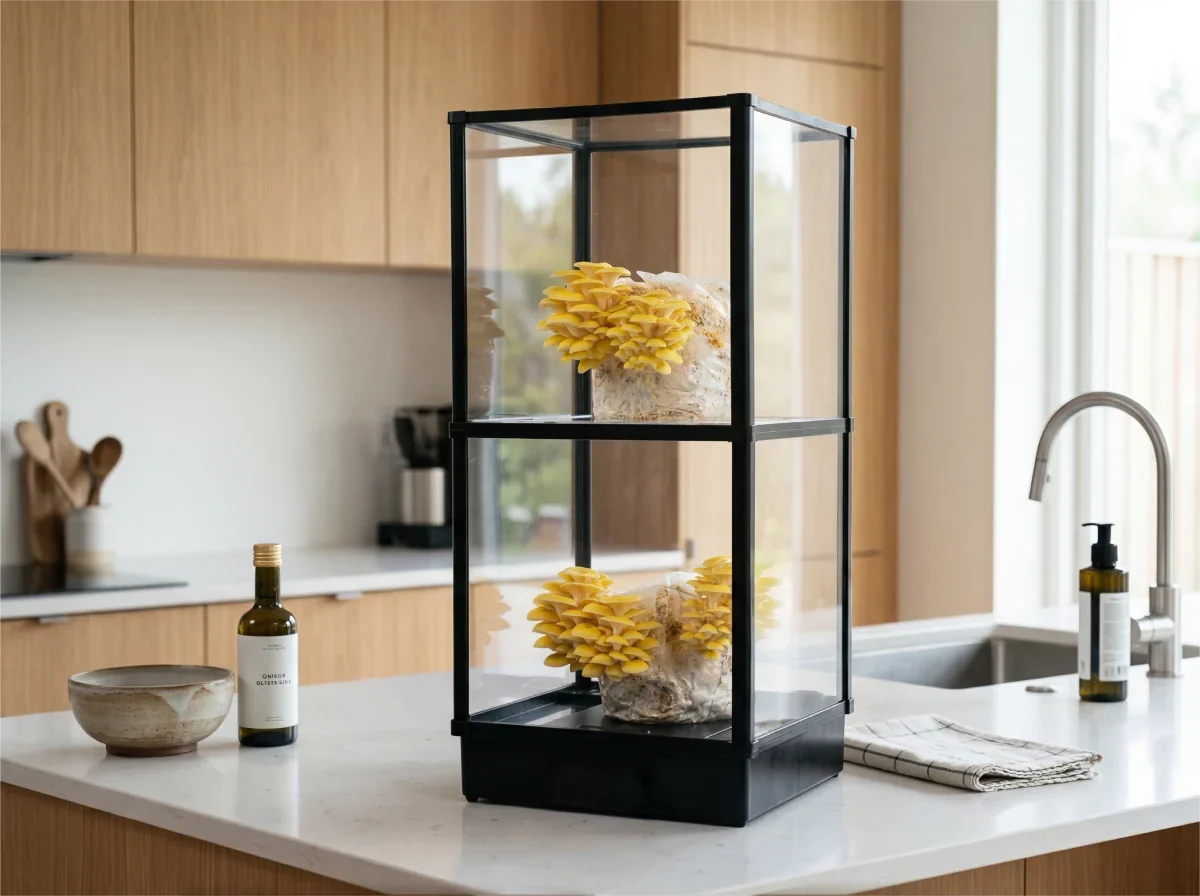
Smart Chamber. Obsidian Black Single
- Same hardware as Bone White
- Matte black premium finish
- Pairs with any kitchen palette
Share:
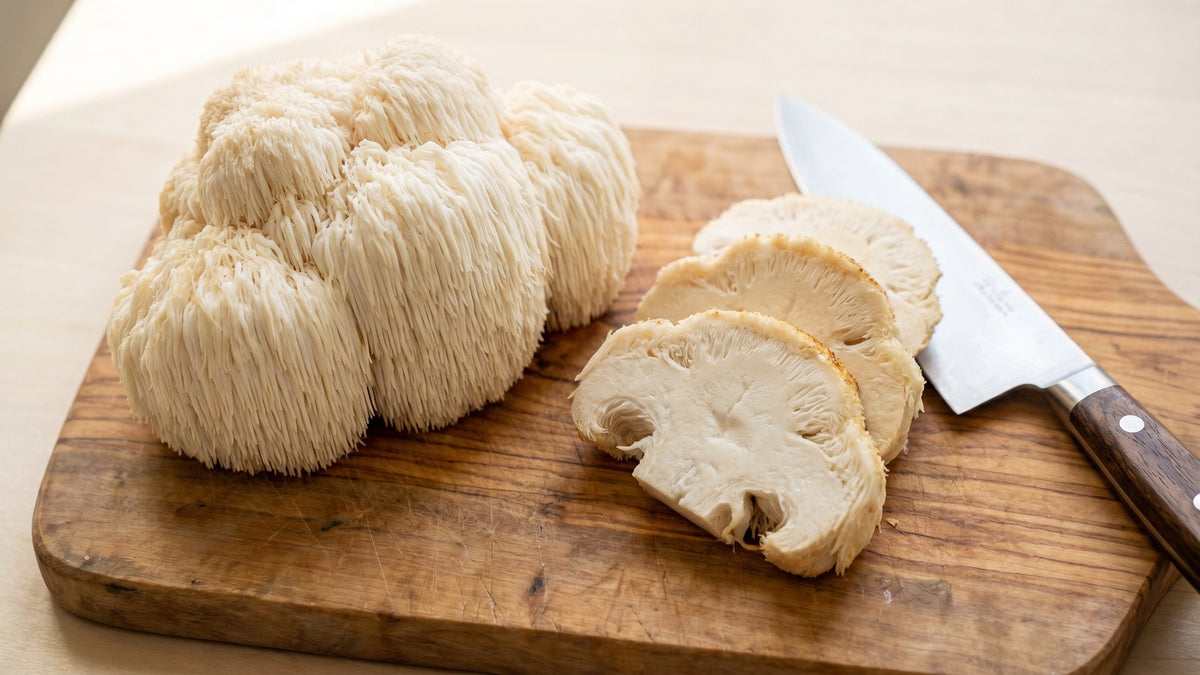
Lion's Mane Grow Kit: How to Grow Fresh Lion's Mane at Home
Pink Oyster Grow Kit: The Beginner's Tropical Mushroom