



Was ist ein Goldgelber Seitling?

In Japan Tamogitake. Auf der Saatgutliste eines US-amerikanischen Anbieters „Yellow Oyster“. Auf dem lateinischen Etikett Pleurotus citrinopileatus. Der lateinische Name bedeutet zitronenhütig.
Der Pilz wächst in dichten Büscheln mit einem Dutzend oder mehr Hüten, die alle aus einer gemeinsamen Basis entspringen. Die Hüte beginnen als stecknadelkopfgroße, rühreigelbe Primordien, flachen sich zu Trichtern ab und nehmen schließlich die Form flacher Schirme mit einem Durchmesser von fünf bis zehn Zentimetern an. Die Farbe reicht von tiefem Goldgelb an kühlen Morgen bis zu blassem Primelgelb nach einem heißen Nachmittag. Die Lamellen laufen wie beim klassischen Austernseitling am Stiel herab. Das Fleisch ist dünn und jung papierartig, bei voller Größe jedoch fleischiger.
Der Goldgelbe Seitling ist ein Saprotroph, das heißt, er ernährt sich von Totholz. In der Kultur gedeiht er auf Hartholzsägemehl, angereichert mit Sojahülsen oder Weizenkleie – derselben Substratmischung, die für Austernseitlinge und Blaue Austernpilze verwendet wird. In der Forschungsdatenbank PubMed Central der US-amerikanischen National Institutes of Health wird er in Ernährungsstudien als ergothioneinreiche Quelle aufgeführt. Ergothionein ist eine antioxidative Aminosäure, die Pilze bilden, Tiere jedoch nicht.
Was unterscheidet diese Art?

Austernseitlinge hassen den Sommer. Goldgelbe Seitlinge lieben ihn. Das ist die Kurzfassung. Vier Unterschiede, die Sie kennen sollten:
- Wärmeliebend. Während Austernseitlinge bei 55 bis 65 °F fruchten und Blaue Austernpilze bei 55 bis 70 °F am besten gedeihen, bevorzugt der Goldgelbe Seitling 70 bis 85 °F. Er ist der Sommerpilz unter den Seitlingen. Eine Küchenarbeitsplatte im Juli liegt näher an seinem natürlichen Klima als ein Keller im Oktober.
- Schnell. Die ersten Primordien erscheinen drei bis fünf Tage nach dem Schneiden des Fruchtungsschlitzes. Die Ernte ist am 10. bis 14. Tag reif. Austernseitlinge und Blaue Austernpilze brauchen 14 bis 21 Tage.
- Farbe braucht die richtigen Bedingungen. Die gelbe Farbe ist mit hohem Stoffwechselaufwand verbunden. Jedes Grad über 85 °F, jede zusätzliche Stunde mit zu viel CO₂ und jedes versäumte Besprühen lassen sie in Richtung Creme verblassen. Wer Wert auf kräftige Farbe legt, hält die Temperatur bei etwa 78 °F und stellt den Block in indirektes Tageslicht.
- Der Geschmack entfaltet sich durch Hitze. Roh schmeckt der Goldgelbe Seitling dünn und leicht bitter. In einer trockenen Gusseisenpfanne sechs Minuten angebraten, karamellisieren die Ränder, und das Fleisch schmeckt nach Cashewbutter, gebräunter Zwiebel und einem Hauch Anis. Diesen Seitling braten Sie kräftiger an, als Sie vielleicht denken.
Nichts davon ist schwierig. Diese Art gehört zu den anspruchslosesten für den Anbau zu Hause. Deshalb führt das Small Farms Program der Cornell University sie zusammen mit dem Austernseitling in seinen Empfehlungen für Anfänger auf.
Was Sie benötigen

Sie benötigen nicht viel: einen Fruchtungsblock mit Goldgelben Seitlingen, 5 lb schwer, von einem US-amerikanischen Anbieter wie North Spore, Smugtown oder Mushroom Media Online. Eine Anbauumgebung, die zwei Wochen lang 70 bis 85 °F und 85 bis 95 Prozent Luftfeuchtigkeit hält. Ein sauberes Messer mit Wellenschliff oder ein Skalpell. Eine Sprühflasche. Für den Erntetag eine N95-Maske. Ein Thermometer und ein Hygrometer, falls Ihre Umgebung deren Werte nicht anzeigt.
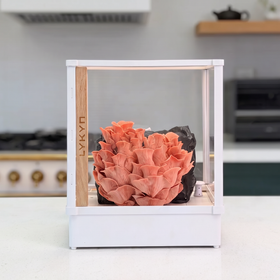
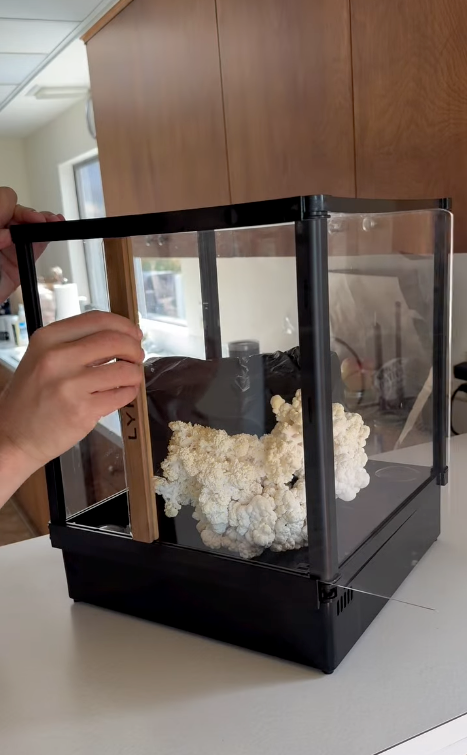
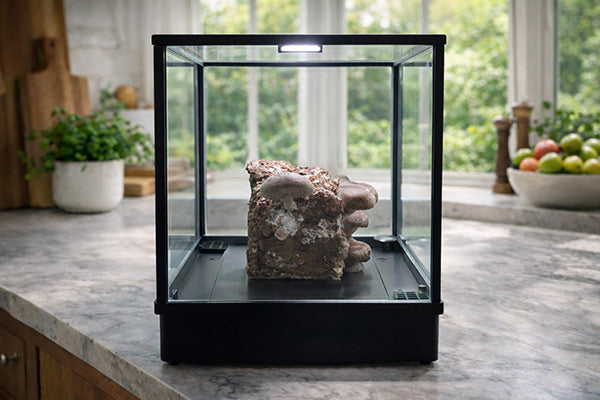
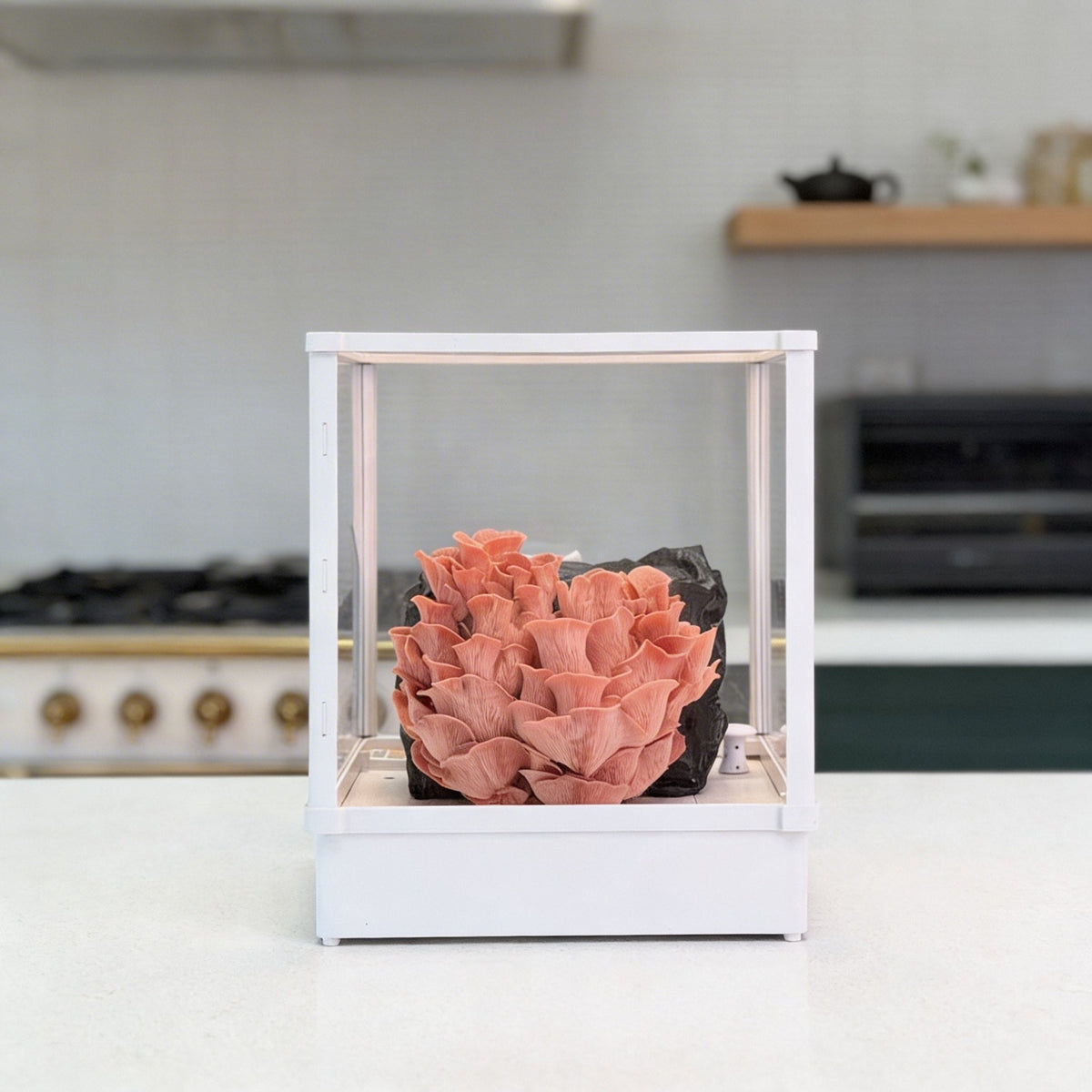
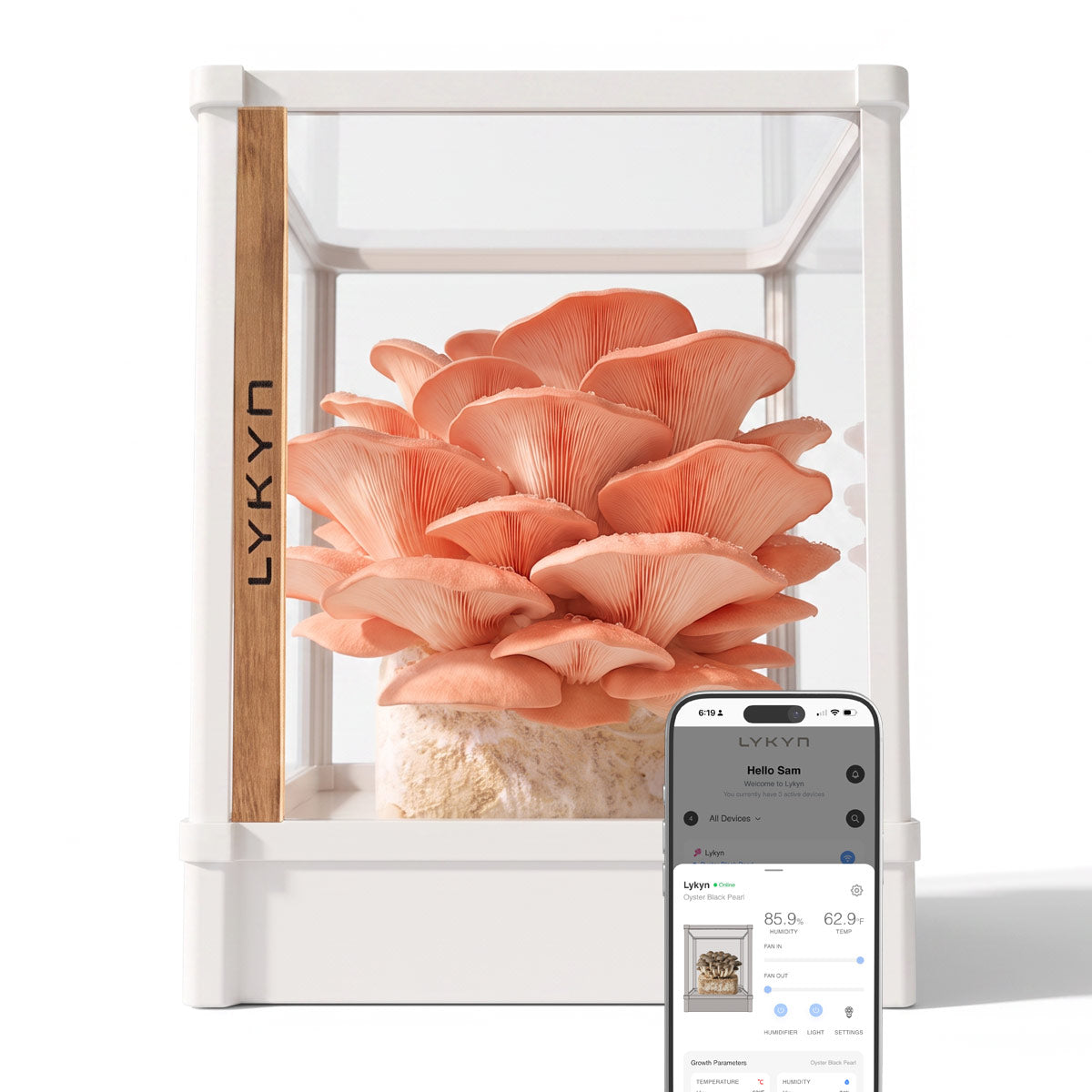
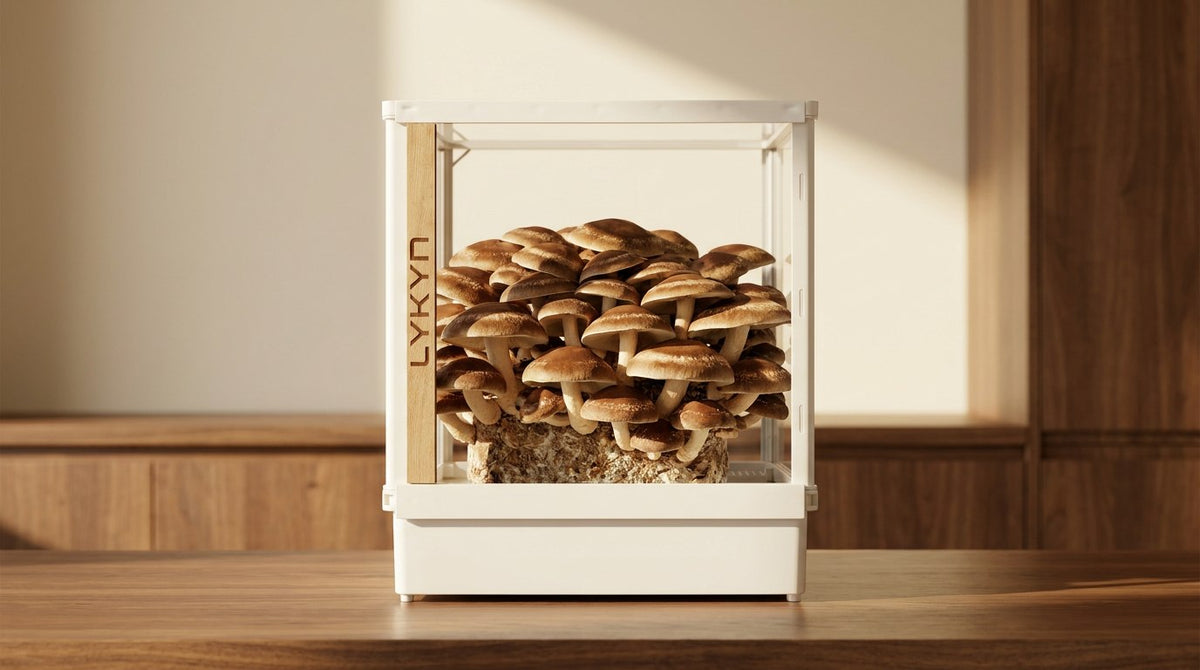
Die Smart Mushroom Grow Box von Lykyn sorgt für die passenden Bedingungen. Das Gerät für die Küchenarbeitsplatte reguliert Temperatur, Luftfeuchtigkeit und Frischluftzufuhr anhand eines Artprofils und funktioniert mit Fruchtungsblöcken jeder Marke. Die Erfolgsquote der ersten Fruchtung liegt bei den in den vergangenen zwölf Monaten verkauften Geräten bei 97,8 Prozent; Grundlage sind Kundenberichte über ihre Ernte. Wenn Sie bereits ein Feuchtigkeitszelt mit stehender Luft haben und einen kleinen Ventilator an eine Zeitschaltuhr anschließen können, lassen sich dieselben Bedingungen auch manuell herstellen – allerdings nur mit mehr Aufwand.
Der Block ist wichtiger als die Kammer. Ein frischer, vollständig durchwachsener Block mit gleichmäßig weißem Myzel und ohne grüne, graue oder schwarze Stellen fruchtet sogar in einem Zelt aus Pappe. Bei einem alten Block kann auch die beste Kammer der Welt keine gute Ernte retten.
Schritt 1. Einen warmen Standort mit 70 bis 85 °F wählen 5 Minuten
Der Goldgelbe Seitling bevorzugt unter den gängigen Kulturarten der Seitlinge die höchste Temperatur. Wählen Sie in Ihrer Wohnung einen Platz, an dem die Umgebungstemperatur während der gesamten zwei Wochen Anbau zwischen 70 und 85 °F bleibt. Eine Küchenarbeitsplatte ohne direkte Sonneneinstrahlung eignet sich gut. Eine im Winter unbeheizte Garage oder ein klimatisiertes Schlafzimmer mit weniger als 68 °F bremst das Wachstum und lässt die Farbe verblassen.
Messen Sie die Temperatur mit einem richtigen Thermometer, statt sie zu schätzen. Die Raumtemperatur in US-amerikanischen Haushalten schwankt stärker, als viele denken – besonders in der Nähe von Außenwänden. Ein Unterschied von fünf Grad zwischen Tag und Nacht ist in Ordnung und trägt sogar dazu bei, dass sich die Farbe ausbildet. Sinkt die Temperatur jedoch länger als eine Stunde unter 65 °F, wird die Bildung der Primordien sichtbar verlangsamt.
Schritt 2. Einen Fruchtungsblock mit Goldgelben Seitlingen bestellen 10 Minuten online
Kaufen Sie bei einem US-amerikanischen Anbieter einen 5 lb schweren Fruchtungsblock aus Sägemehl und Sojahülsen, der mit Pleurotus citrinopileatus beimpft wurde. Der Block sollte vollständig durchwachsen geliefert werden. Das Substrat muss durch die Kunststoffhülle hindurch gleichmäßig weiß aussehen. Nehmen Sie keinen Block mit grünen, grauen oder schwarzen Stellen, feuchten Flecken oder einem säuerlichen Ammoniakgeruch.
Wenn Sie bereits andere Arten anbauen und den Goldgelben Seitling aus Körnerbrut ziehen möchten, bestellen Sie 250 g Körnerbrut mit Goldgelben Seitlingen. Vermischen Sie sie in einem Filterbeutel mit 0,5-Mikron-Filterfläche mit 2,5 kg pasteurisiertem Stroh oder angereichertem Hartholzsägemehl. Bei 70 °F durchwächst die Art das Substrat schnell, innerhalb von 10 bis 14 Tagen, und verzeiht Anfängerfehler.
Schritt 3. Den Block prüfen und ruhen lassen 24 Stunden
Die meisten Anbieter versenden die Blöcke gekühlt. Packen Sie Ihren Block aus, prüfen Sie alle sechs Seiten bei hellem Licht und lassen Sie ihn vor dem Aufschneiden 24 Stunden bei Zimmertemperatur auf der Arbeitsplatte stehen. Wird ein kalter Block geöffnet und in eine warme, feuchte Kammer gestellt, kann sich Kondenswasser im Beutel bilden und Bakterienfäule begünstigen, bevor die Pilze richtig zu wachsen beginnen.
Achten Sie während der Ruhezeit an den Rändern des Blocks auf einen leichten Gelbstich. Er deutet darauf hin, dass sich unter der Kunststoffhülle frühe Primordien bilden, und ist ein gutes Zeichen. Auch kleine gelbe Primordien, die gegen den Beutel drücken, sind unbedenklich. Sie fallen zwar zusammen, werden aber durch die Primordien ersetzt, die später durch Ihren Fruchtungsschlitz wachsen.
Schritt 4. Den Fruchtungsschlitz schneiden 5 Minuten
Schneiden Sie mit einem sauberen Messer mit Wellenschliff oder einer neuen Skalpellklinge einen einzelnen Schlitz in X-Form in eine Seite des Beutels. Jeder Schenkel des X sollte etwa zehn Zentimeter lang sein. Schneiden Sie nicht mehrere Schlitze in verschiedene Seiten. Goldgelbe Seitlinge fruchten zuverlässiger an einer einzigen Stelle, weil sie ihr Wachstum in einem Büschel bündeln können, statt ihre Energie auf konkurrierende Ansätze zu verteilen.
Wischen Sie das Messer vor dem Schneiden mit 70-prozentigem Isopropylalkohol ab. Diese Art bildet ein kräftiges Myzel und steckt eine leichte Kontamination weg. Ein sauberer Schnitt verringert trotzdem das Risiko von Bakterienflecken auf der Fruchtungsseite.
Schritt 5. Die Fruchtungsbedingungen einstellen 10 Minuten zum Einstellen, dann 2 Tage bis zu den ersten Primordien
Stellen Sie den Block in Ihre Anbauumgebung und sorgen Sie für 75 bis 82 °F, 85 bis 95 Prozent Luftfeuchtigkeit, zwölf Stunden indirektes Tageslicht und vier- bis sechsmal stündlich Frischluftzufuhr. Wenn Sie die Lykyn Smart Mushroom Grow Box verwenden, wählen Sie in der iPhone-App das Profil „Golden Oyster“ aus. Von jetzt an führt Sie die Box durch die Bildung der Primordien und erinnert Sie ans Besprühen.
Wenn Sie ein Feuchtigkeitszelt mit stehender Luft verwenden, besprühen Sie sechs- bis achtmal die Zeltwände, nicht den Block selbst. Öffnen Sie das Zelt außerdem alle vier Stunden für 30 Sekunden, um die Luft auszutauschen. CO₂-Anreicherung ist die häufigste Ursache für blasse Goldgelbe Seitlinge mit langen Stielen beim Anbau zu Hause.
Schritt 6. Die Phase der Primordienbildung begleiten 2 bis 3 Tage
Zwischen dem dritten und fünften Tag sollten am Schlitz rühreigelbe Primordien erscheinen. In diesen empfindlichen 48 Stunden braucht die Kultur besonders viel Aufmerksamkeit. Halten Sie die Luftfeuchtigkeit über 85 Prozent und die Temperatur zwischen 75 und 82 °F. Besprühen Sie die Primordien nicht direkt. Auf den jungen Hüten stehendes Wasser begünstigt Bakterienfäule und gelbbraune Streifen.
Sobald sich die Primordien sichtbar zu kleinen, erkennbaren Hüten verlängert haben, senken Sie die Luftfeuchtigkeit auf 80 bis 85 Prozent und erhöhen die Frischluftzufuhr. So signalisieren Sie dem Pilz, dass er Hüte statt langer Stiele bilden soll. Lange Stiele und kleine Hüte sind ein typisches Zeichen dafür, dass die Luftfeuchtigkeit zu hoch und die Belüftung zu schwach war.
Schritt 7. Bei hochgebogenen Huträndern ernten 10 Minuten
Ernten Sie die Goldgelben Seitlinge, sobald sich die Hutkanten aus der flachen Schirmform leicht nach oben zu wölben beginnen. Dieses Zeitfenster ist kurz: Es öffnet sich an einem einzigen Morgen zwischen dem zehnten und 14. Tag. Wer einen weiteren Tag wartet, büßt Geschmack ein und riskiert Verunreinigungen. Vollständig ausgereifte Hüte geben reichlich gelbe Sporen ab, die sich auf Arbeitsflächen und bei Menschen mit empfindlichen Atemwegen auch in der Lunge absetzen können.
Der Ertrag hängt vom Block, der Zuchtlinie und den Anbaubedingungen ab. Ermitteln Sie beim ersten Fruchtungsschub Ihren eigenen Ausgangswert und richten Sie sich danach. Fassen Sie das Büschel mit sauberen, bloßen Händen am Ansatz und drehen Sie es mit einer Bewegung ab. Beim Abschneiden einzelner Hüte bleiben Stummel zurück, die im Block faulen und den zweiten Fruchtungsschub verkürzen. Wiegen Sie das Büschel, notieren Sie den Wert in Ihrem Anbaujournal und schneiden Sie vor dem Kochen das äußerste Ende der Basis mit einem Messer ab.
Schritt 8. Den zweiten Fruchtungsschub auslösen 10 Minuten Arbeit, dann 10 bis 14 Tage Wartezeit
Goldgelbe Seitlinge bringen einen brauchbaren zweiten Fruchtungsschub, einen dritten jedoch nur selten. Um ihn auszulösen, tauchen Sie den ganzen Block vier Stunden lang in kühles Leitungswasser, lassen ihn gründlich abtropfen und stellen ihn unter denselben Bedingungen wie beim ersten Schub zurück in die Kammer. Fünf bis sieben Tage später erscheinen neue Primordien. Geerntet wird am 10. bis 14. Tag des zweiten Zyklus.
Rechnen Sie beim zweiten Schub mit 50 bis 65 Prozent des Ertrags des ersten. Ist die zweite Ernte abgeschlossen, können Sie den Block entsorgen. Wild wachsende Bestände haben sich aus entkommener kommerzieller Brut ausgebreitet, und Pleurotus citrinopileatus gilt inzwischen in mehreren östlichen Bundesstaaten als eingebürgerte, nicht heimische Art. Verpacken Sie den verbrauchten Block und entsorgen Sie ihn im Hausmüll oder verwenden Sie ihn in Innenräumen als Bodenverbesserer für Zimmerpflanzen.
Fehlersuche

Die Pilze sind blass, fast weiß statt leuchtend gelb. Am häufigsten liegt das an Temperaturen über 85 °F während der Bildung der Primordien. Die zweithäufigste Ursache ist zu wenig Licht. Stellen Sie den Block an einen kühleren Ort und sorgen Sie für zwölf Stunden indirektes Tageslicht oder Licht einer 6500-K-LED. Beim nächsten Fruchtungsschub werden die Pilze dann gelber.
Lange, dünne Stiele mit winzigen Hüten. Das ist ein typisches Zeichen für zu wenig Frischluft und zu viel CO₂. Sorgen Sie für bessere Belüftung. Wenn Sie ein Feuchtigkeitszelt mit stehender Luft verwenden, öffnen Sie die Tür häufiger und fächeln Sie Luft hinein. Wenn Sie eine Lykyn-Box verwenden, prüfen Sie, ob der Ventilator für den Frischluftaustausch blockiert ist.
Der Block riecht säuerlich oder das Substrat sieht schleimig aus. Das deutet auf eine bakterielle Kontamination hin. Pseudomonas tolaasii hat sich angesiedelt. Sobald der Schleim sichtbar ist, lässt sich der Block nicht mehr retten. Entsorgen Sie ihn und fangen Sie von vorn an. Sauberere Schnitte und eine geringere Luftfeuchtigkeit während der ersten 24 Stunden nach dem Schneiden des Schlitzes verringern das Risiko.
Grüner Schimmel an den Rändern des Fruchtungsschlitzes. Das ist Trichoderma, der häufigste Kontaminant bei Austernpilzen. Entdeckst du ihn am ersten Tag als kleinen Fleck, besprühe ihn mit 3-prozentigem Wasserstoffperoxid und mach weiter. Breitet er sich über eine Seite aus, entsorge den Block. Iss keine Pilze, die innerhalb von 15 cm um sichtbaren grünen Schimmel gewachsen sind.
Nach sieben Tagen noch keine Primordien. Ein Temperaturproblem. Goldseitlinge verharren bei Temperaturen unter 20 °C. Stelle den Block an einen wärmeren Ort und gib ihm weitere 72 Stunden, bevor du davon ausgehst, dass er nicht mehr fruchten wird.
Nach der Ernte überall gelber Staub im Raum. Goldseitlinge geben sehr viele gelbe Sporen ab. Ernte einen Tag früher, wische die Arbeitsflächen ab, lasse während und nach der Ernte einen Raumluftreiniger mit HEPA-Filter laufen und trage immer eine Maske.
Goldseitlinge zubereiten

Roh schmecken Goldseitlinge nach fast nichts. Ihr ganzes Aroma entsteht durch Hitze und den trockenen Kontakt mit einer heißen Pfanne. Behandle sie wie Pfifferlinge, nicht wie Champignons.
In der trockenen Pfanne anbraten, sechs Minuten. Erhitze eine gusseiserne Pfanne zwei Minuten lang auf hoher Stufe ohne Öl. Reiße den Pilzverband in einzelne Hüte und gib sie in die trockene Pfanne. Lass sie Wasser abgeben, zischen und an den Rändern anfangen zu bräunen. Nach vier Minuten gib einen Esslöffel Butter, eine Prise flockiges Salz und eine kleine geriebene Knoblauchzehe dazu. Gare alles weitere zwei Minuten, bis die Ränder kräftig goldbraun sind. Mit dieser Technik entsteht die für die Art typische Note von Cashewbutter.
Sahne und Pasta. Brate die Pilze wie oben an, lösche die Pfanne dann mit einem Schuss trockenem Weißwein ab, gib 100 ml Sahne und einen Löffel geriebenen Parmesan dazu, lasse die Sauce auf die Hälfte einkochen und vermenge sie mit Pappardelle. Verfeinere das Gericht mit Zitronenschale und grobem Pfeffer.
Einlage für vegetarische Brühe. Röste die Hüte zwölf Minuten lang bei 200 °C auf einem Blech mit Olivenöl und Thymian und gib sie dann in eine Schale mit klarer Miso- oder Dashi-Brühe. Die gelben Hüte vor dunkler Brühe sehen auf Fotos aus wie ein Gemälde und behalten während des ganzen Essens ihre Konsistenz.
Iss Goldseitlinge nicht roh oder unzureichend gegart. Alle Pleurotus-Arten haben Zellwände aus Chitin, das den menschlichen Darm unverdaut passiert und leichte Blähungen verursachen kann. Beim Garen wird Chitin abgebaut. Deshalb wird derselbe Pilz, der roh dünn und bitter schmeckt, in der heißen Pfanne herzhaft und aromatisch.
Häufig gestellte Fragen
Wie lange dauert es vom Block bis zur Ernte bei Goldseitlingen?
Bei 24 bis 28 °C dauert es ab dem Tag, an dem du den Fruchtungsschlitz schneidest, zehn bis vierzehn Tage. Bei unter 21 °C kann es mehr als drei Wochen dauern.
Welche Temperatur brauchen Goldseitlinge?
Die Besiedelung gelingt bei 20 bis 24 °C. Für die Fruchtung sind warme 21 bis 29 °C ideal, am besten 24 bis 28 °C. Unter 18 °C kommt das Wachstum zum Stillstand und die Farbe wird blass.
Warum sind meine Goldseitlinge blass statt leuchtend gelb?
Das leuchtende Kanariengelb entsteht bei ausreichend Licht und kühleren Nächten. Blasse Pilze deuten entweder auf zu wenig Licht, Temperaturen über 29 °C oder einen CO₂-Anstieg durch unzureichenden Luftaustausch hin.
Sind Goldseitlinge dasselbe wie Gelbe Austernpilze?
Ja. Beides sind gebräuchliche Namen für Pleurotus citrinopileatus. Einige Anbieter führen sie auch unter ihrem japanischen Namen Tamogitake.
Kann ich Goldseitlinge statt aus einem Block auch aus Getreidebrut ziehen?
Ja. Mische 250 g Getreidebrut unter 2,5 kg pasteurisiertes Stroh oder angereichertes Sägemehl, lasse die Mischung zehn bis vierzehn Tage bei 21 °C in einem verschlossenen Beutel besiedeln und bringe sie dann zur Fruchtung. Die Art besiedelt das Substrat schnell und ist auch für Anfänger gut geeignet.
Wie schmecken Goldseitlinge?
Gegart haben sie ein kräftiges Aroma nach Cashewbutter oder gerösteten Nüssen und bekommen beim Karamellisieren einen festen Biss. Roh oder nur leicht gedämpft schmecken sie dünn und bitter. Brate sie deshalb in der Pfanne, bis die Ränder gebräunt sind.
Kann ich Goldseitlinge zusammen mit einer anderen Art in derselben Kammer züchten?
Nicht gleichzeitig. Eine große Sporenmenge kann sich auf einem langsamer besiedelnden Block wie dem Igelstachelbart absetzen und ihn kontaminieren. Züchte pro Kammer nur eine Art und reinige die Kammer zwischen den Durchgängen.
Wie verhindere ich, dass sich Sporen auf meiner Arbeitsfläche ablagern?
Ernte einen Tag früher, bevor sich die Hüte vollständig abflachen. Ausgewachsene Hüte geben große Mengen gelber Sporen ab. Eine etwas frühere Ernte bewahrt auch das Aroma.
Können Goldseitlinge Allergien auslösen?
Längeres Einatmen von Austernpilzsporen kann eine Atemwegsempfindlichkeit auslösen, die bei Beschäftigten in der kommerziellen Pilzzucht dokumentiert wurde. Trage während der Ernte eine N95-Maske und lüfte den Raum anschließend.
Kann ich die Lykyn Smart Mushroom Grow Box für Goldseitlinge verwenden?
Ja. Sie hält die Temperatur bei 21 bis 29 °C und die Luftfeuchtigkeit bei 85 bis 95 Prozent und führt nach einem artspezifisch abgestimmten Zeitplan Frischluft zu. Goldseitlinge gehören zu den 28 unterstützten Profilen der Lykyn Smart Mushroom Grow Box und eignen sich für Fruchtungsblöcke jeder Marke.



Aktie:
Austernseitlinge zu Hause anbauen: Der umfassende Leitfaden für 2026
Wie man Löwenmähnenpilze zu Hause züchtet: Der umfassende Ratgeber für 2026