


Published March 14, 2026 · Updated August 25, 2026
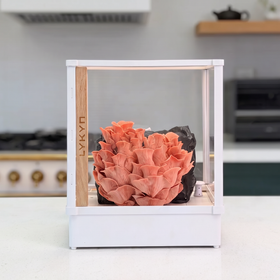
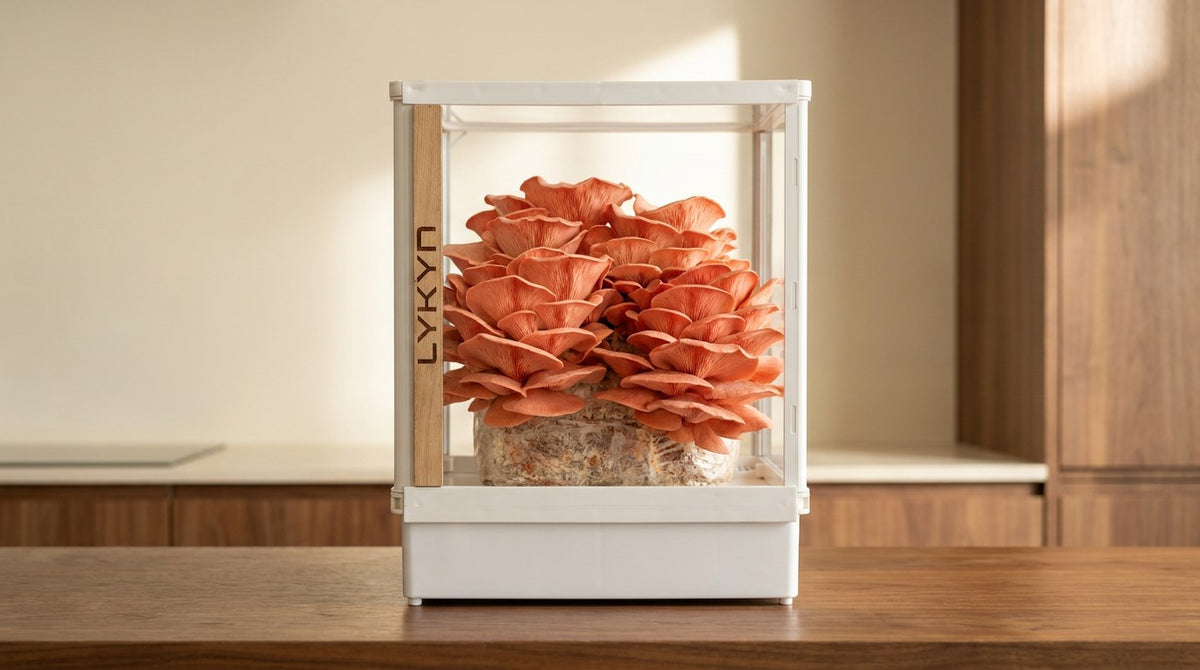
Updated August 2026Pink oyster mushroom (Pleurotus djamor) is a warm-loving, coral-pink cluster mushroom that fruits from a sterilized block in 10 to 14 days. The fastest common oyster species. It thrives at 65 to 80 F, must be harvested before the caps release their heavy pink spore load, and delivers a smoky, meaty flavor that many cooks compare to bacon. This guide walks the full 8-step method from cold-water soak to second flush, with the exact humidity and airflow targets that hit the 97.8% first-flush rate we now see on the Lykyn Smart Mushroom Grow Box.
- What pink oyster is, and what makes it distinct
- What you need to grow pink oyster
- Step 1 · Prepare the grow chamber
- Step 2 · Cold-water soak the fruiting block
- Step 3 · Position the block and set climate targets
- Step 4 · Trigger pin site formation
- Step 5 · Manage the pinning window
- Step 6 · Support cap expansion
- Step 7 · Harvest before spore drop
- Step 8 · Reset for a second flush
- Troubleshooting
- Cooking, storage, and nutrition
- Frequently asked questions

What pink oyster is, and what makes it distinct

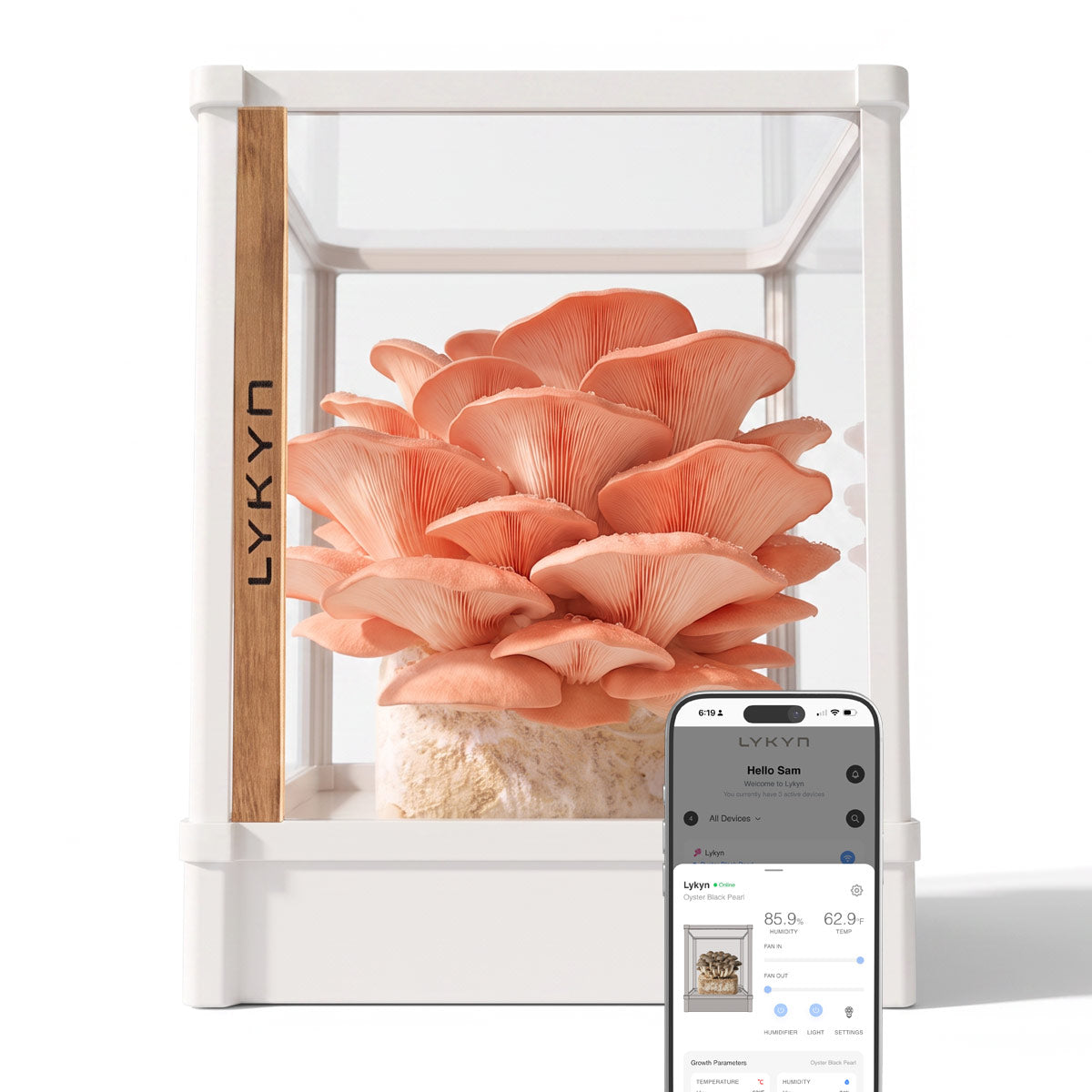
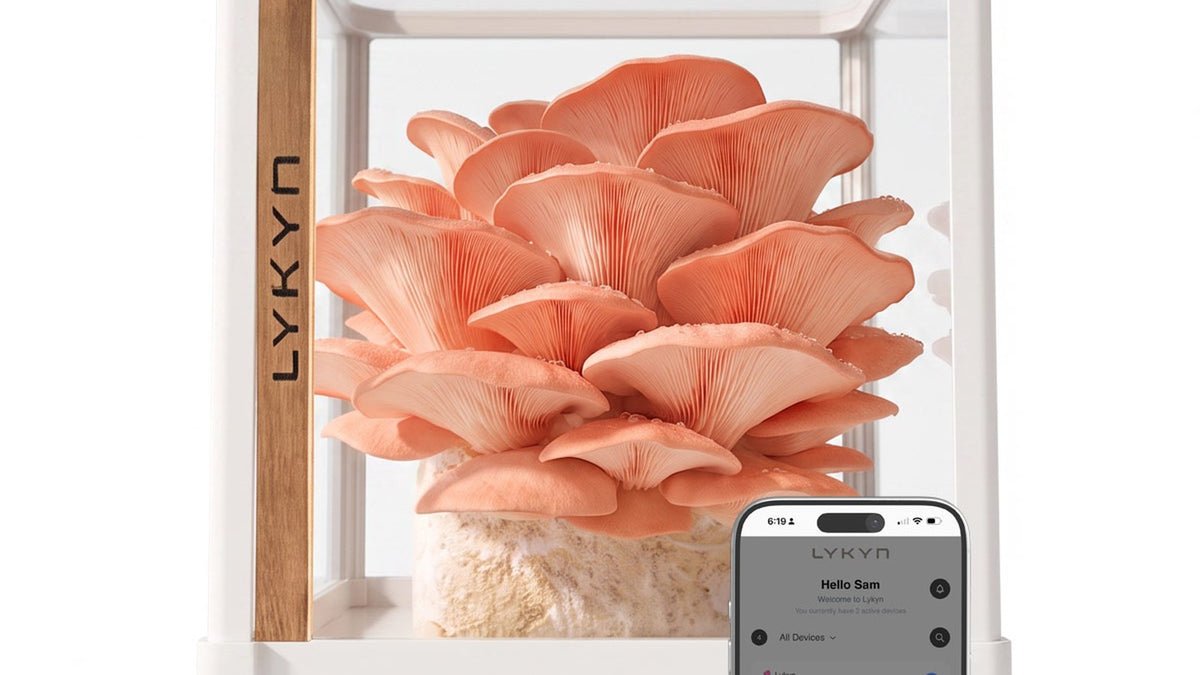
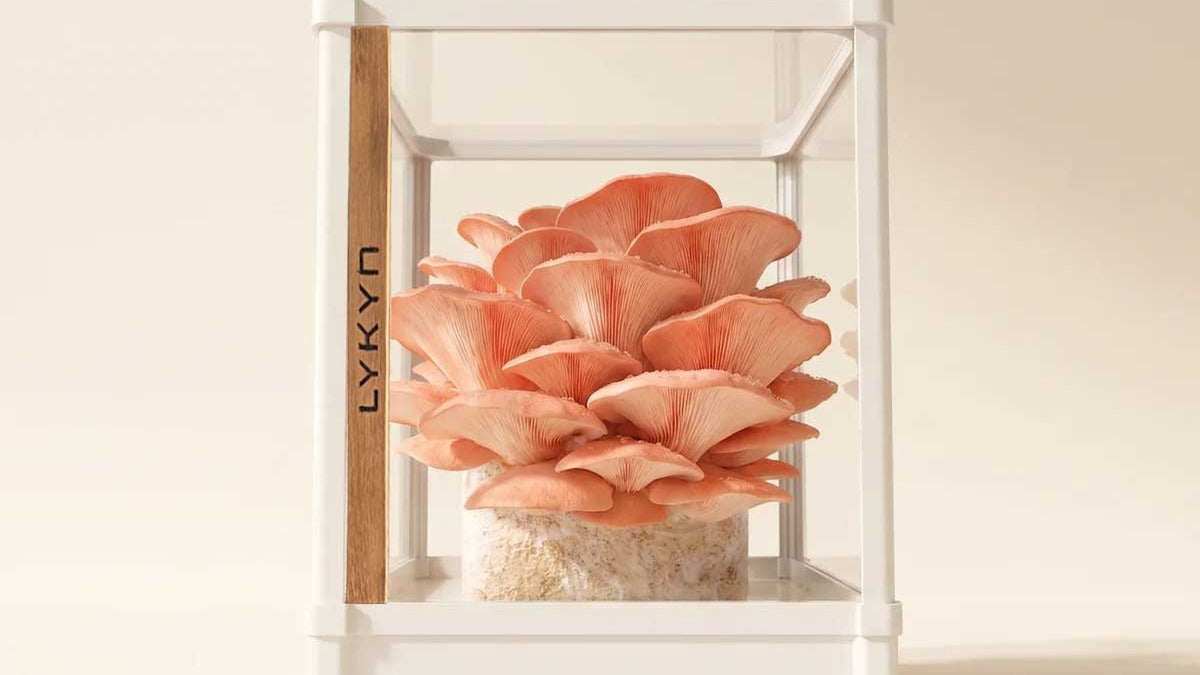
The coral pigment holds all the way through cap expansion, then fades the day spores drop. That color shift doubles as the harvest clock. Pink oyster mushroom is Pleurotus djamor It grows in cascading fan-shaped clusters, and the flesh runs from soft salmon on young caps to a deep coral on mature ones. Under a phone macro lens, the gills look almost fluorescent in low light.
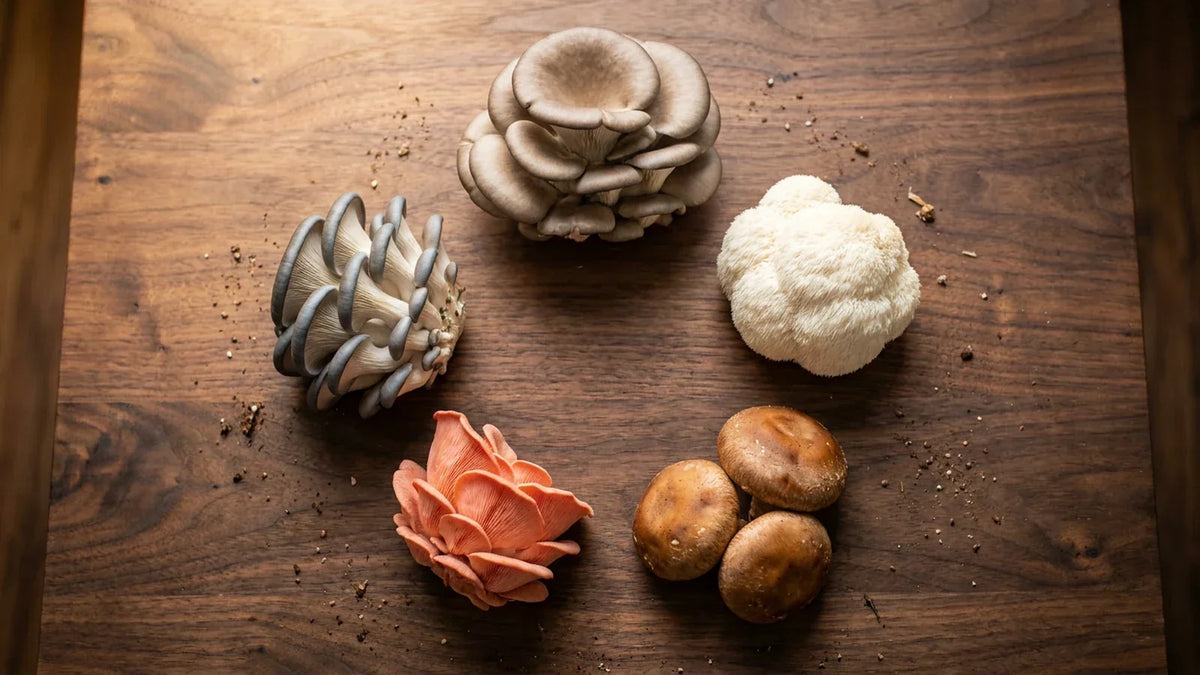
Four traits set pink oyster apart from every other cultivated oyster species:
- Speed. Pin to harvest averages 10 to 14 days on a controlled chamber. Pearl oyster runs 14 to 21. Blue oyster runs 18 to 24.
- Warm range. Pink oyster is the only common oyster species that fruits comfortably at kitchen-warm temperatures. The productive band is 65 to 80 F, peaking at 72 to 78 F. It stalls below 60 F.
- Color that reads. The coral pigment is stable through cap expansion. It only fades once the caps flatten and start dropping spore, which doubles as the harvest cue.
- Bacon-like aroma. Dry-panned in a hot skillet without oil for the first two minutes, pink oyster releases a smoky, cured aroma. The chemistry is a high concentration of 1-octen-3-ol and related eight-carbon aldehydes, the same compound family that gives wet-forest and cured-meat notes their character.
Because pink oyster runs warm, wet, and fast, it exposes any weakness in a growing setup. Passive humidity tents lose water too quickly. Cold basements stall the pinning window. Rooms without airflow trap CO2 and produce stalky, long-stemmed caps. That is why the standard beginner recommendation now is a chamber that reads humidity and airflow instead of a bag with slits. The fruiting window is short enough that a two-day drift costs the flush.
What you need to grow pink oyster

The materials list is short. Everything below is common home-cultivation kit, and none of it is species-locked. A pink oyster block will fruit anywhere pearl or blue oyster fruits, provided the environment stays warm.
Required
- One pink oyster (Pleurotus djamor) fruiting block, 5 to 6 lb, sterilized commercial substrate. Any reputable supplier works. Lykyn boxes accept any brand of fruiting block or grain spawn.
- A humidity- and airflow-controlled fruiting chamber. Options range from a shotgun fruiting chamber (SGFC) with a hygrometer at the low end to an automated appliance like the Lykyn Smart Mushroom Grow Box at the appliance end. The 97.8% first-flush success rate quoted throughout this guide is our internal 2026 data on the Lykyn chamber. Passive setups run lower.
- Filtered water, 2 gallons, for the cold-water soak.
- 70% isopropyl alcohol, for wiping the chamber interior before load.
- A clean single-edge blade or sharp knife, for scoring the block.
Optional
- Digital hygrometer, only if the chamber does not report humidity in real time.
- Kitchen thermometer, only if the chamber does not report temperature.
- Small oscillating fan, for passive setups that need forced fresh-air exchange.
- Paper harvest bag, for immediate refrigeration.
For a broader look at how the sensor loop actually shortens the cultivation curve, see our Lykyn Smart Mushroom Grow Box product page.
The 8-step method

1 Prepare the grow chamber
30 minutesWipe the interior walls and the sensor cluster of the chamber with 70% isopropyl on a lint-free cloth. Empty and rinse any drain tray. Confirm the humidity sensor is reading a plausible ambient number (35 to 55% in most US kitchens) before the load, and confirm airflow is active. Set the target range to 85 to 95% relative humidity and 70 to 78 F.
If you are using a passive SGFC, moisten the perlite bed until it holds water when squeezed but does not drip. Position the chamber out of direct sun and away from an active HVAC vent. Both dry the air faster than the chamber can replace it.
2 Cold-water soak the fruiting block
12 to 24 hoursSubmerge the intact fruiting block, plastic sleeve and all, in a bath of cold filtered water. Weight it down with a plate so the block stays fully submerged. Cold shock triggers pin formation in Pleurotus djamor and rehydrates the substrate for a fuller first flush.
Water temperature should sit at 45 to 55 F. Duration is 12 hours for a first flush from a fresh block, and 24 hours for a second-flush revive. Skipping the soak is the single most common reason pink oyster kits underperform their spec.
3 Position the block and set climate targets
5 minutesDrain the block for 15 minutes. Cut a single wide X across the plastic on the flat face you want to fruit. A 4 by 4 inch cut is enough. Do not remove the plastic. Load the block into the chamber with the X facing outward, into the fruit space.
Confirm humidity climbs above 85% within 30 minutes of the door closing. If the number stalls, your chamber seal is leaking. Check the door gasket first. Set the airflow to a slow steady exchange, 2 to 3 room-volumes per hour.
4 Trigger pin site formation
Days 1 to 3Hold the chamber at 72 to 78 F and above 90% humidity for the first three days. Do not open the door. Pinheads appear as small coral-pink dots along the cut edge and, within 48 hours, as tightly packed clusters across the fruit face.
Pin formation is the visible cue that the flush is committed. If you see no pins by hour 72, verify humidity is holding through the night (temperature drops relax the seal on many passive chambers) and confirm ambient temperature has not dipped below 65 F.
5 Manage the pinning window
Days 4 to 7Drop humidity to 85 to 90% and increase fresh-air exchanges to 4 to 6 per hour. This is the window where pins either mature into caps or abort into small brown nubs. Excess CO2 produces long stems with tiny caps. The classic underairflow tell. Excess condensation on pins produces bacterial blotch (see troubleshooting below).
On the Lykyn chamber, the pinning window is fully automated: the sensor loop steps humidity down and airflow up on a schedule tied to detected pin density. On a passive setup, mist the chamber walls (not the pins) twice daily and crack the lid for a minute morning and evening.
6 Support cap expansion
Days 8 to 12Caps expand from pinhead to full 2 to 4 inches across in 4 to 5 days. Coral color deepens on the upper surface. Keep humidity at 80 to 88% and airflow steady. Do not spray water directly onto the caps. Surface moisture during expansion causes soft spots that shorten shelf life.
Photograph the cluster daily if you like. Cap edges are the harvest clock. Once you see the first edge start to flatten from convex to level, you have 18 to 30 hours before spore release.
7 Harvest before spore drop
Day 10 to 14Harvest the whole cluster the moment cap edges start to flatten or curl slightly upward. Slide a hand under the base, grip firmly, and twist the entire cluster off with a single rotation. Do not cut individual caps. Leaving cap bases attached to the block invites bacterial rot into the second flush.
Weigh the harvest immediately. Yield depends on your specific block, strain, and grow environment. Refrigerate at 34 to 38 F in a paper bag within 60 minutes of harvest for maximum shelf life.
8 Reset for a second flush
Days 15 to 21Do not soak the block again immediately. Rest it in the chamber, uncovered, for 3 days at 70 F and 60 to 70% humidity. This dry rest lets the mycelium recolonize the fruit face and consolidate energy for a second push.
On day 18 to 19, cold-soak the block a second time for 12 hours, drain, and reload. Second flush arrives on the same 10 to 14 day curve and returns 60 to 70% of first-flush weight. A third flush is possible but small. Composting the block and starting a new one delivers a better yield per week of counter space.
Troubleshooting

Most pink oyster failures look catastrophic in the chamber and fix in under two minutes at the counter. Every one carries a specific tell, and every tell has a specific correction. Work down the list.
Pins turned brown or slimy with a sour smell. Bacterial blotch, caused by standing water on developing pins. Pseudomonas tolaasii thrives when pins stay wet for more than a few hours. Fix: cut misting frequency in half, raise airflow to 6 exchanges per hour, and remove the affected pins with clean tweezers. Healthy pins remain firm and coral-toned.
Long stems, tiny caps. Elevated CO2 during cap expansion. Fix: open the chamber for 60 seconds every 2 hours, or (on an automated chamber) step airflow up one notch. Long-stem pink oyster is still edible and even a touch more tender, just less visually true to the species.
No pins by day 4. Two causes to check. Either ambient temperature has dropped below 65 F overnight (a common shoulder-season problem), or the block was not cold-shocked long enough. Fix: move the chamber to a warmer wall, verify the soak was a full 12 hours in genuinely cold water, and give the block another 48 hours before declaring it dead.
Second flush much smaller than expected. Under-hydrated block. Fix: on the second flush, extend the soak to 24 hours and drain longer before load. Also verify the block was stored at 45 to 55 F, not at room temperature, before use.
Coral fading to pale peach. Normal color drift as caps mature past the harvest window. If caps are already flattening, harvest immediately regardless of color. If caps are still convex, drop the temperature 2 to 3 degrees and re-verify humidity is holding above 82%.
Green or black patches on the substrate. Contamination, most commonly Trichoderma (green mold) or a Cladosporium (dark spotting). Fix: cull the entire block into a sealed bag and dispose. Wipe the chamber with a fresh 70% isopropyl pass before the next load. Never reuse a contaminated substrate.
Cooking, storage, and nutrition

Slice a raw pink oyster cap and chew a sliver. Rubbery. Muted. Barely worth the counter space. Now drop the same strips into a dry cast-iron pan over medium-high heat and wait ninety seconds. The mushroom that emerges is a different food entirely.
The dry-pan bacon method. Slice the cluster into strips, place in a dry cast-iron skillet over medium-high heat, and let them go for 2 to 3 minutes without any oil or salt. The mushrooms release their internal moisture, brown at the edges, and pick up a smoky, cured aroma. Add a splash of olive oil and a pinch of salt only after the water has cooked off. Two more minutes and they are done. This is the closest a plant delivers to bacon without a substitute product.
Other reliable pairings. Miso and butter (Japanese pan-fry). Garlic and thyme (Provencal). Soy, ginger, and sesame (Chinese stir-fry). Coconut milk, lemongrass, and chili (Thai). Pink oyster holds up in a fast wok pass better than pearl oyster because the flesh is denser.
Storage. Fresh: paper bag, refrigerated at 34 to 38 F, keeps 5 to 7 days. Frozen: dry-saute for 60 seconds, cool, and freeze in a flat single layer. Dehydrated: 115 F for 6 to 8 hours until brittle, then store in an airtight jar with a food-safe desiccant. Rehydrated pink oyster returns most of its flavor for soups and braises.
Nutrition, per 100 g fresh. About 33 calories, 3.3 g protein, 6 g carbohydrate (of which 2 g dietary fiber), negligible fat. Meaningful sources of niacin, riboflavin, potassium, phosphorus, and copper. Pleurotus species also carry ergothioneine, a stable dietary antioxidant that survives cooking.
Skip the guesswork. Grow pink oyster on autopilot.
The Lykyn Smart Mushroom Grow Box holds humidity and airflow inside the exact range this guide specifies, without a hygrometer or a timer. First-flush success rate is 97.8% across our 2026 test cohort. Kitchen-counter size. US-made in Santa Rosa, California. Works with any brand of fruiting block or grain spawn.
Frequently asked questions
How long does it take to grow pink oyster mushrooms at home?
10 to 14 days from cold soak to first harvest in a humidity-controlled chamber. Add a week for a passive bag kit. Fastest of the common oyster species.
What temperature does pink oyster mushroom need to grow?
65 to 80 F, with the sweet spot at 72 to 78. Below 60 pins stall. Above 85 caps abort. The only common oyster that fruits at kitchen-warm temperatures.
Why does my pink oyster smell like bacon when cooked?
1-octen-3-ol and related eight-carbon aldehydes. Dry-panned in a hot skillet those compounds throw a smoky, cured-meat note that many cooks name as bacon.
Do pink oysters need light to grow?
A few hours of indirect ambient daylight is enough. Light acts as a directional cue for cap orientation, not a food source. No photosynthesis involved.
When should I harvest pink oyster mushrooms?
The moment cap edges start to flatten or curl upward, and before any pink dust settles on the chamber floor. That dust is spore. Waiting one day too long costs shelf life and flavor.
How do I store fresh pink oyster mushrooms?
Paper bag in the fridge at 34 to 38 F. Keeps 5 to 7 days fresh. Freezes cleanly after a 60-second dry saute. Dehydrates at 115 F for 6 to 8 hours.
Is pink oyster mushroom safe for beginners?
Yes. One of the fastest and most forgiving species for a first grow, as long as the fruiting block is sterilized commercial substrate. Never forage without species-level certainty.
Why did my pink oyster pins turn brown or slimy?
Bacterial blotch. Standing water on developing pins let a Pseudomonas colony take hold. Cut misting frequency, raise airflow to 6 exchanges per hour, and pull the affected pins. Healthy pins stay firm and coral.
Can I grow pink oyster on a kitchen counter?
Yes. The 70 to 78 F range that pink oyster loves is the same window most US kitchens already hold. A humidity-controlled chamber removes the misting guesswork.
How many flushes can one pink oyster block produce?
First flush is the biggest. Second returns 60 to 70% of that on a full 12-hour re-soak. A third flush is possible but small and rarely worth the counter space.
Are pink oyster mushroom spores a health risk?
Higher spore load than most cultivated species. Prolonged high-exposure inhalation has been linked to allergic pneumonitis in commercial growers. Harvest before the heavy spore drop and ventilate the space during any large release.
What is the difference between pink oyster and other oyster species?
Warmer, faster, and shorter shelf life than pearl or blue. Coral pigment holds through cap expansion, and the denser flesh takes a hot wok pass better than the cooler-climate oysters.
Aktie:
Best Mushroom Grow Kit for Beginners in 2026: Honest Picks After Testing 12 Setups
How to Grow Blue Oyster Mushrooms at Home: Complete 2026 Guide