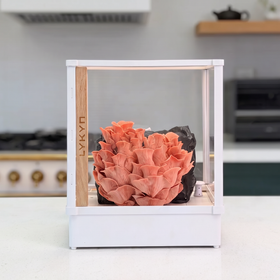



Fuel Your Mushroom Journey

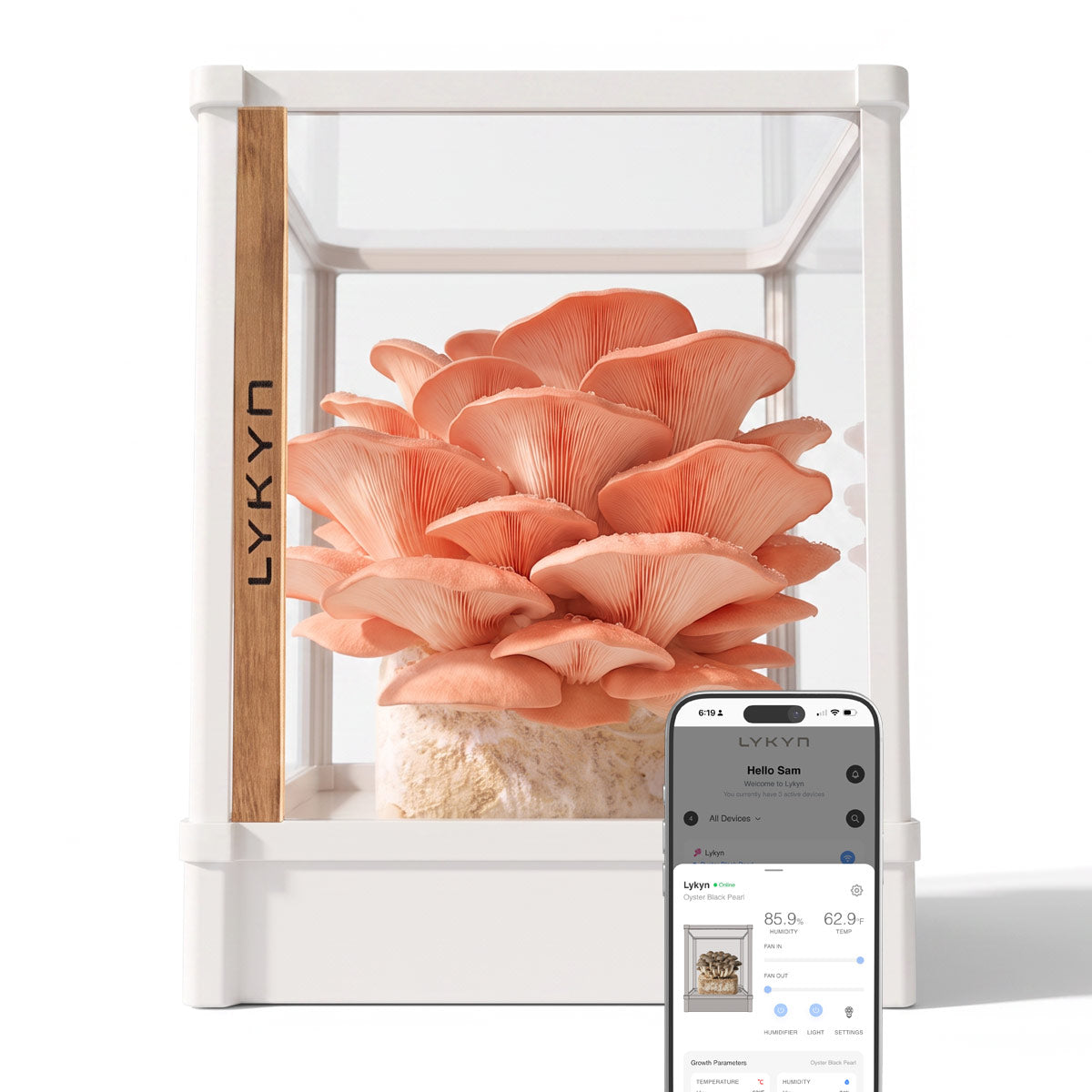
Smart Chamber. Bone White Single
- 2.8L tank, 90% humidity automatic
- App-controlled, plug-and-play
- 6 lb block ceiling, in stock

Smart Chamber. Obsidian Black Single
- Same hardware as Bone White
- Matte black premium finish
- Pairs with any kitchen palette

Author note. This guide draws on Lykyn Growing Team observations across 500+ growers (2024 to 2026), peer-reviewed mycology references, and US-published cultivation literature.
When to Harvest Oyster Mushrooms (The 12-Hour Window You Can't Miss)
When to Harvest Oyster Mushrooms
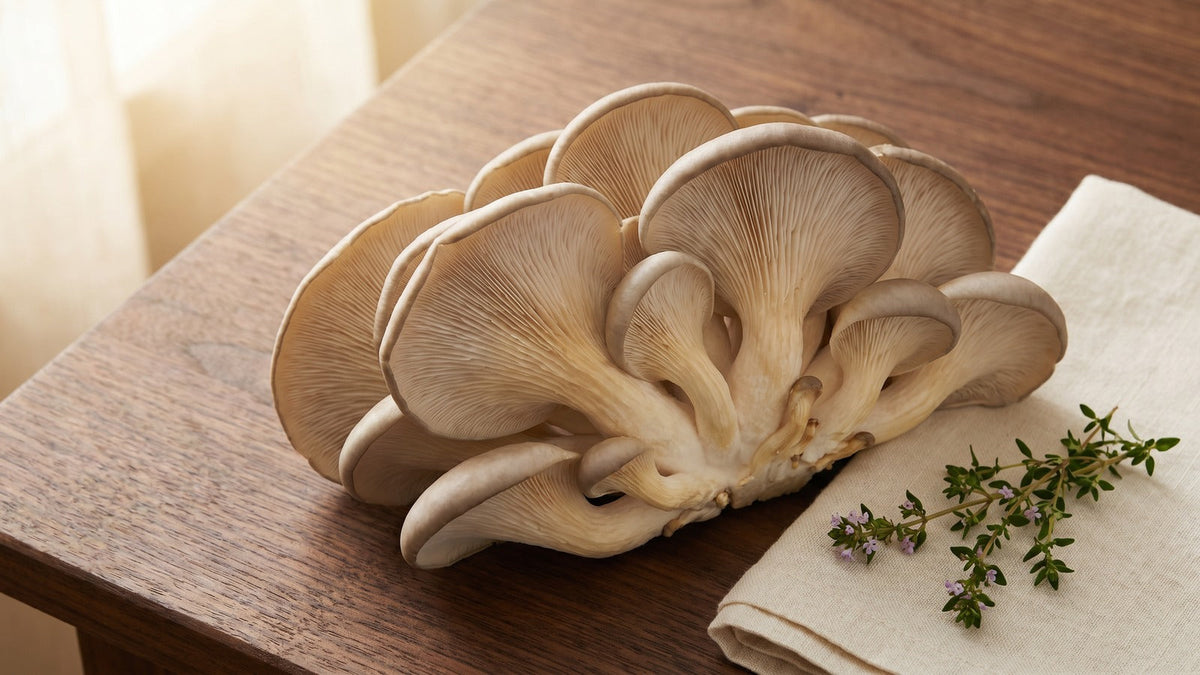
Quick answer: Harvest oyster mushrooms when the cap edges have just started to curl upward but before they flatten completely. This is the "champagne flute" window. Caps are still slightly cupped, the gills underneath are crisp and clean, and the cluster has not released its spores. You have roughly 12 hours inside this window, so most growers harvest in the morning of the day the curl begins. Catching this moment protects yield, flavor, shelf life, and a clean chamber for your second flush.
Wait until the caps go flat and the chamber fogs with fine white dust and you have hit spore drop. The mushrooms are still edible, but texture turns rubbery, the cluster sheds weight as it releases millions of spores, and the chamber needs a deep wipe before the next flush.
The Cap-Curl Signal: What You're Actually Watching For
Oyster mushrooms (Pleurotus species: pearl, blue, gold, pink, king) go through five visible stages once primordia set. The harvest signal lives in stage 3.
- Pinning. Tiny dark heads break through the substrate around day 7 to 10. Pinhead-sized, no shape yet.
- Cluster forming. Pins thicken into stubby convex caps, curled tightly under the gills.
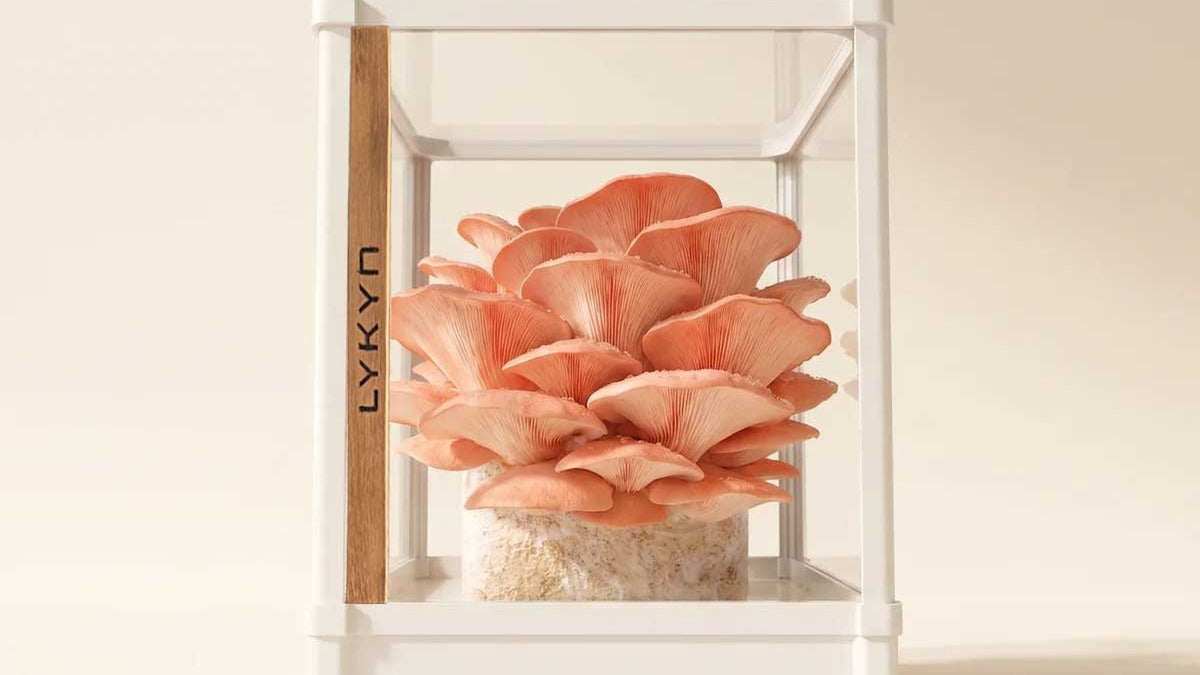
- Cap curl onset (the harvest window). Caps reach 2 to 4 inches across. The outer rim has just lifted away from the gills. From the side, each cap looks like a shallow saucer or a half-open champagne flute. Gills are visible but tucked. This is when you pick.
- Flat caps. Rim lifted fully. Caps flat or slightly upturned. Still edible but peak passed.
- Spore drop. Caps wavy and pulled back. Faint white or lavender dust on substrate, chamber walls, and the cluster. Texture rubbery, flavor muted.
A useful trick from extension cultivation research: track the cap as a clock face. Rim at "10 and 2" relative to the stem equals peak harvest. "9 and 3" or beyond is late.
The other tell is gill exposure from the side. Crouch to eye level. A hint of gill structure underneath is sweet spot. A full open fan means spore drop is hours away.
What slows or speeds the window
- Cooler temperatures (60 to 65 degrees Fahrenheit) stretch the window to 16 to 24 hours.
- Warm rooms (above 75 degrees Fahrenheit) compress it to 8 hours, especially for pink oyster.
- Low humidity makes caps crack and curl prematurely without real maturity. Look at gills, not just rim shape.
- High CO2 produces long stems and small caps. Improve fresh air exchange next round.
Why the 12-Hour Window Matters (Spore Drop Explained)
Oyster mushrooms reproduce by releasing spores from the gills on the underside of each cap. A single mature pearl oyster cluster can release roughly 30 billion spores in 24 hours. That trivia has three practical consequences.
1. Lost yield. Every spore is biomass leaving the cluster. Full spore drop can cost 10 to 15 percent of harvest weight. A 1.25-pound cluster picked late drops to roughly 1.06 pounds.
2. Texture and flavor decline. Pre-spore caps are dense, springy, slightly sweet. Post-spore caps are softer, more fibrous, faintly bitter. In a hot pan, pre-spore caps brown evenly and hold shape. Post-spore caps weep liquid and steam.
3. Chamber contamination and respiratory issues. Heavy spore loads coat the chamber, fan blades, and humidity sensor. Penn State Extension documents that prolonged oyster spore inhalation can trigger a flu-like reaction (farmer's lung) in sensitive individuals, which is why commercial farms run aggressive ventilation. At home, the fix is simple: harvest before spore drop and you skip the cleanup.
Lykyn tip: Set a 24-hour reminder on your phone the moment you see your first curling cap. Check the chamber morning and evening once stage 3 starts and you will never miss the window.
How to Pluck a Cluster Cleanly
Oyster mushrooms grow as a cluster from a single point on the substrate. You harvest the entire cluster as one piece. Pulling individual caps damages the stem base, invites bacterial rot, and ruins your second flush.
Step 1. Clean hands and clean tools. Wash with soap and water. If using a knife, wipe the blade with isopropyl alcohol. You are about to expose fresh tissue on the substrate.
Step 2. Grip the cluster at the base. Find the point where all the stems converge into a single mass at the substrate. Wrap your hand around the cluster so your fingers are at this base, not on the caps. Caps bruise. Stems are sturdy.
Step 3. Twist, do not cut. Rotate the cluster a quarter turn clockwise while pulling gently outward. The whole cluster releases with a clean break. A twist separates along the natural mycelium boundary and heals quickly. A knife cut leaves a wet, ragged surface that holds moisture and invites contamination. King oyster is the exception (its dense single stem takes a clean slice better than a twist).
Step 4. Trim the stem base. Slice off the bottom quarter inch with a clean knife. The trimmed butt is tough, slightly bitter, often has substrate bits attached. Compost it.
Step 5. Place the cluster gills-down on a clean surface. Gills are still actively dropping spores even after you pull the cluster. Setting it gills-down on a paper towel catches any final release, keeps your counter clean, and lets you move straight to storage.
Total time from chamber to counter: under 60 seconds.
Four Timing Windows Compared
Tape this to the inside of your chamber door if you tend to second-guess.
| Window | Cap appearance | Yield impact | Spore drop | Cooking quality |
|---|---|---|---|---|
| Too early (stage 2) | Caps still convex, curled tightly under. No rim lift. | 25 to 35 percent below max. | None. | Bland. Mushrooms are mostly water. |
| Sweet spot (stage 3) | Rim just curled up. Caps slightly cupped. Gills tucked but visible from the side. | Peak. Roughly 1 to 1.5 pounds from a 5 to 6 pound block. | None or trace. | Best. Dense, springy, sweet. Browns evenly. |
| Late (stage 4) | Caps flat or wavy. Rim fully lifted or curled back. | 5 to 10 percent below peak. | Trace to light. | Acceptable. Softer texture. Good for soups, stocks, mushroom pate. |
| Way late (stage 5) | Caps fully wavy. Visible white or lavender powder on substrate. | 10 to 15 percent below peak. | Heavy. Dust everywhere. | Poor. Rubbery, fibrous, faintly bitter. Best for stock or compost. |
If you are unsure which window you are in, look at the gills underneath. Tucked and tight equals sweet spot. Fully exposed equals late. Dusty equals way late.
Triggering a Second Flush After Harvest
A healthy oyster block gives you 2 to 4 flushes before the mycelium exhausts the substrate. Each is smaller than the last (expect 60 to 70 percent of the first flush's weight on flush two). Four conditions set within 24 hours of harvest trigger the next round.
- Cold shock. Place the block in a cool spot (50 to 55 degrees Fahrenheit) for 12 to 24 hours. This mimics the seasonal drop that triggers a new fruiting cycle. A refrigerator crisper drawer works.
- Soak. Submerge the block in cold water (50 to 55 degrees Fahrenheit) for 4 to 8 hours. Weigh down with a clean plate so it stays submerged.
- Drain and return to chamber. Drain thoroughly (standing water invites bacterial rot). Humidity high (90 to 95 percent), fresh air exchange on, temperature back to 65 to 72 degrees Fahrenheit.
- Wait. Pins appear within 5 to 10 days. Do not poke, mist directly, or open the chamber repeatedly.
If pins do not appear within 14 days, the block may be exhausted. Thinning mycelium, dark patches, or a sour smell are the signs. Compost and start fresh.
Fuel Your Mushroom Journey
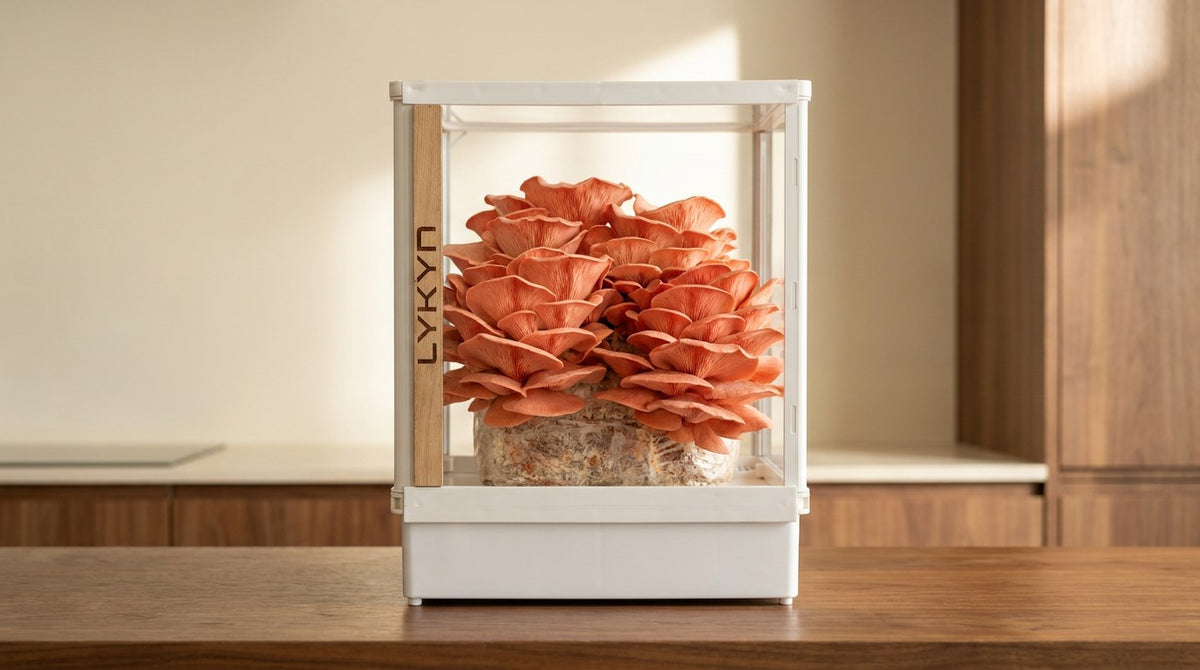
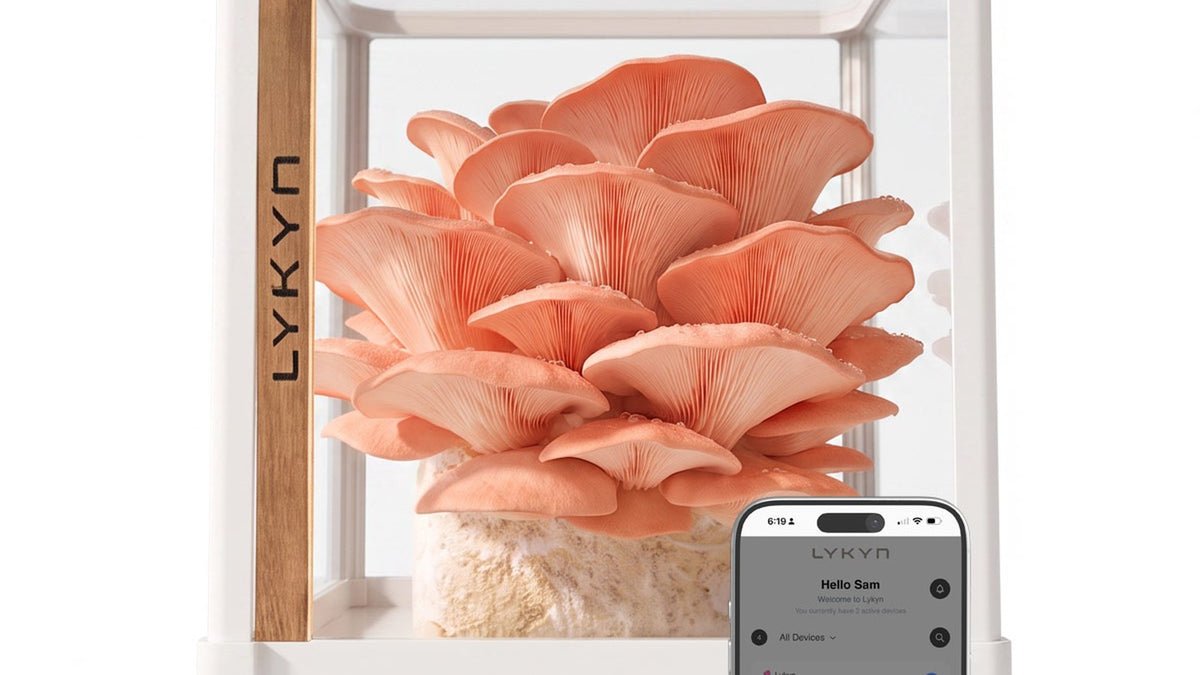
Pink Oyster Grow Kit
Hardwood sawdust block colonized with Pink Oyster mycelium. Drops straight into your Lykyn chamber and starts pinning within days.
Add to cart $29.95Frequently Asked Questions
What time of day should I harvest oyster mushrooms?
Morning. Caps are cooler and firmer first thing, gills are still tucked from overnight temperatures, and you have the full day to clean, cook, or store the cluster before warm afternoon air accelerates spore drop.
Should I cut or twist oyster mushrooms?
Twist for pearl, blue, gold, pink, and chestnut oyster. The cluster releases cleanly with a quarter-turn-and-pull motion and the natural break heals fast so the block can push a second flush. Cut only for king oyster (Pleurotus eryngii), where the dense single stem takes a clean slice better than a twist. Always use a clean knife wiped with isopropyl alcohol.
What if I harvest one day late?
You are probably looking at flat caps with light spore drop. Still edible and fine in soups, stocks, sauces, or pate. Skip raw applications and high-heat saute, where softer texture shows up most. Wipe the chamber walls with a damp paper towel before triggering the second flush.
Do oyster mushrooms grow back after harvest?
Yes. A healthy oyster block produces 2 to 4 flushes total, each roughly 60 to 70 percent of the previous flush's weight. Cold shock for 12 to 24 hours, soak in cold water for 4 to 8 hours, drain, return to the chamber. Pins appear 5 to 10 days later.
How big should oyster mushrooms get before harvest?
Most oyster species harvest around 2 to 4 inches across at the widest cap. King oyster goes larger (4 to 6 inches). Pink oyster harvests smaller (1.5 to 3 inches). Cap size alone is not the signal. Cap-curl onset is. A 2-inch pearl oyster with a curled rim is ripe. A 4-inch pearl oyster with a still-tucked rim is not.
After Harvest: Storage and Cooking
Fresh oyster mushrooms keep for 5 to 7 days in the fridge when stored correctly: paper bag in the crisper drawer, no plastic, no rinsing until you cook them. Full step-by-step lives in our storing oyster mushrooms guide.
For cooking, dry saute in a wide cast iron pan over medium-high heat for 3 minutes (no oil), let them release water and dry off, then add butter or oil and finish 3 to 4 minutes until edges go golden. Deep umami flavor, crisp edges, no sog.
Still figuring out earlier stages? The mushroom pinning guide walks through chamber conditions for the first week.
Ready for your next cluster? The Pearl Oyster Grow Block is the easiest first species to learn the cap-curl signal on, and the Lykyn smart fruiting chamber handles temperature, humidity, and fresh air exchange so you can focus on watching the cluster, not the dials.
Catch the curl. Twist the cluster. Cook it that night. That is the whole game.
Share:
How Much Lion's Mane Is Too Much? Daily Dose Reality Check
How to Make the Best Golden Mushroom Soup at Home