



What is a golden oyster mushroom

Tamogitake in Japan. Yellow oyster on a US supplier's spawn list. Pleurotus citrinopileatus on the Latin label. The Latin translates as lemon-capped.
The mushroom grows in tight clustered bouquets of a dozen or more caps sharing a single base. Caps start as pinhead pins the colour of scrambled egg, flatten into funnels, and finish as flat parasols two to four inches across. Colour ranges from deep marigold on cool mornings to pale primrose after a hot afternoon. Gills run down the stem in the classic oyster pattern, and the flesh is thin, papery when young, meatier at full size.
Golden oyster is a saprotroph, meaning it feeds on dead wood. In cultivation it thrives on hardwood sawdust supplemented with soy hulls or wheat bran, the same substrate mix used for pearl and blue oyster. Nutritional research indexed on the National Institutes of Health PubMed Central archive flags it as a strong source of ergothioneine, the antioxidant amino acid mushrooms make and animals cannot.
What makes this species different

Pearl oyster hates summer. Golden oyster loves it. That is the shortest version. Four differences worth knowing:
- Warm range. Where pearl oyster fruits at 55 to 65 F and blue oyster peaks at 55 to 70 F, golden oyster prefers 70 to 85 F. It is the summer mushroom of the oyster family. A kitchen counter in July is closer to its native climate than a basement in October.
- Speed. First pinheads appear 3 to 5 days after cutting the fruiting slit. Full harvest lands at day 10 to 14. Pearl and blue oyster take 14 to 21 days.
- Colour cost. The yellow is metabolically expensive. Every degree above 85 F, every hour of extra CO2, every missed misting dulls it toward cream. Growers who prize the colour keep temperatures near 78 F and give the block indirect daylight.
- Flavour after heat. Raw, golden oyster is thin and slightly bitter. Pan roasted in a dry cast-iron skillet for six minutes, the edges caramelise and the flesh tastes of cashew butter, browned onion, and a whisper of anise. It is the oyster you cook harder than you think.
None of this is difficult. The species is one of the most forgiving in home cultivation, which is why Cornell's Small Farms Program lists it in its beginner recommendation set alongside pearl oyster.
What you need

The kit is short. One 5 lb golden oyster fruiting block from a US supplier such as North Spore, Smugtown, or Mushroom Media Online. A grow environment that will hold 70 to 85 F and 85 to 95 percent humidity for two weeks. A clean serrated knife or scalpel. A spray bottle. An N95 mask for harvest day. A thermometer and hygrometer if your environment does not report them.
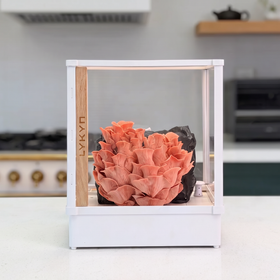
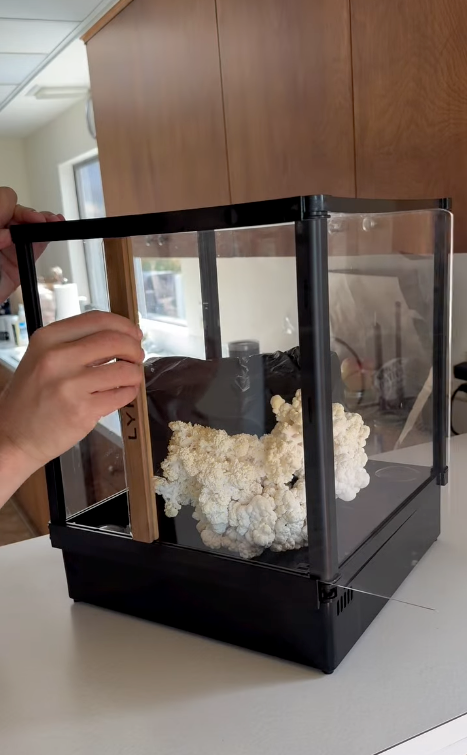
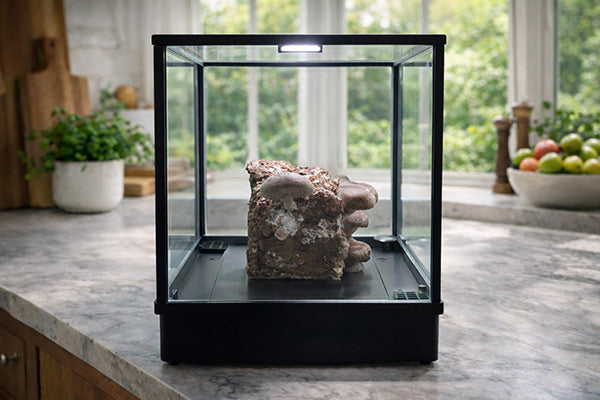
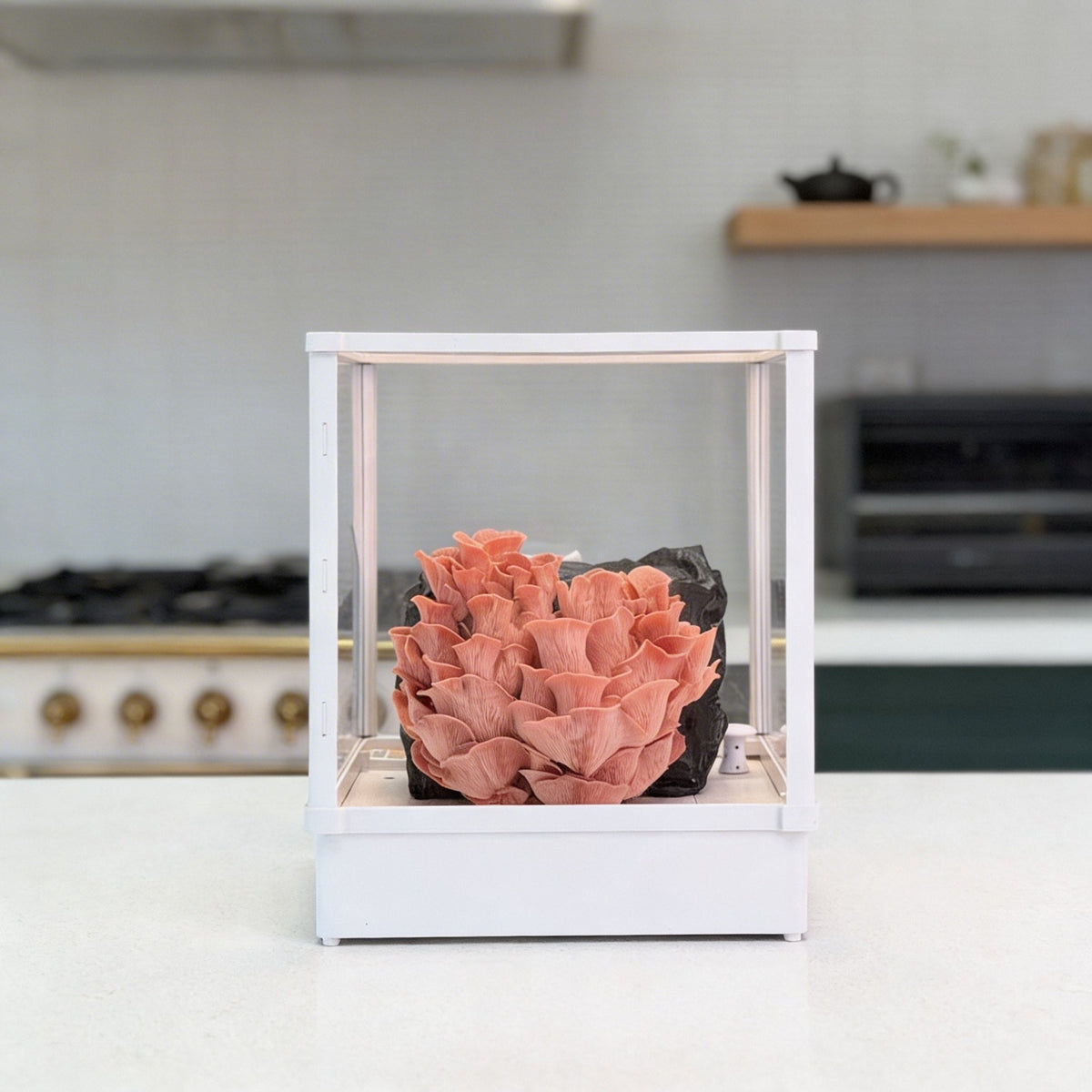
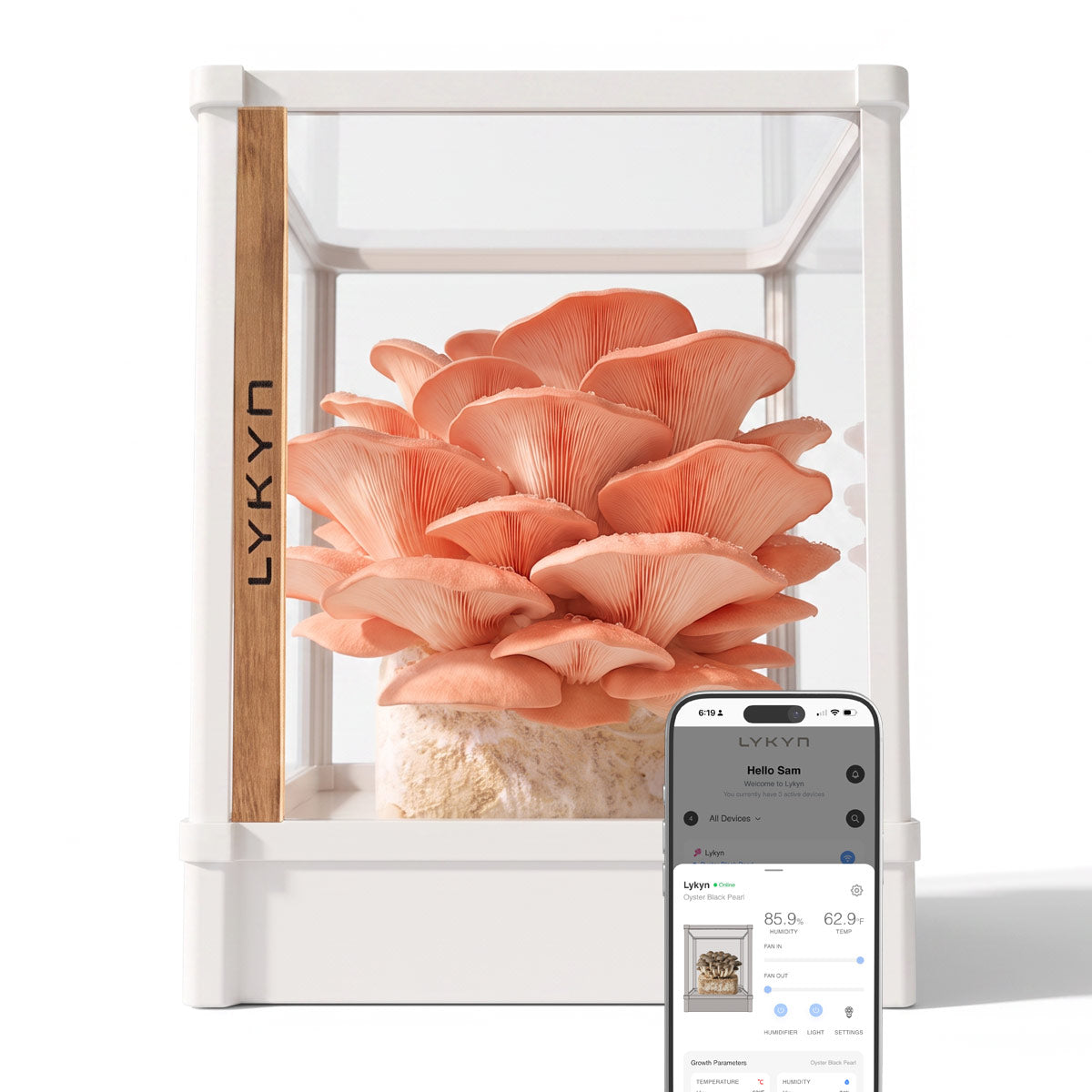
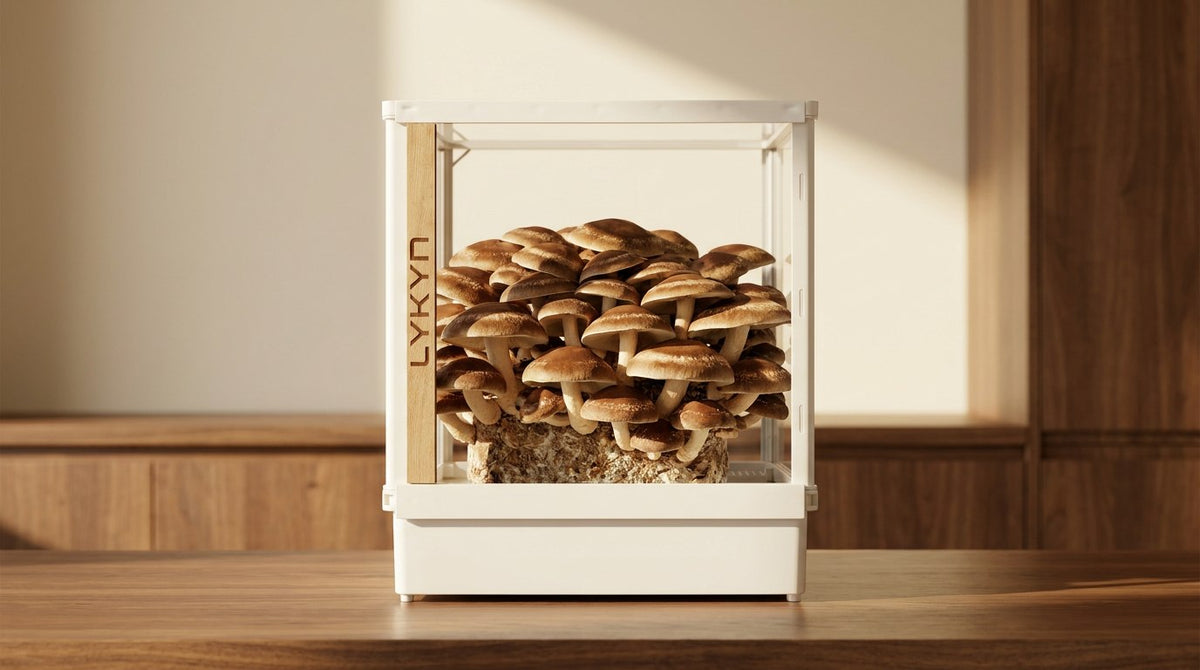
The Lykyn Smart Mushroom Grow Box covers the environment side. It is a kitchen counter appliance that holds temperature, humidity, and fresh air exchange on a species profile, and it works with any brand of fruiting block. First-flush success across the last twelve months of shipped units is 97.8 percent, verified against customer harvest reports. If you already own a still-air humidity tent and can rig a small fan on a timer, the same conditions are reachable manually with more attention.
The block matters more than the chamber. A fresh, fully colonised block that shows uniform white mycelium and no green, grey, or black patches will fruit even in a cardboard box tent. A tired block will disappoint the best chamber ever built.
Step 1. Choose a warm 70 to 85 F location 5 minutes
Golden oyster is the warmest oyster in the standard cultivation set. Pick a spot in your home where the ambient temperature stays between 70 and 85 F for the full two weeks of the grow. A kitchen counter away from a hot window works well. An unheated garage in winter or an air-conditioned bedroom below 68 F will stall the grow and pale the colour.
Measure with a real thermometer, not a guess. Room temperature in a US home varies more than most people expect, especially near exterior walls. A five-degree drop between day and night is fine and even helps colour set, but a drop below 65 F for more than an hour will visibly slow pinning.
Step 2. Order a golden oyster fruiting block 10 minutes online
Buy a 5 lb sawdust and soy hull fruiting block inoculated with Pleurotus citrinopileatus from a US supplier. The block should ship fully colonised, meaning the substrate looks uniformly white through the plastic. Reject any block showing green, grey, or black patches, wet spots, or a sour ammonia smell.
If you already grow other species and want to try golden oyster from grain spawn, order 250 g of golden oyster grain spawn and mix it into 2.5 kg of pasteurised straw or supplemented hardwood sawdust in a 0.5 micron filter patch bag. The species colonises fast, within 10 to 14 days at 70 F, and is forgiving with beginners.
Step 3. Inspect and rest the block 24 hours
Blocks arrive cold from most suppliers. Unpack yours, inspect all six faces under bright light, and let it sit on the counter at room temperature for 24 hours before cutting. A cold block cut open into a warm humid chamber can sweat inside the bag and invite bacterial rot before the mushrooms get moving.
During the rest period, look for a light yellow tint at the edges of the block. That is early primordia forming under the plastic and is a good sign. Small yellow pins pressing against the bag are also fine, though they will collapse and be replaced by the pins that come out through your fruiting slit.
Step 4. Cut the fruiting slit 5 minutes
With a clean serrated knife or a fresh scalpel blade, cut a single X-shaped slit on one face of the bag. Each arm of the X should measure about four inches. Do not cut multiple slits on multiple faces. Golden oyster fruits more reliably from a single site because it can concentrate its cluster into one bouquet instead of splitting energy between competing pin sites.
Wipe the knife with 70 percent isopropyl before you cut. This species has a strong mycelium and shrugs off minor contamination, but a clean cut still lowers the risk of a bacterial blotch on the pinning face.
Step 5. Set the fruiting environment 10 minutes to set, then 2 days to first pins
Move the block into your grow environment and set it to hold 75 to 82 F, 85 to 95 percent humidity, indirect natural light for 12 hours and fresh air exchange four to six times per hour. If you are running the Lykyn Smart Mushroom Grow Box, select the Golden Oyster profile in the iPhone app; the box will walk you through pinning windows and misting cues from here on.
If you are running a still-air humidity tent, mist the walls of the tent, not the block itself, six to eight times and flap the tent open for thirty seconds every four hours to exchange air. CO2 buildup is the single biggest cause of pale, long-stemmed golden oyster in home grows.
Step 6. Manage the pinning window 2 to 3 days
Between day 3 and day 5, watch for pinheads the colour of scrambled egg emerging from the slit. This is the most delicate 48 hours of the grow. Keep humidity above 85 percent, keep temperature in the 75 to 82 F band, and do not mist directly onto pins. Water pooling on baby caps invites bacterial rot and yellow-brown streaks.
Once the pins have visibly elongated into recognisable tiny caps, drop the humidity to 80 to 85 percent and increase fresh air exchange. This tells the mushroom to grow caps rather than long stems. Long stems and small caps are the signature of a grow left too humid with too little air.
Step 7. Harvest at edge curl 10 minutes
Harvest golden oyster the moment the cap edges just begin to curl upward from the flat parasol shape. That window is short, a single morning at day 10 to 14, and waiting one more day costs both flavour and cleanliness. Fully mature caps release yellow spore prints heavily, which will settle on your counters and, if you have respiratory sensitivity, in your lungs.
Yield varies with block, strain, and grow environment. Measure your own baseline on flush one and calibrate from there. Grip the base of the cluster with clean bare hands and twist the entire bouquet off in one motion. Cutting individual caps leaves stubs that rot back into the block and shorten the second flush. Weigh the cluster and log the number in your grow journal, then trim the very base with a knife before cooking.
Step 8. Trigger the second flush 10 minutes work, then 10 to 14 days waiting
Golden oyster gives a workable second flush but rarely a third. To trigger it, submerge the whole block in cool tap water for four hours, drain thoroughly, and return it to the chamber under the same conditions as the first flush. New pins appear five to seven days later, followed by harvest at day 10 to 14 of the second cycle.
Expect the second flush to deliver 50 to 65 percent of the weight of the first flush. When the second flush finishes, retire the block. Wild populations have spread from escaped commercial spawn, and Pleurotus citrinopileatus is now recognised as a naturalised, non-native species in several eastern states. Bag the spent block and dispose of it in household waste, or use it indoors as a soil amendment for houseplants.
Troubleshooting

The mushrooms are pale, almost white, instead of bright yellow. The most common cause is temperature above 85 F during pinning. The second cause is inadequate light. Move to a cooler spot, give the block 12 hours of indirect natural or 6500 K LED daylight, and the next flush will come in yellower.
Long, thin stems with tiny caps. Classic signature of low fresh air exchange and high CO2. Increase ventilation. If you are using a still-air humidity tent, flap the door open more often. If you are running a Lykyn box, check that the FAE fan is not blocked.
The block smells sour or the substrate looks slimy. Bacterial contamination. Pseudomonas tolaasii has moved in. Once slime is visible, the block will not recover. Retire it and start again. Cleaner cuts and a lower humidity in the first 24 hours after cutting the slit reduces the risk.
Green mould appearing at the edges of the fruiting slit. That is Trichoderma, the most common oyster contaminant. If you catch it in the first day as a small patch, spray it with 3 percent hydrogen peroxide and continue. If it spreads across a face, retire the block. Do not eat mushrooms fruited within six inches of visible green mould.
No pins after seven days. A temperature problem. Golden oyster sits and waits at temperatures below 68 F. Move the block somewhere warmer and give it another 72 hours before assuming the block has failed.
Yellow dust everywhere in the room after harvest. Golden oyster releases prolific yellow spores. Harvest a day earlier, wipe down counters, run a HEPA-rated room air purifier during and after harvest, and always mask up.
Cooking golden oyster

Golden oyster tastes of almost nothing raw. All of its flavour is created by heat and dry contact with a hot pan. Treat it the way you would treat a chanterelle, not the way you would treat a button.
Dry pan sear, six minutes. Heat a cast-iron skillet on high for two minutes without oil. Tear the cluster into single-cap pieces and drop them into the dry pan. Let them release their water, hiss, and start to brown at the edges. After four minutes, add one tablespoon of butter, a pinch of flaky salt, and a small clove of grated garlic. Cook two more minutes until the edges are deep gold. This is the technique that produces the cashew-butter note the species is known for.
Cream and pasta. Sear as above, then deglaze the pan with a splash of dry white wine, add 100 ml of double cream and a spoon of grated parmesan, reduce by half, and toss with pappardelle. Finish with lemon zest and coarse pepper.
Vegetarian broth garnish. Roast the caps at 400 F on a sheet pan with olive oil and thyme for twelve minutes, then float them on a bowl of clear miso or dashi. The yellow caps against a dark broth photograph like a painting and hold their texture for the full meal.
Do not eat golden oyster raw or under-cooked. All Pleurotus species contain chitin cell walls that pass through the human gut undigested and can cause mild bloating. Cooking breaks chitin down, which is why the same mushroom that is thin and bitter raw becomes rich and savoury in a hot pan.
Frequently asked questions
How long does golden oyster take from block to harvest?
Ten to fourteen days from the day you cut the fruiting slit, in the 75 to 82 F range. Cooler than 70 F pushes that past three weeks.
What temperature does golden oyster need?
Colonisation holds at 68 to 75 F. Fruiting runs warm at 70 to 85 F, with the sweet spot at 75 to 82 F. Below 65 F growth stalls and colour goes pale.
Why is my golden oyster pale instead of bright yellow?
The bright canary yellow comes from adequate light and cooler nights. Pale mushrooms mean either too little light, temperatures above 85 F, or CO2 buildup from poor air exchange.
Is golden oyster the same as yellow oyster?
Yes. Both are common names for Pleurotus citrinopileatus. Some suppliers also list it as tamogitake, its Japanese name.
Can I grow golden oyster from grain spawn instead of a block?
Yes. Mix 250 g of grain spawn into 2.5 kg of pasteurised straw or supplemented sawdust, colonise in a sealed bag for 10 to 14 days at 70 F, then fruit. The species colonises fast and is forgiving with beginners.
What does golden oyster taste like?
Cooked, it has a rich cashew-butter or roasted-nut flavour with a firm bite once caramelised. Raw or lightly steamed it is thin and bitter, so pan roast until the edges brown.
Can I grow golden oyster in the same chamber as another species?
Not at the same time. Heavy spore loads settle on and contaminate a slower colonising block such as lion's mane. Run one species per chamber and clean the chamber between grows.
How do I stop the spore print on my counter?
Harvest one day earlier, before caps flatten fully. Mature caps release yellow spores heavily. A slightly early harvest also protects flavour.
Do golden oysters cause allergies?
Prolonged inhalation of oyster spores can trigger respiratory sensitivity, a condition documented in commercial mushroom workers. Wear an N95 during harvest and ventilate the room afterwards.
Can I use the Lykyn Smart Mushroom Grow Box for golden oyster?
Yes. It holds 70 to 85 F, 85 to 95 percent humidity, and cycles fresh air on a schedule tuned per species. Golden oyster is one of 28 supported profiles on the Lykyn Smart Mushroom Grow Box and pairs with any brand of fruiting block.



Share:
How to Grow Blue Oyster Mushrooms at Home: Complete 2026 Guide
How to Grow Lion Mane Mushroom at Home: Complete 2026 Guide