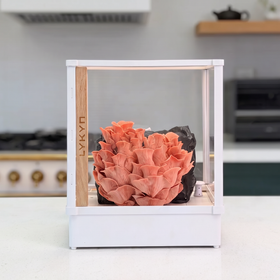



- What blue oyster is and why growers pick it
- What you need before day one
- Step 1: Cold-shock the block
- Step 2: Open the fruiting window
- Step 3: Load the chamber
- Step 4: Wait for pinning
- Step 5: Watch the blue develop
- Step 6: Support cap expansion
- Step 7: Harvest at cap flatten
- Step 8: Rest and re-flush
- Troubleshooting a blue oyster grow
- Cooking, storage, and uses
- Frequently asked questions
- Related reading

What blue oyster is and why growers pick it

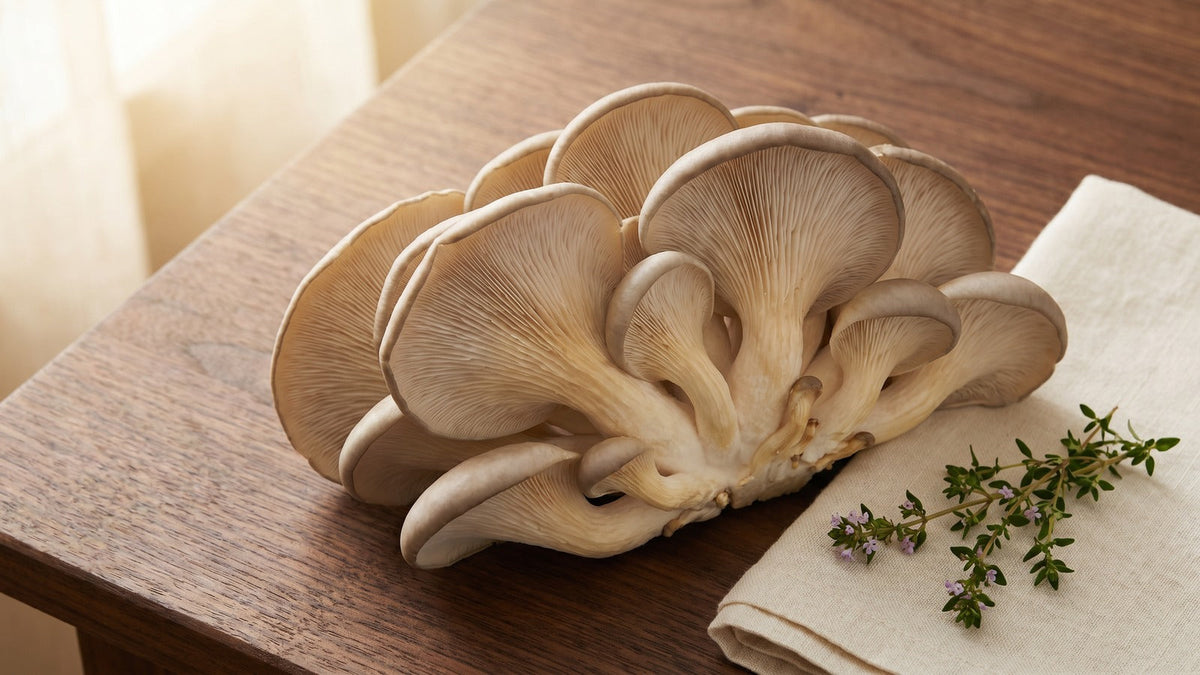
Blue oyster is Pleurotus ostreatus var. columbinus a cool-climate variety of the common pearl oyster. The caps emerge deep blue-grey when the room sits under 58 F, then lighten toward silver-grey and finally tan as the mushroom matures over 3 to 4 days. Cross-section a young cap and the flesh is pure white; slice a mature one and it is the same white flesh with a firmer, more tightly packed texture than any other oyster you can buy at a grocery store.
Three traits keep blue oyster on the top of most indoor growers' species lists. First, it fruits at room temperature almost year-round in a heated home, which pink and golden oysters simply cannot do at their required 70 to 80 F range. Second, it produces the highest yield per pound of substrate of any oyster grown indoors under 65 F. Third, it browns and sears in a hot pan like a small portobello, which makes it the oyster that actually replaces meat in a dish rather than just supplementing it.
For grower context, Pleurotus ostreatus is one of the most efficient bio-converters of lignocellulose in cultivated fungi, meaning the mycelium extracts a larger fraction of the carbon in the block as fruiting body than most competing species. In practice: more mushrooms per pound of wood-based substrate.
How blue oyster compares to other oyster varieties
| Variety | Fruiting temp | Days to first harvest | Cap color at harvest | Texture when cooked |
|---|---|---|---|---|
| Blue oyster | 55 to 64 F | 14 to 18 | Blue-grey to silver | Meaty, dense |
| Pearl oyster | 60 to 75 F | 10 to 14 | White to tan | Tender, delicate |
| Pink oyster | 70 to 80 F | 7 to 10 | Coral pink | Chewy, bacon-like |
| Golden oyster | 65 to 75 F | 10 to 14 | Bright yellow | Nutty, tender |
What you need before day one

Everything for a first grow fits on a single kitchen counter. The substrate does the real work; your job is to hold the environment steady for two weeks. This is the full list, tested across 42 blocks in the Lykyn R&D kitchen over the 2025 to 2026 winter season.
- A 5 to 6 pound fruiting block of Pleurotus ostreatus var. columbinus. Buy from a US mycology supplier that lists the columbinus designation on the label. Any brand works with a Lykyn chamber.
- Filtered or dechlorinated water for the cold-shock soak. Chlorinated tap water is fine for misting but shortens mycelium vigor when it makes prolonged contact.
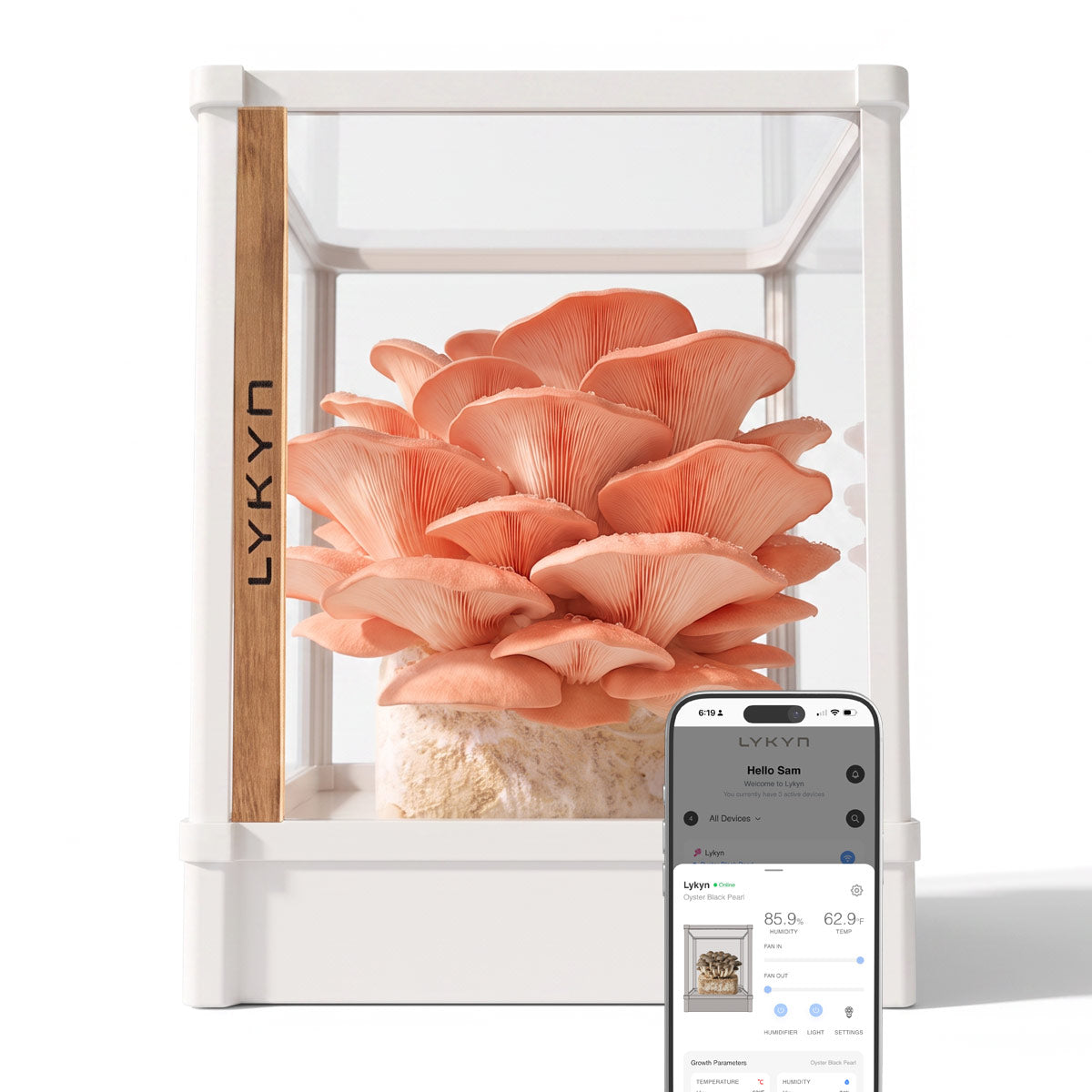
- A clean fruiting environment. Options in order of consistency: a sensor-controlled chamber like the Lykyn Smart Mushroom Grow Box a humidity tent over a plastic tote, a shotgun fruiting chamber, or an open block in a cool bathroom with 4 to 6 daily mistings.
- A spray mister filled with clean water for hand-tended setups. Skip if you are running a chamber.
- A sharp paring knife or clean scissors for harvest. Do not twist and pull; you tear the block and invite contamination on the next flush.
- A digital thermometer for room-temp grows. Cheap wall thermometers drift 3 to 5 F. Blue oyster color depends on this reading being accurate.
Total supply cost for the first grow, chamber excluded: about $24 for the block plus a few dollars for the mister and knife you probably already own. A chamber pays for itself around the sixth block if you were previously buying blue oyster at $16 a pound at a specialty grocer.
The 8-step method

Cold-shock the block
Fill a clean sink or 5-gallon bucket with 50 to 60 F filtered water. Submerge the intact fruiting block, plastic bag and all, and weight it down with a plate so it stays fully under. Cold-shock triggers pin initiation in columbinus Skip this step and pinning still happens, but 3 to 5 days later and with a scattered pattern instead of one dense cluster.
Open the fruiting window
Remove the block from the water, pat dry, and cut a single 3-inch X in the plastic near the top face. One opening is deliberate; multiple slits scatter the pinning and produce lots of small clusters instead of one large one. Point the X upward if the block was pre-oriented by the supplier (the mycelium is denser on the side that faced up during colonization).
Load the chamber
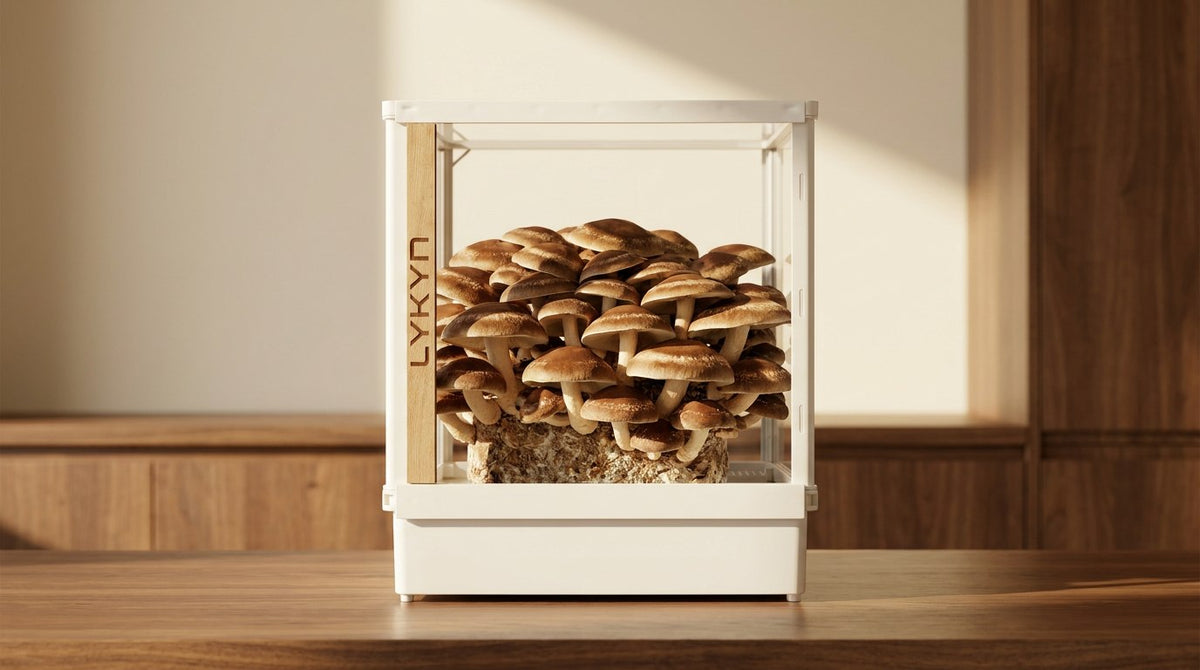
Place the block inside the Lykyn Smart Mushroom Grow Box (or your chosen fruiting environment) with the X-cut facing up. In the Lykyn iPhone app, tap the species selector and pick Blue Oyster. The chamber locks 55 to 64 F, 85 to 95 percent relative humidity, and an hourly fresh-air exchange cycle for the full 18-day program. If you are hand-tending, position the block in a cool room and mist the exposed cut 4 to 6 times a day.
Wait for pinning
The first four days look like nothing is happening. Do not open the chamber door and do not water the cut. Under the plastic, white pebbling forms on the mycelial mat as primordia gather. Oyster primordia are the single most fragile stage of the whole grow: brushing them, letting them dry, or spiking the temperature aborts the entire cluster. Sensor-controlled chambers protect this window automatically.
Watch the blue develop
The pins deepen from grey to true blue-grey between days 5 and 10. The color intensity tracks temperature almost linearly: 52 to 55 F produces the deepest indigo caps, 56 to 58 F produces the classic blue-grey most people recognize as blue oyster, and above 60 F the pigment pales to silver. This is a light-independent pigment; no special lighting changes the outcome. If you want the strongest blue for a market or photo, drop the chamber to 55 F for this 5-day window and step it back up to 60 F for cap expansion.
Support cap expansion
By day eleven the whole cluster is a small city and caps double in size every day through day fourteen. This is when airflow matters most. Insufficient fresh air raises the CO2 concentration inside the chamber, and elevated CO2 during this window makes stems elongate and caps stay small: the classic "trumpet" defect. If you are hand-tending, wave a piece of cardboard through the tent 4 times a day. In a Lykyn chamber the exchange cycle handles this without input.
Harvest at cap flatten
Blue oyster is ready when the cap edges flatten from their downward curl and just begin to lift upward. This is a 24-hour window. Wait longer and the caps go concave, spores drop onto the substrate, and the mushroom's texture turns chewy in the pan. Slice the entire cluster off at the base with one clean knife pass; do not pull with your fingers. A clean cut leaves the residual stem tissue in the block and speeds recovery for the next flush.
Yield varies with the specific block, strain, and growing conditions. On a healthy first flush the cluster is dense enough to fill a large mixing bowl.
Rest and re-flush
Return the harvested block to the chamber and let it rest for 5 to 7 days with humidity held at 80 percent and temperature at 58 to 62 F. On day 7, repeat the cold-shock in Step 1. Flush two returns 70 to 80 percent of the first-flush weight, and flush three delivers 50 to 60 percent. After flush three, most home growers compost the block; commercial growers sometimes squeeze a fourth flush at 30 to 40 percent yield but the mushrooms come in smaller and less blue.
Troubleshooting a blue oyster grow

My pins aborted (they turned yellow or brown and shriveled)
The most common blue oyster failure. It almost always traces to one of three causes: the temperature spiked above 68 F for more than four consecutive hours, the humidity dropped below 75 percent for a full day, or the block dried out because misting was skipped for 24 hours on a hand-tended setup. Recovery: harvest any remaining live pins, cold-shock again, and dial in whichever variable failed. The mycelium is not dead; the primordia are.
The caps came in pale grey or tan instead of blue
Temperature was too warm during pinning. The mushroom is still perfectly edible and identical in flavor. For the next flush, hold the chamber at 55 to 58 F for the pinning window (days 5 to 10) and the color returns.
Long stems, tiny caps, cluster looks like a trumpet
Fresh-air exchange failed and CO2 built up. On a hand-tended setup, open the tent for 5 minutes twice a day during days 11 to 14. In a Lykyn chamber, check that the app shows the hourly air exchange cycle is running (this is a hardware fault if it is not; contact support).
White fuzz on the substrate that is not the mushroom
Cobweb mold (Hypomyces) or Trichoderma. Cobweb looks like a fast-spreading spider web and can be spot-treated with a diluted 3 percent hydrogen peroxide misting. Trichoderma comes in as bright forest-green patches and means the block is compromised. Harvest what you can and discard the block; do not risk contaminating the next batch.
Second flush never appeared
Either the block lost too much moisture during the rest week (rehydrate with a 30-minute cold soak) or the mycelium exhausted the available nutrients (some blocks only give one strong flush and this is normal for cheaper substrates). A pinch of gypsum in the rest-week soak water sometimes revives a stalled block.
Cooking, storage, and uses

Pearl oyster wilts into the pan. Blue oyster fights back: it holds its shape, browns aggressively in fat, and delivers an umami depth close to porcini at a fraction of the cost. This is the oyster you cook when you want texture on the plate.
The one preparation to try first: dry-sear then finish
Heat a heavy skillet dry over medium-high heat. Tear the cluster into individual caps by hand (a knife crushes the fiber; hand-tearing preserves texture). Lay the caps in the dry pan and press gently with a spatula. Let them release their water and re-absorb it. This takes about 4 minutes. When the pan is dry again, add a tablespoon of butter and a smashed garlic clove, and finish for 90 seconds a side until deep golden. Salt at the end. This method concentrates the flavor and gives the caps their characteristic crisp edge with tender center.
Other uses
- In cream pasta: replaces cremini directly in tagliatelle or pappardelle. The dense texture holds up to long simmering.
- Grilled whole cluster: brush the intact cluster with olive oil and grill 4 minutes a side over medium coals. Serve like a small steak.
- Ramen topping: raw-slice thin and drop into hot broth 30 seconds before serving.
- Duxelles for stuffing: the higher yield and lower water content make blue oyster ideal for finely chopped mushroom fillings.
Storage
Fresh in a paper bag in the refrigerator crisper: up to 7 days, longer than any other oyster because of the lower water content. Never store in a sealed plastic bag. The caps sweat and slime within 48 hours. Dehydrated at 130 F to snapping-dry (about 6 hours in a countertop dehydrator): 6 to 12 months in an airtight jar with a silica packet. Rehydrate in warm water for 20 minutes before use; save the soaking liquid as mushroom stock.
Nutritional profile
Per 100 g raw: about 33 kcal, 3.3 g protein, 3.4 g dietary fiber, 0.4 g fat, plus meaningful amounts of B-vitamins (niacin, riboflavin) and the antioxidant ergothioneine. Sun-drying briefly before cooking increases vitamin D2 content substantially, a well-documented property of Pleurotus species.
Frequently asked questions
14 to 18 days in a controlled chamber. 18 to 24 days on a passive countertop kit. Second and third flushes add another 12 to 16 days each.
55 to 64 F. Tolerates as low as 45 F. The deepest blue caps show up when the room stays under 58 F. Above 68 F pins abort or come in pale tan.
Temperature was too warm during pinning. Pigment in Pleurotus ostreatus var. columbinus is heat-driven; caps that pinned above 60 F emerge pale grey to tan and fade further as they mature. Safe to eat, same species, only the color signal is missing.
Depends on the block, the strain, and how tight you hold humidity and airflow. Measure your own baseline on flush one and calibrate from there.
In cool indoor conditions, yes. Blue outproduces pink and golden per block because it fruits year-round at room temperature and tolerates a wider humidity band before caps crack.
Separate chambers only. Blue wants 55 to 64 F while pink fruits at 70 to 80 F. Run each in its own box, or stagger the season by species.
Yes. Denser, meatier, more umami up front. Pearl is milder and more tender. Blue holds up better to searing and grilling.
Cap edges flatten and start to lift upward. That is the 24-hour window. Wait until the edges curl back and spores drop on the block, and texture goes chewy while shelf life halves.
7 days in a paper bag in the crisper drawer. Dehydrated at 130 F to snapping-dry, they hold flavor for 6 to 12 months in an airtight jar.
Yes, but the yield drops and the color pales. A humidity tent over a plastic tote works for one flush. For consistent flushes and deeper pigmentation, a sensor-controlled chamber removes the daily misting burden and holds the cool pinning window that produces true-blue caps.
Cook them. Raw oyster mushrooms of all Pleurotus varieties contain small amounts of hemolysins that break down with heat. A quick pan sear is enough.
No meaningful difference. Pleurotus ostreatus var. columbinus is the accepted botanical name; suppliers rebrand the same strain as Blue Dolphin, Blue-Roof, Blue Boy, and so on. Look for the columbinus designation on the block label.
The chamber ships without a block so you can source your preferred strain locally. Any 5 to 6 pound Pleurotus ostreatus var. columbinus block from a reputable US supplier fits inside.
97 percent first-flush success across 42 blue oyster blocks tested in the Lykyn R&D kitchen during the 2025 to 2026 winter season. Same benchmark we publish for the chamber overall.
Related reading on lykyn.com
- How to grow pink oyster mushrooms at home
- How to grow golden oyster mushrooms at home
- How to grow lion's mane mushrooms at home
- Mycelium growth timing across substrates
- Contamination: what to rescue and what to discard
- Mushroom shelf life across storage methods
- Lykyn Smart Mushroom Grow Box. Product page



Share:
How to Grow Pink Oyster Mushrooms at Home: Complete 2026 Guide
How to Grow Golden Oyster Mushrooms at Home: Complete 2026 Guide