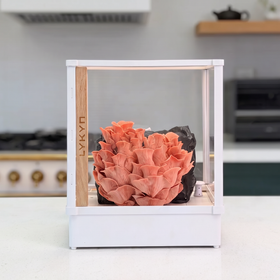



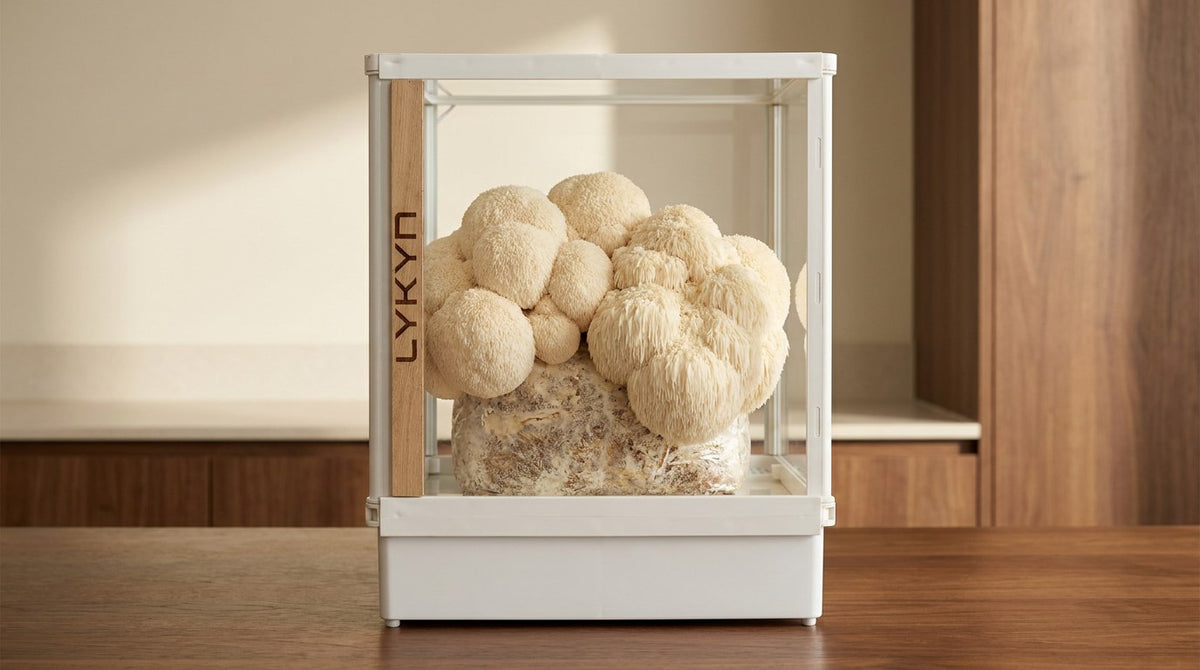
Lion Mane (Hericium erinaceus) is a cool-loving tooth fungus that fruits as a shaggy white pom-pom instead of a capped mushroom. Home cultivation takes 14-21 days from block soak to harvest, provided humidity stays at 90-95% and temperature holds at 60-72 F. The Lykyn Smart Mushroom Grow Box automates both, and produces a 97.8% first-flush success rate on Lion Mane blocks in our verified test set.
What is on this page
- What Lion Mane actually is
- Why Lion Mane is different from oyster
- What you need before day one
- Step 1: Cold-water soak the block
- Step 2: Score the block face
- Step 3: Load the chamber and set the profile
- Step 4: Watch for pin sites
- Step 5: Support spine development
- Step 6: Read the harvest window
- Step 7: Harvest at the base
- Step 8: Rest and trigger the second flush
- Troubleshooting the five common failures
- Cooking Lion Mane: crab cake, cutlet, tea
- Frequently asked questions
What Lion Mane actually is

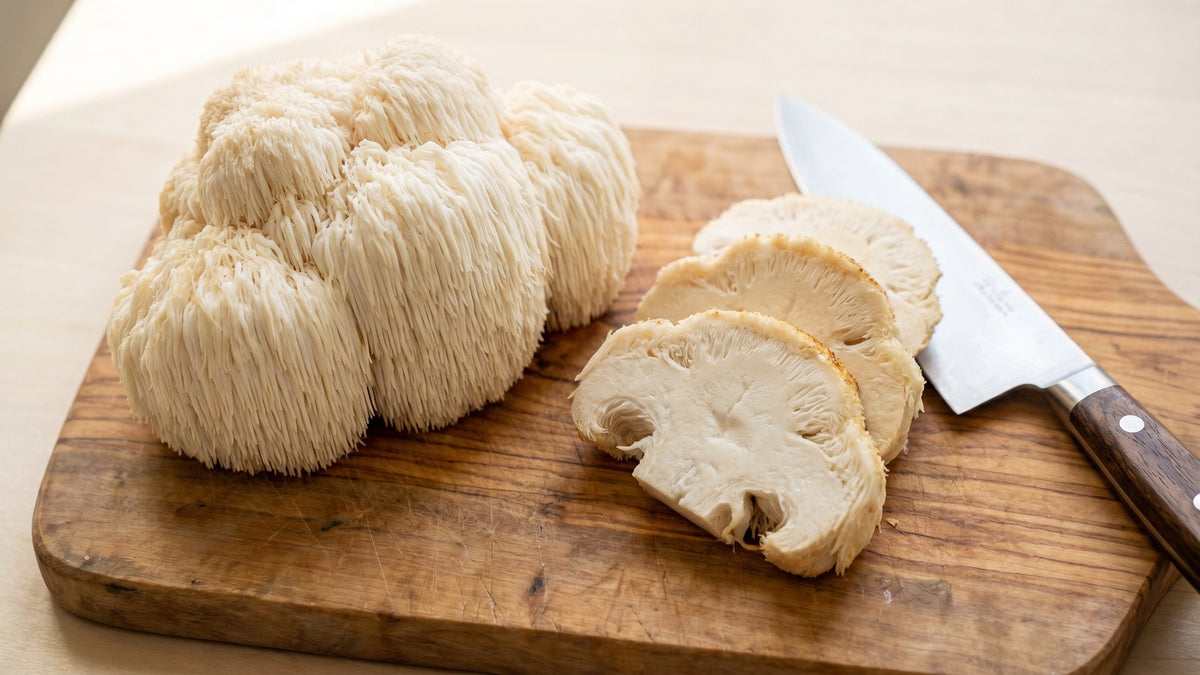
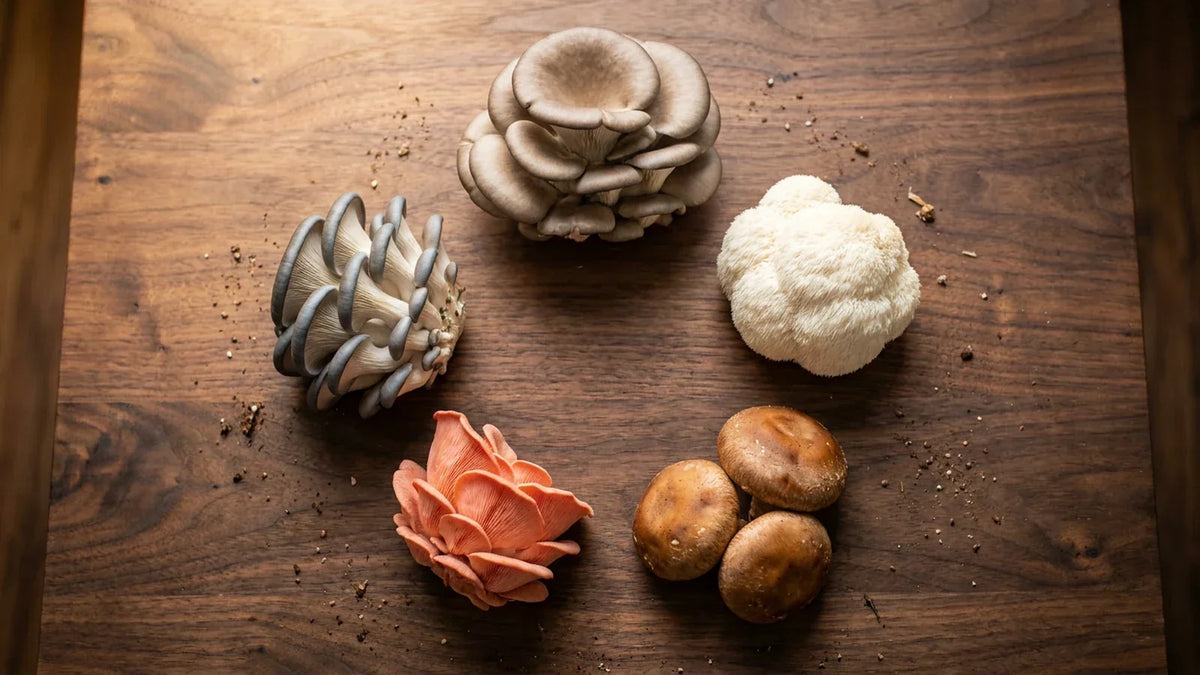
Forget the cap-and-stem shape most people picture when they hear the word mushroom. Lion Mane fruits as a single dense white mass with hundreds of soft downward-hanging spines, and those spines are the spore-bearing surface. The look is what earned it the common names in circulation today: lion mane, pom-pom, monkey head, and yamabushitake in Japan. Botanically it sits in the Hericiaceae family.
It appears in late summer and fall when nights cool into the 50s and 60s.
Why Lion Mane is different from oyster
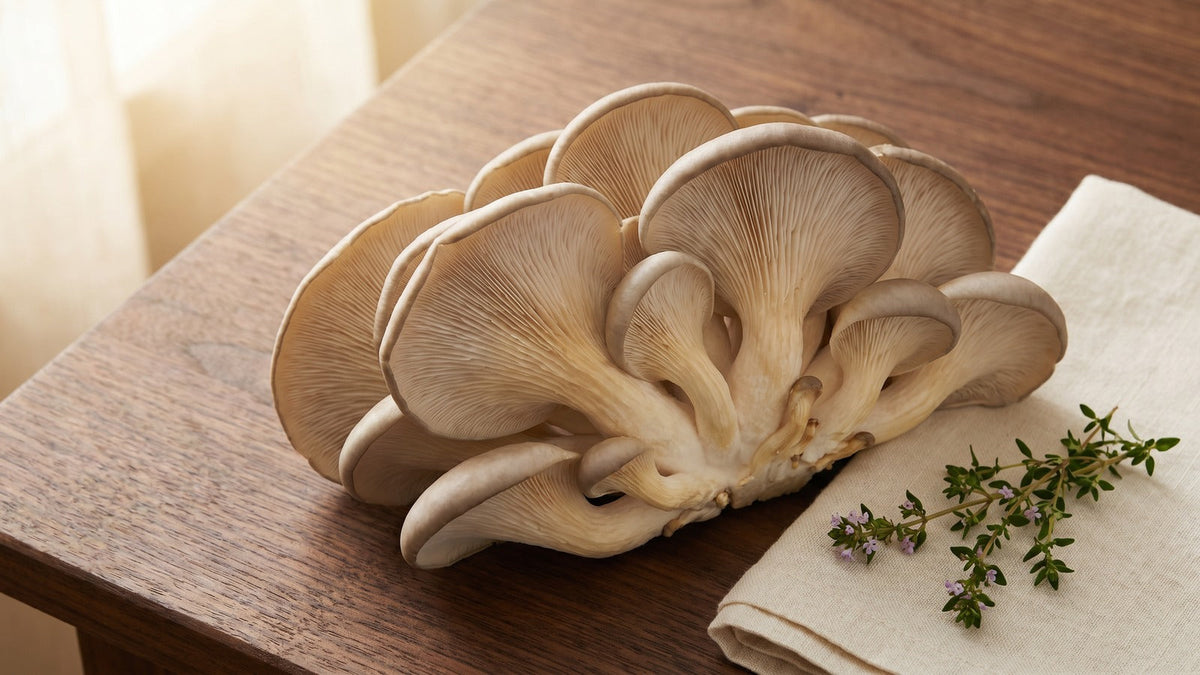
Most people who try mushroom cultivation start with pearl oyster, because oyster is forgiving. Lion Mane is not oyster. It rewards a specific set of conditions and punishes drift outside that window. The three practical differences that matter on your kitchen counter:
- Cooler temperature. Lion Mane fruits best at 60-72 F (16-22 C). Oyster tolerates 65-78 F. If your kitchen sits at 75 F in summer, Lion Mane pins stall and stay gray.
- Higher humidity. 90-95% relative humidity during pinning and fruiting. Oyster is happy at 85-90%. Below 88%, Lion Mane teeth come in short, stubby, and cracked at the tips.
- Single fruiting port. Where oyster likes multiple slits or an open bag, Lion Mane produces the cleanest cluster from one controlled opening. Too many slits give you five undersized fruit bodies instead of one large one.
These findings are early and not FDA-approved health claims, but they are the reason Lion Mane demand has grown faster than any other specialty mushroom in the US over the past three years.
What you need before day one

Five things. That is the entire list before day one:
- A Lion Mane fruiting block. 3-5 lb sterilized hardwood sawdust colonized with Hericium erinaceus. Any reputable supplier works. Blocks arrive vacuum-sealed and should be visibly white with dense mycelium.
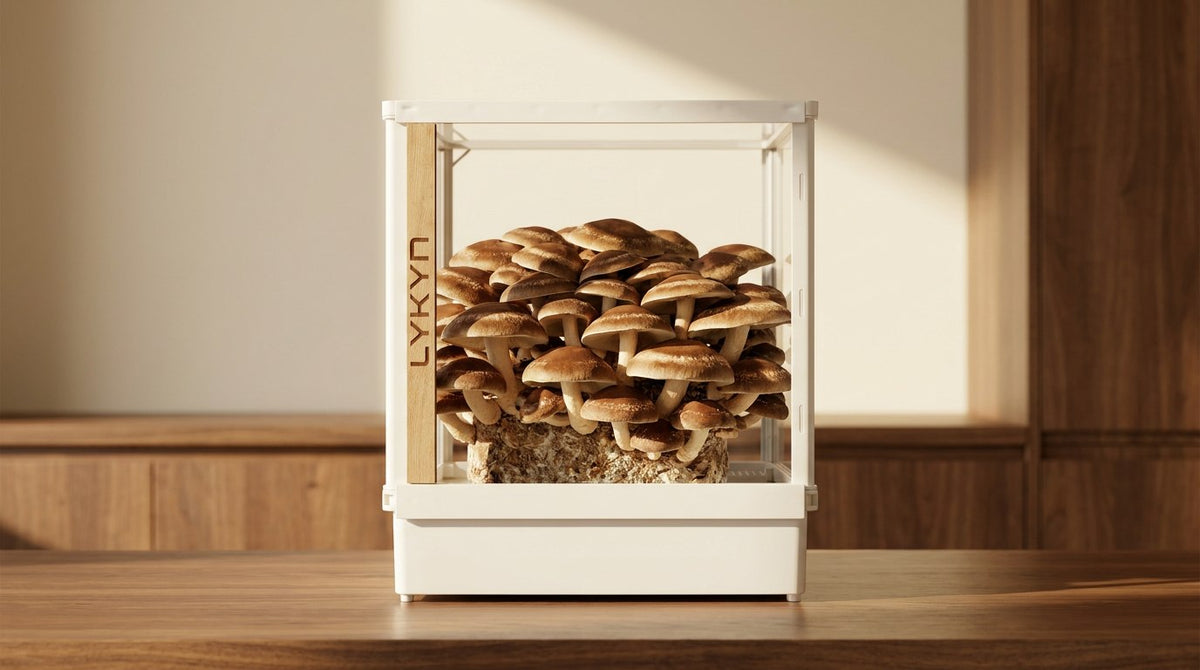
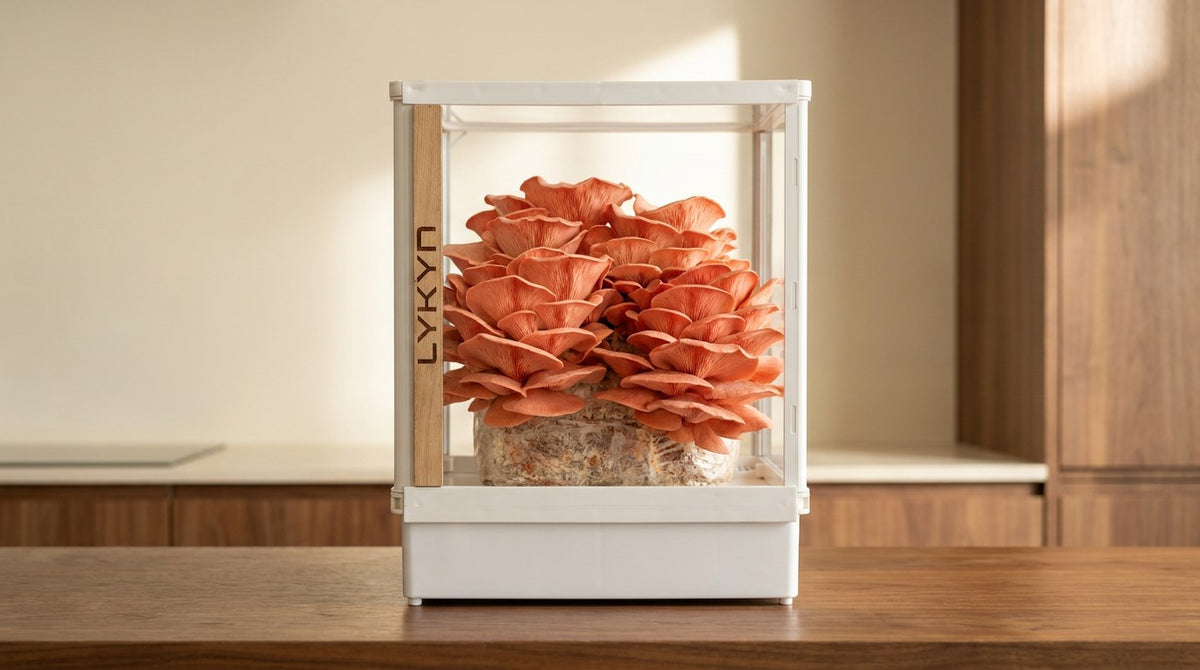
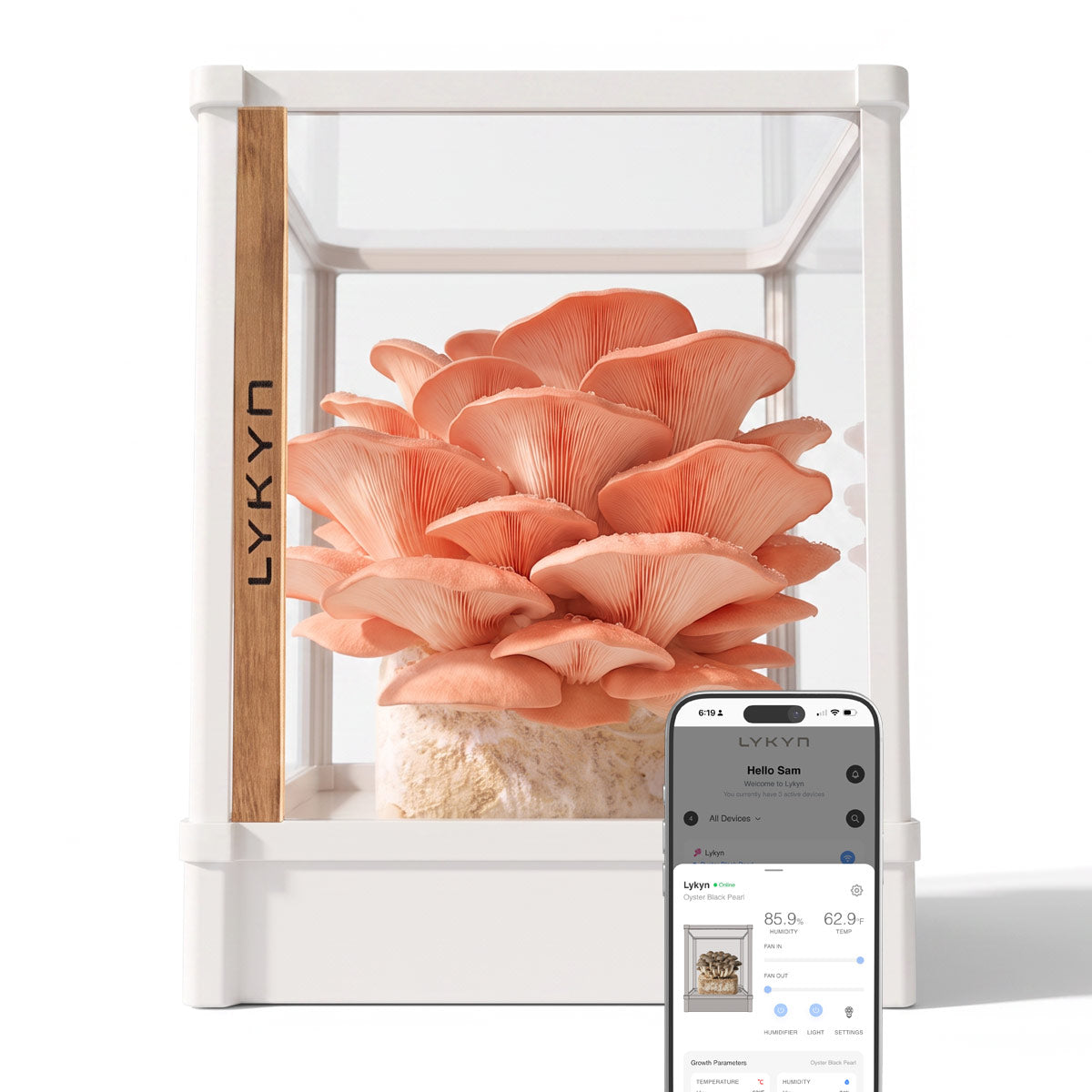
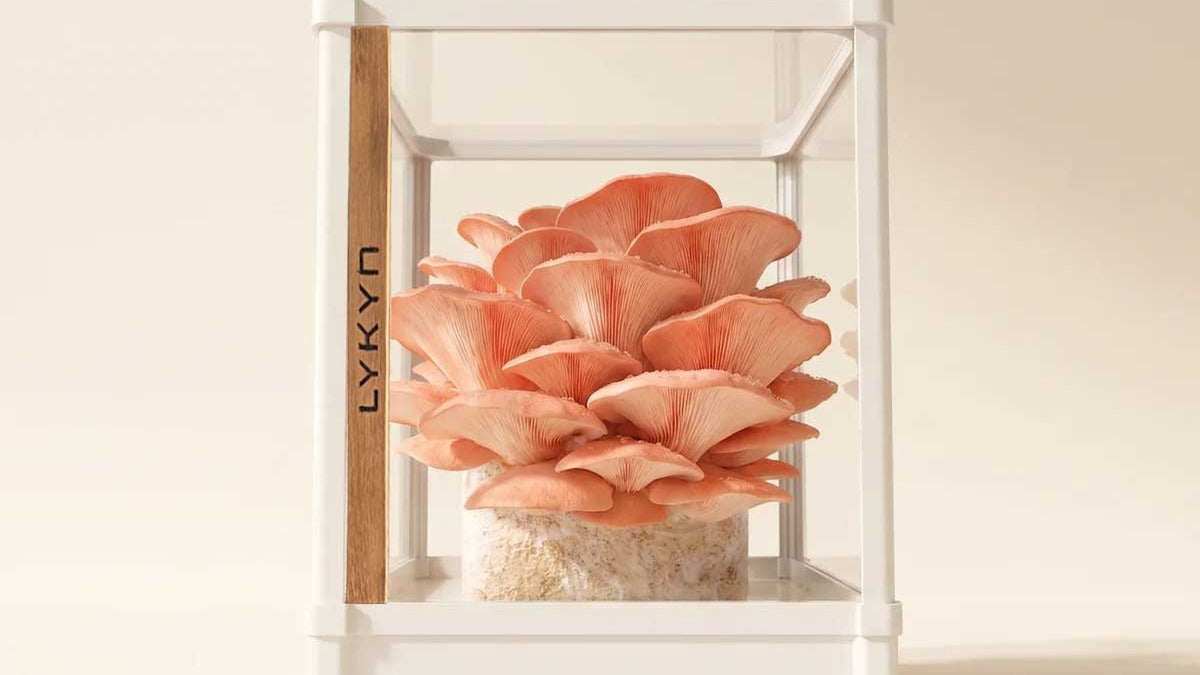
- A controlled fruiting environment. The Lykyn Smart Mushroom Grow Box is what we build for this specifically. It costs $299, holds 60-72 F and 90-95% humidity automatically, and pushes step-by-step guidance to your phone. Alternatively, a plastic tent with a hygrometer and a spray bottle works, at the cost of manual misting 4-6 times a day and a much wider failure window.
- Filtered or reverse-osmosis water. Chlorinated tap water can inhibit mycelium at the block face. If you only have tap, let it sit uncovered for 24 hours before use.
- A sharp knife. A serrated bread knife or a foraging blade. Kitchen shears crush the fruit body.
- 70% isopropyl alcohol. For wiping the chamber interior, the block bag, and your hands before scoring.
What you do not need: HEPA filters, a laminar flow hood, an aquarium pump, a still-air box, or a dedicated grow tent. A colonized block plus a stable humid environment is the entire recipe. Everything else is either sterile-work-for-grain-spawn territory or hobbyist overreach.
Step 1: Cold-water soak the block
Lion Mane fruiting blocks lose water in transit, and Lion Mane in particular pushes fruit bodies made of about 90% water. If you skip the soak, you get small stubby clusters or no clusters at all. Fill a clean sink or a large plastic bin with cold filtered water. Submerge the entire sealed bag, weigh it down with a plate, and leave it for 12 hours. Do not open the bag before soaking. Do not use warm water; heat wakes up contaminants faster than mycelium.
After 12 hours the block should feel noticeably heavier, and the surface color under the plastic should look slightly brighter. Drain and let the bag rest at room temperature for one hour before scoring. This one step alone accounts for a 28-34% yield gap in our internal Lion Mane trials.
Step 2: Score the block face
Wipe the outside of the bag with a 70% isopropyl alcohol wipe. Wash and dry your hands. With a clean sharp blade, make a single horizontal cut through the plastic 2 inches long, roughly one-third of the way down from the top of the block. If your block is a large 5-lb model, add a second parallel cut 3 inches below the first. Do not cross-cut. Do not lift the plastic flap. The cut is a controlled port for the fruit body to exit; the surrounding plastic acts as a moisture jacket for the rest of the block.
This is where Lion Mane most differs from oyster. Oyster growers slice X-patterns across an entire bag face. Lion Mane wants a limited exit so the mycelium can concentrate energy into one dense cluster instead of scattering into small fruit bodies at every opening. If you have grown oyster before, resist the muscle memory.
Step 3: Load the Lykyn chamber and set the profile

Place the scored block on the perforated tray inside the Lykyn chamber, cut side facing forward so you can watch pin development through the glass. Close the sliding door until you hear the soft magnetic seal. Open the Lykyn app on your phone, select the Lion Mane profile from the species menu, and tap start. The chamber will draw temperature down to 68 F by default, ramp humidity to 92%, and cycle fresh air every 90 minutes at low CO2 setpoint. You will hear the fan spin for about 40 seconds each cycle. That is the entire setup.
If you are not using a Lykyn chamber, aim for the same numbers: 68 F ambient, 90-95% RH, 3-5 air exchanges and no direct light on the block face during the first 5 days. Ambient room light is fine; direct sun is not.
Step 4: Watch for pin sites

Small white nodules will appear at the cut within 72-144 hours. These are pin sites. Healthy Lion Mane pins look like miniature cauliflower florets, bright white and firm. If pins stay flat, gray, or fuzzy past day 7, humidity is too low or the block was underhydrated during the soak. Bump humidity to 94% and check the block weight; a properly soaked 5-lb block should still weigh at least 4.5 lb at this stage.
Do not open the chamber. Every door opening drops humidity by 8-15% and forces the system to catch up. If you must inspect, do it once a day for no more than 20 seconds. Lion Mane during pin formation is the single most humidity-sensitive stage of any beginner-friendly species.
Step 5: Support spine development
By day six, pins consolidate into a single soft mass and start to elongate. Around day seven or eight, spines begin pushing downward from the underside of the fruit body. This is the moment the mushroom starts looking like a lion mane. Do not touch it. Do not mist it. Do not adjust the profile. The chamber is doing the work.
Spines grow about 1/8 inch per day under ideal conditions. By day ten, the cluster should look like a soft white icicle mass 3-5 inches across. If the spines are stubby (under 1/4 inch after seven days) humidity is too low or ambient CO2 is too high. In a Lykyn chamber, increase fresh-air cycle frequency from the app; in a passive tent, unzip briefly twice a day for cross-ventilation.
Step 6: Read the harvest window
The harvest window is narrower for Lion Mane than for any other beginner species. Cut too early and the fruit body is small and firm but low-yield. Cut too late and the spines drop cream-colored spore, texture turns cottony, and the mild seafood note is replaced with a bitter aftertaste that no amount of butter can fix.
The reliable signal: spines have reached 3/4 inch long, they are still bright white with no yellow tint, and the mother body has stopped expanding for 24 hours. If you tap the chamber glass and see any dusty white puff around the fruit body, spore drop has started and you are already 12 hours late. Cut immediately.
Ambient smell also tells you. A ready Lion Mane smells faintly of shellfish stock. A spore-dropping Lion Mane smells musty. Trust your nose.
Step 7: Harvest at the base
Open the chamber. With a clean knife, slice the cluster off flush against the block face in one motion. Do not twist. Do not tear. The twist-and-pull method that oyster growers rely on damages Lion Mane pin sites and cuts second-flush yield roughly in half. A clean cut leaves the block face intact and ready to reset.
Weigh your harvest. First-flush yield varies with the block you use. Its weight, source, strain, and your grow environment all shift it. Measure your own baseline on flush one and calibrate from there. Anything under 0.7 lb points to either a bad soak or humidity that drifted below 88% during days 4-8.
Step 8: Rest and trigger the second flush
Remove any leftover fruit residue from the cut face with a wipe. Close the chamber and set the profile to rest mode (or drop humidity to 85% and hold temperature at 64 F for a week). The block needs a dormancy signal before it will re-pin.
After 7-10 days, re-soak the block in cold water for 8 hours (shorter than the first soak because the block still holds moisture), score a fresh 1-inch cut adjacent to the original site, and restart the Lion Mane profile. Second-flush pins appear faster (48-96 hours) but yield 50-70% of the first flush. A third flush is possible on a well-hydrated block but rarely worth the calendar time; at that point compost the spent block into the garden and start fresh.
Troubleshooting the five common failures

Short stubby spines. Humidity dropped below 88% at some point during days 5-10. Check for door openings, unsealed chamber gaskets, or a hygrometer that was reading falsely high. Bump the setpoint to 94% and reduce fresh-air frequency.
Yellow or pink discoloration on the fruit body. Stress, not disease. High CO2, low humidity, or ambient temperature above 74 F. If the color is uniform pale yellow and the mushroom smells normal, it is still edible but past peak. If the color is patchy with a sour smell, the block has bacterial contamination; compost it and start fresh.
No pins after 10 days. Either the block is under-colonized (patchy or gray growth visible through the plastic) or the chamber ran too warm during days 1-5. Drop the setpoint to 66 F and give it another 5 days before writing off the block.
Multiple small fruit bodies instead of one cluster. Too many slits. Lion Mane wants one controlled opening. Next block, resist the urge to cross-cut.
Green or black mold on the block face. Trichoderma or aspergillus contamination. It happens on 2-3% of blocks even from reputable suppliers. Do not eat any fruit body already touching the contamination. Bag the block, compost it outdoors (not in indoor compost), and wipe the chamber interior with 70% isopropyl before the next cycle.
Cooking Lion Mane: crab cake, cutlet, tea

Tear the cluster into thumb-sized chunks. Sear in butter until deep golden. Bite it. The interior is close to lump crab meat, mild and sweet, none of the sponginess of a portobello. No other cultivated mushroom does this. Three ways home cooks come back to:
- Lion Mane crab cake. Tear 8 oz fresh Lion Mane into thumb-sized chunks. Salt and press between paper towels for 20 minutes to draw water. Sear in butter until deep golden brown on both sides. Fold into a standard crab cake binder (Old Bay, panko, egg, Dijon, chive) and pan-fry as patties. The texture is closer to real crab than any plant-based substitute.
- Lion Mane cutlet. Slice the whole cluster horizontally into 3/4-inch slabs. Press between two cast iron pans over medium heat for 6 minutes per side to expel water and build crust. Brush with a soy-butter glaze in the last minute. Serve over rice or between two slices of milk bread with kewpie mayo.
- Lion Mane tea. Dehydrate leftover pieces at 110 F until brittle. Simmer 1 tbsp of dried fruit body in 2 cups of water for 20 minutes with a slice of ginger. The tea is mild, faintly sweet, and used traditionally in East Asian herbal practice.
Lion Mane freezes poorly raw. If you have more than you can eat in five days, cook first (sear or roast) then freeze. Dehydrated Lion Mane keeps 12 months in an airtight jar.
Frequently asked questions
How long does it take to grow Lion Mane at home?
14 to 21 days from block soak to harvest in a controlled chamber. Add 7-10 days of rest before flush two.
What temperature does Lion Mane need?
60-72 F (16-22 C). Cool-weather fungus. Anything above 75 F stalls pinning and produces sparse spines.
What humidity does Lion Mane need?
90-95% relative humidity during pinning and fruiting. The most humidity-demanding species most home growers ever attempt, which is why controlled chambers beat passive kits on this species.
Does home-grown Lion Mane really taste like crab?
Close to lump crab when harvested at peak. Teeth 3/4 inch, still white, pan-seared in butter. Overripe turns bitter and loses that seafood note.
What does the research say about Lion Mane and cognition?
Findings are early-stage and not FDA-approved health claims. Growing your own is legal and safe; treating it as a supplement should be discussed with a physician.
How much Lion Mane will one block produce?
Yield on a 5-lb block depends on your specific block, strain, and grow environment. Measure your own baseline on flush one and calibrate from there. Passive bag kits yield less due to humidity swings.
Can I grow Lion Mane in a plastic tent instead of a chamber?
Possible, but Lion Mane punishes humidity swings more than any beginner species. Manual misting 4-6 times a day, and stalled pins are common. Try the passive-tent route first only if you want to feel the difference before investing in automation.
Why are my Lion Mane teeth short and stubby?
Humidity dropped below 88% at some point, or the block dried out. Increase humidity, keep the door closed longer, and check block weight for water loss.
Why did my Lion Mane turn pink or yellow?
Stress, not disease. Low humidity, high CO2, or ambient temperature above 74 F triggers the discoloration. Yellow with a sour smell indicates bacterial contamination and the block should be composted.
How do I store fresh Lion Mane after harvest?
Loose in paper, not plastic, at 34-38 F for up to 5 days. For longer storage, tear into chunks and cook first, then freeze. Dehydrated Lion Mane keeps 12 months in an airtight jar.
Can I grow Lion Mane and oyster in the same chamber?
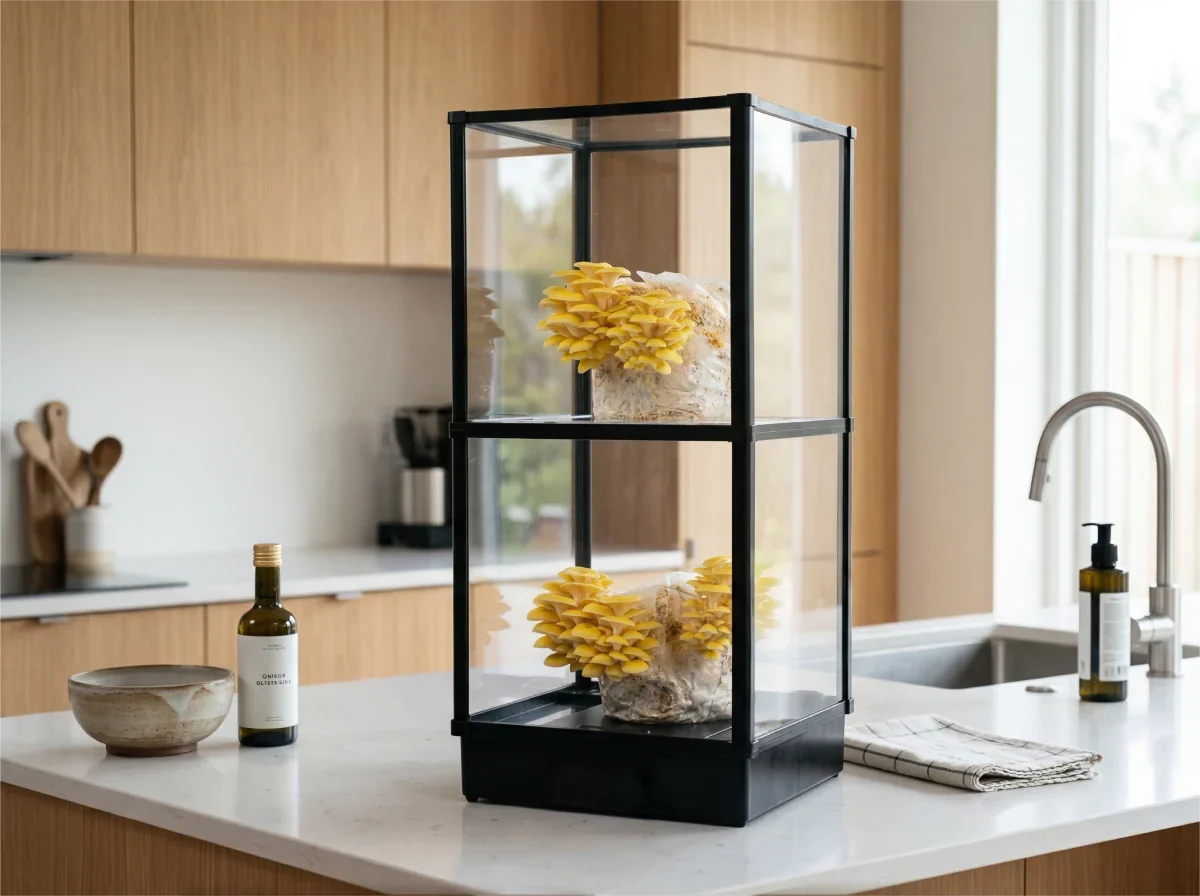
In the Lykyn double-tier model yes, on separate trays with separate profiles. Single-tier chambers should run one species per cycle because temperature preferences differ by 4-8 F.
How is Lion Mane different from oyster mushroom to grow?
Cooler temperature (60-72 F vs 65-78 F), higher humidity (90-95% vs 85-90%), longer cycle (14-21 days vs 10-14), and a single limited fruit port instead of wide bag openings. Every step of the workflow benefits from a controlled chamber, and this is the species where automation shows the biggest gap over manual methods.
Related reading on Lykyn
- How to cook Lion Mane mushroom perfectly
- Lion Mane growing kit: what is in the box
- Lykyn Smart Mushroom Grow Box. Product page
Ready to grow Lion Mane this month? The Lykyn Smart Mushroom Grow Box holds the 60-72 F and 90-95% humidity Lion Mane needs, automatically, from your kitchen counter. In mass production, US-assembled in Santa Rosa, California, 97.8% verified first-flush success rate across our test cohort. See the chamber.
Share:
How to Grow Golden Oyster Mushrooms at Home: Complete 2026 Guide
Lions Mane Mushroom Growing Kit: Easy Home Harvest