


The king trumpet mushroom (Pleurotus eryngii) has the densest, most meat-like flesh in the entire oyster family. Slice the stem thick, score it deep, and sear it hard, and you get a "steak" with a golden crust, a tender center, and a savory umami punch that holds its own next to a real ribeye. This guide covers the science behind the texture, the exact pan-sear technique, three flavor variations, and how to grow king trumpets at home so you always have a steak on hand.
Quick answer: A king trumpet mushroom steak is a thick crosscut of the dense white stem of Pleurotus eryngii, scored in a tight crosshatch and pan-seared in cast iron at high heat with butter, garlic, and fresh herbs. Total cook time is 7 to 8 minutes for a steak that tastes like seared scallop.

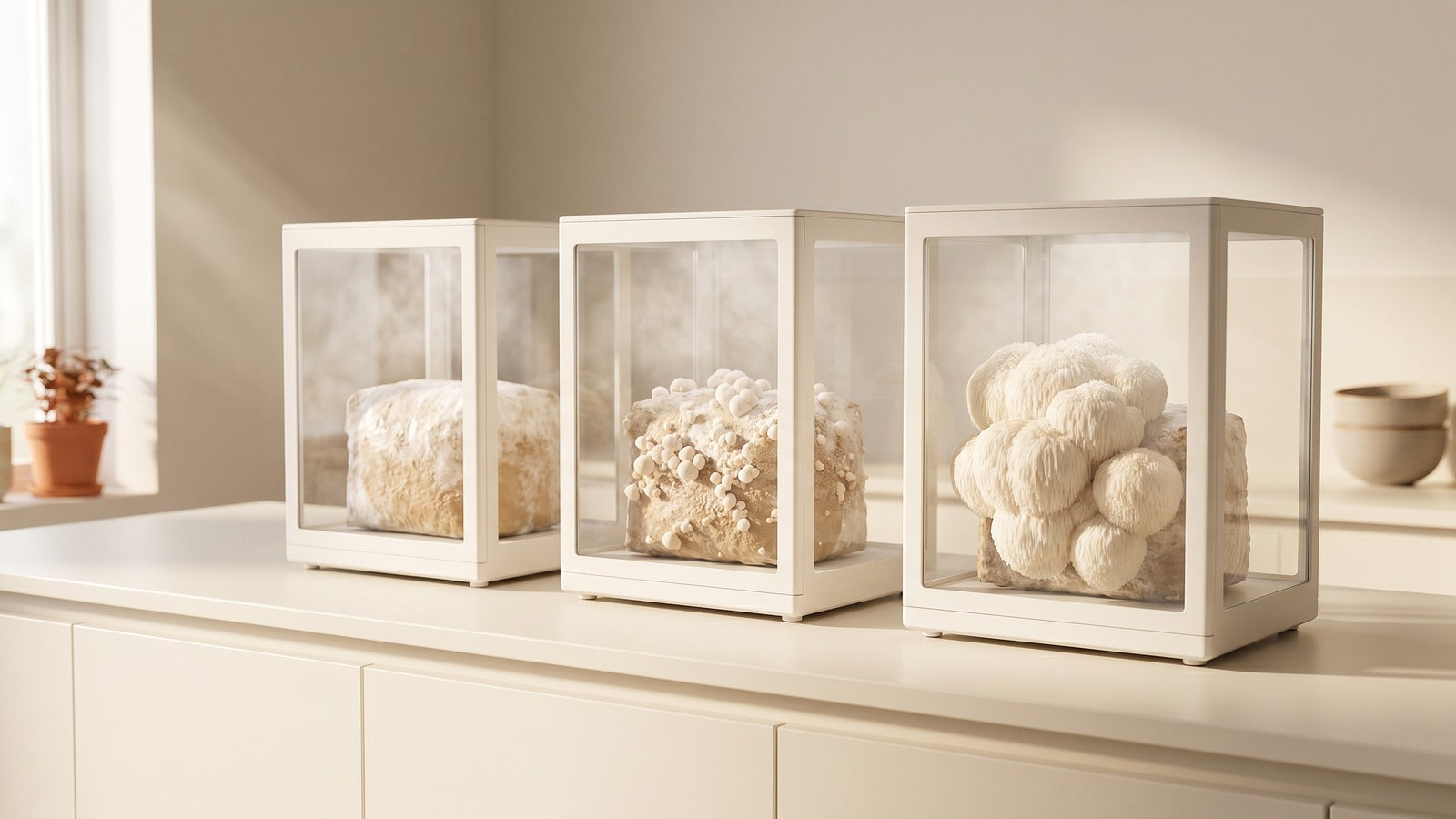
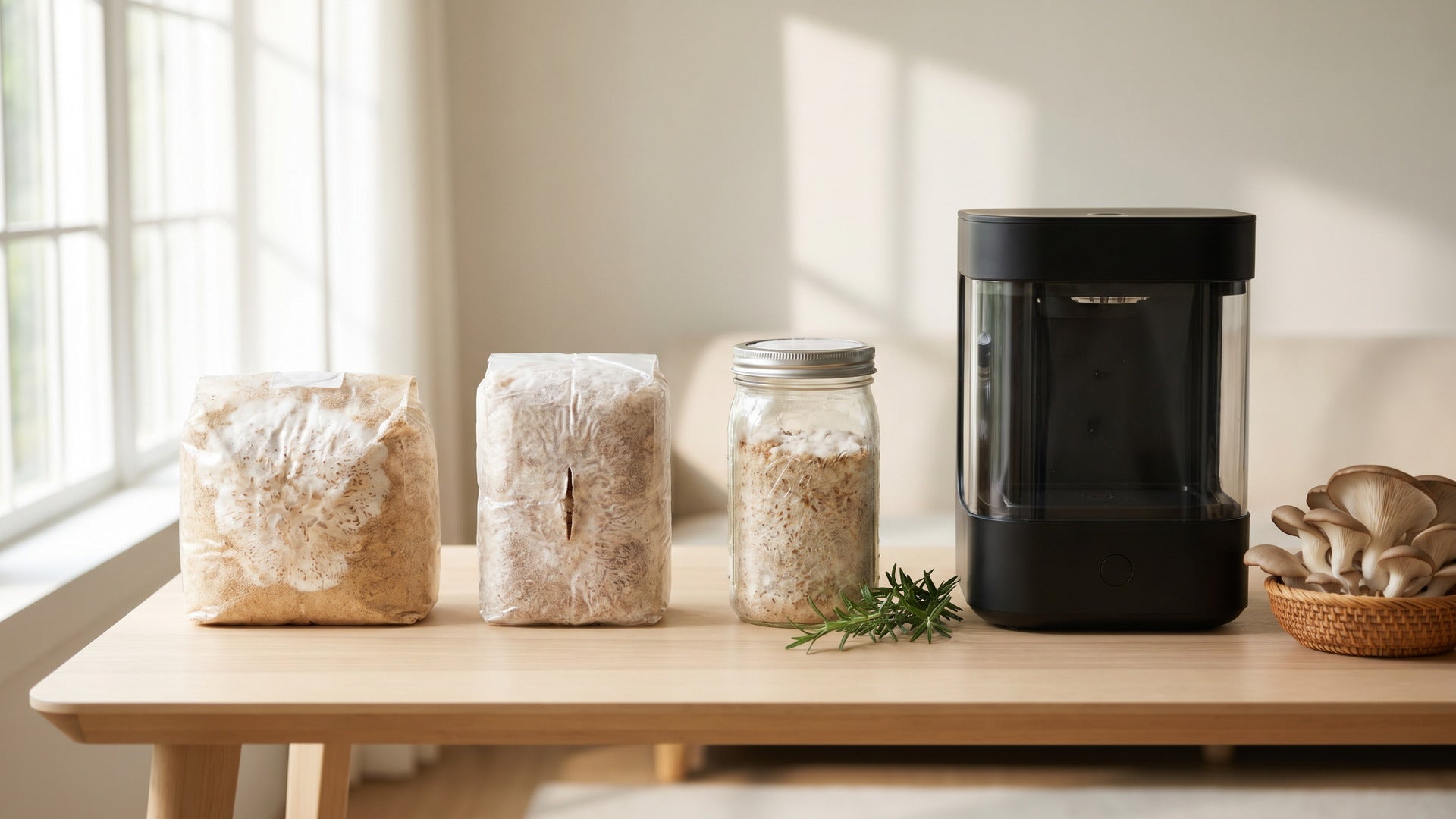
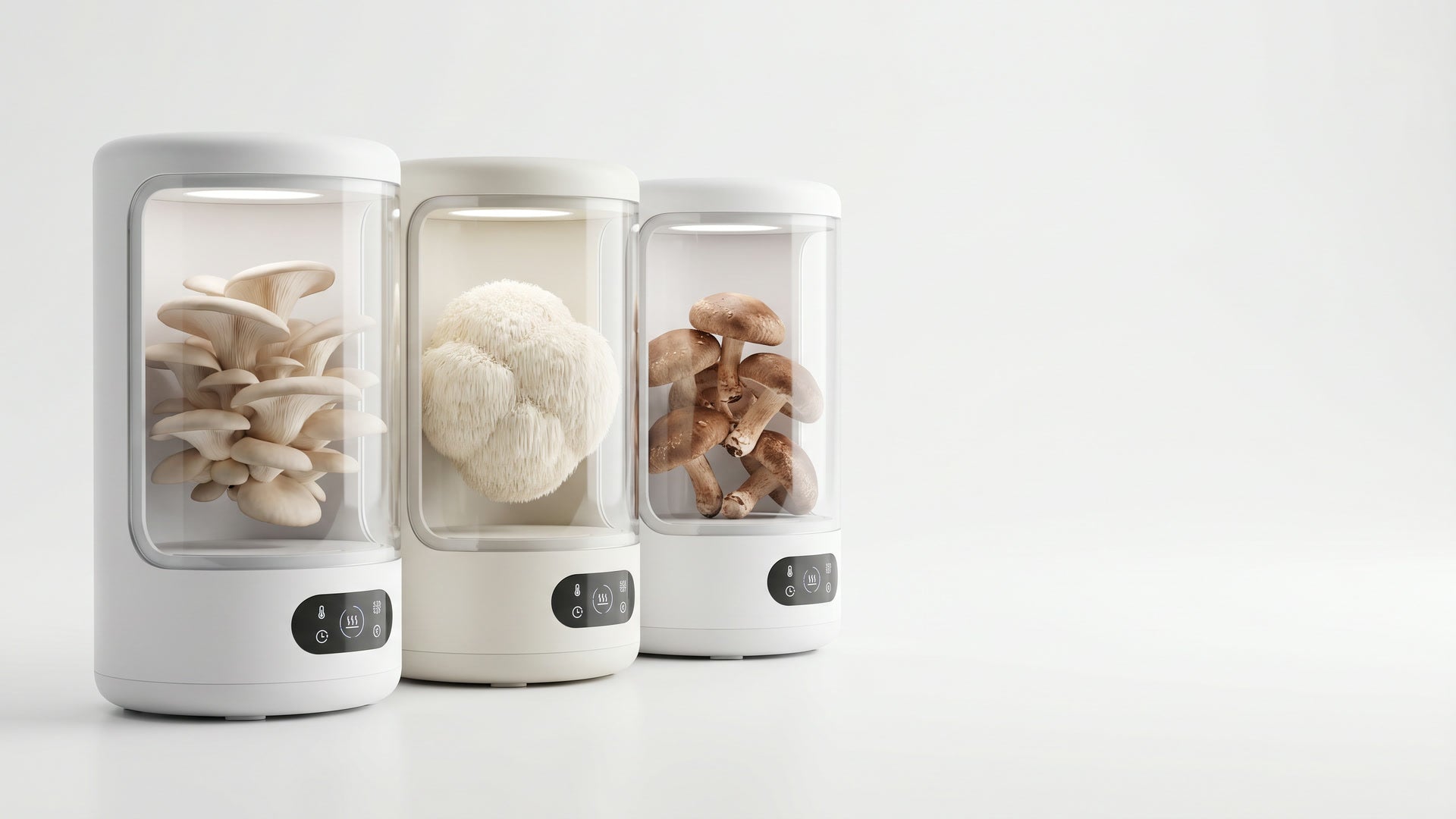
Smart Chamber. Bone White Single
- 2.8L tank, 90% humidity automatic
- App-controlled, plug-and-play
- 6 lb block ceiling, in stock

Smart Chamber. Obsidian Black Single
- Same hardware as Bone White
- Matte black premium finish
- Pairs with any kitchen palette


What a King Trumpet "Steak" Actually Is
A king trumpet steak is a thick crosscut of the mushroom's stem, scored and pan-seared until both faces are deep golden brown. Unlike a portobello cap (which goes soft and watery), the king trumpet stem is dense, springy, and naturally low in moisture. That density is what lets it brown the way a piece of meat browns, instead of just steaming in its own juices.
The flesh is white, almost glossy when raw, and it stays pale through the cook. Once seared, the cut sides develop a crust that's structurally similar to a seared scallop. A 2018 paper in the journal Mycologia describes Pleurotus eryngii as "the most carnivorous-textured of the cultivated Pleurotus species" because its hyphae bundle into long parallel fibers that mimic muscle striation. That's not marketing copy. That's the actual reason it eats like meat.
For the home cook, three things matter:
- The stem is the steak. The brown cap is edible and delicious, but it's too thin to cut into a proper steak. Save the caps for stir-fry or a side sauté.
- Thickness rules. A steak under 3/4 inch will overcook before it browns. Aim for 3/4 to 1 inch slices.
- Score deep. Crosshatching the cut sides exposes more surface to the pan and helps the heat penetrate the dense core.
How to Score a King Trumpet Stem

Scoring is the single technique that separates a great king trumpet steak from a mediocre one. The cuts let oil, butter, and seasoning reach the inside of the steak, and they create a crackled, crispy surface that traps flavor.
- Lay the stem on its side, root end pointing away from you.
- Slice off the cap (save it). Trim the dried, fibrous base if needed.
- With a sharp chef's knife, make diagonal cuts about 1/8 inch deep across one cut face, spaced 1/4 inch apart.
- Rotate 90 degrees and repeat, creating a tight crosshatch pattern.
- Flip and score the other cut face the same way.
Press the steak gently between your palms after scoring. You want the scored faces to "open up" slightly when seared, like the surface of a seared duck breast. Skip the score and you'll get a flat, dull crust. Score too deep (past 1/4 inch) and the steak falls apart in the pan.
For a step-by-step on the broader cooking method, the existing Lykyn guide on how to cook king oyster mushrooms walks through stir-fry, roast, and braise techniques too.
The Classic Pan-Seared King Trumpet Steak Recipe

This is the flagship recipe. Twelve minutes of active cooking, five minutes of prep, two restaurant-quality steaks on the plate. Cast iron is non-negotiable here. A thin nonstick pan will not hold the heat needed for a real crust.
Ingredients (2 steaks)
- 2 large king trumpet mushrooms (Pleurotus eryngii), 4 to 6 oz each
- 2 tbsp neutral oil (grapeseed, avocado, or refined olive)
- 3 tbsp unsalted butter
- 3 garlic cloves, smashed but whole
- 4 sprigs fresh thyme
- 2 sprigs fresh rosemary
- Flaky sea salt
- Cracked black pepper
- Lemon wedge (optional, for finishing)
Instructions
- Prep the steaks. Trim caps and root ends. Slice each stem lengthwise in half if very thick, or crosswise if you prefer a round cut. Score both faces of each piece in a tight crosshatch about 1/8 inch deep.
- Heat the pan. Place a 10 or 12 inch cast iron skillet over medium-high heat for 3 minutes until ripping hot. A drop of water should evaporate on contact.
- Sear face one. Add the neutral oil. Place the steaks scored-side down. Press flat with a smaller pan or a spatula for the first 60 seconds to maximize contact. Cook undisturbed for 4 minutes until deep golden brown.
- Flip and add butter. Turn the steaks. Add butter, smashed garlic, thyme, and rosemary to the pan. Tilt the pan and baste the steaks continuously with the foaming herb butter for 3 to 4 minutes.
- Check the center. Press a steak with tongs. It should feel firm but yielding, like a medium-cooked ribeye. If it's still spongy, give it another minute.
- Rest and serve. Transfer to a warm plate. Spoon a tablespoon of the herb butter over the top. Finish with flaky salt, cracked pepper, and a squeeze of lemon.
Lykyn tip: Don't move the steaks during the first sear. The crust is the entire point. If you peek at minute 2 and the surface looks pale, the pan wasn't hot enough. Crank the heat and let it ride.
Three Flavor Variations
Once you have the base technique down, the king trumpet steak takes on almost any flavor profile.
Asian-Glazed (Soy, Mirin, Ginger)
Sear the steaks in neutral oil only. After the flip, deglaze with 2 tbsp soy sauce, 1 tbsp mirin, and 1 tsp grated fresh ginger. Reduce until syrupy, about 90 seconds. Spoon over the steak and finish with toasted sesame seeds and sliced scallion. This pairs especially well with a side of garlic bok choy.
Herb Butter (the classic, doubled down)
For a richer take, add 1 tbsp white miso paste to the butter in step 4. The miso amplifies the natural glutamates in the mushroom and adds a savory depth without making the dish taste "Asian." This is the version most professional kitchens serve as a vegan main.
Vegan Miso-Garlic Steak
Skip the dairy butter entirely. Use 2 tbsp olive oil plus 2 tbsp vegan butter or coconut oil. Whisk together 1 tbsp white miso, 1 tbsp tamari, 1 tsp maple syrup, and 1 grated garlic clove. Brush onto the seared steaks in the last 30 seconds in the pan. Caramelizes beautifully. Pure umami.
Cooking Tips That Actually Matter
The internet is full of king trumpet steak recipes that gloss over the parts that decide whether the steak is great or sad. These are the four that change the outcome the most.
1. Use high heat from the start. Medium-high, not medium. Pleurotus eryngii is 89 percent water by weight. You need heat aggressive enough to drive that moisture off the surface fast, or the steaks will braise in their own liquid and never crust.
2. Score deep, but not too deep. Target 1/8 inch on each face. A shallower score won't open up. A deeper one (more than 1/4 inch) means the steak loses structural integrity during the flip.
3. Press flat for the first minute. Cast iron + weight = maximum surface contact = real crust. A smaller skillet, a foil-wrapped brick, or a pan press all work.
4. Don't crowd the pan. Two steaks in a 10 inch skillet is the max. Three or four and the temperature drops, moisture pools, and the crust is gone.

Fuel Your Mushroom Journey
Smart Mushroom Grow Chamber
Plug-and-play smart chamber with humidity, light, and airflow dialed in for every species. Beginners harvest their first flush in days, not months.
Add to cart $299For more nuanced techniques across the king oyster repertoire, the dedicated king oyster mushroom recipe collection covers scallops, carpaccio, and slow-roasted variations.
Where to Get King Trumpet Mushrooms

King trumpets aren't always easy to find. Whole Foods carries them seasonally, Asian grocers stock them year round, and high-end produce sections will have them at 8 to 12 dollars per pound. Cooked correctly, that's reasonable. But if you cook these regularly, the math points one direction: grow them yourself.
King trumpets thrive in a controlled humidity environment, which is exactly what the Lykyn smart mushroom grow box is built to provide. The chamber holds humidity at 90 percent and fresh-air exchange at the rate the species needs to develop those characteristic thick, white stems. Mushroom fruiting blocks of king trumpet aren't in our current rotation (the chamber lineup ships pink oyster, blue oyster, lion's mane, shiitake, and cinnamon cap), but the automated fruiting chamber supports any pre-colonized Pleurotus eryngii block from a reputable supplier. For deeper background on the species itself and how it differs from other oysters, the king trumpet mushroom guide covers identification, biology, and growing parameters in detail.
A fresh-harvested king trumpet has noticeably firmer flesh than store-bought (which has often been sitting in cold storage for a week). That firmness translates directly into a better sear. You taste the difference.
Nutrition Snapshot
A 100 gram serving of king trumpet mushroom delivers about 35 calories, 3 grams of protein, 6 grams of carbohydrates, and 2.5 grams of fiber, with negligible fat. According to USDA FoodData Central entries for Pleurotus eryngii, the species is a notable source of ergothioneine, an amino acid antioxidant the body cannot synthesize on its own. It's also a good source of B vitamins (especially niacin and riboflavin) and ergosterol, which converts to vitamin D2 when exposed to UV light.
For the vegan cook, this matters: a king trumpet steak delivers real micronutrient density, not just texture. A 2020 review in Frontiers in Nutrition on culinary mushrooms specifically called out Pleurotus eryngii for "exceptional nutritional density relative to its calorie content."
Frequently Asked Questions
What do king oyster mushrooms taste like?
King oyster (also called king trumpet) has a mild, savory, slightly nutty flavor. The texture is what stands out most. The thick stem is dense and springy, much closer to seared scallop or abalone than to a typical mushroom. When seared in a hot pan with butter and thyme, the savory umami opens up and the texture becomes meaty. Raw, the flavor is faint. The real depth comes out only with heat.
Are king oyster mushrooms the same as king trumpet mushrooms?
Yes. King oyster and king trumpet are two common names for the same species, Pleurotus eryngii. You may also see it labeled eryngii, royal trumpet, or trumpet royale at specialty grocers. All four names point to the exact same mushroom. The "oyster" naming reflects the genus (Pleurotus, the oyster mushroom family), and "trumpet" describes the thick, trumpet-shaped stem.
How do you cut king oyster mushrooms for a steak?
First trim the small brown cap and the dried base. For a steak, slice the thick white stem crosswise into rounds 3/4 to 1 inch thick. For very large mushrooms, you can slice lengthwise to get longer, oval steaks instead. Score both faces of each steak in a tight crosshatch about 1/8 inch deep before searing. The score opens up on the heat and gives you a much better crust.
How long do you cook king oyster mushrooms in a pan?
For a 3/4 inch steak, sear 4 minutes on the first side over medium-high heat, then 3 to 4 minutes on the second side while basting with herb butter. Total active cook time is 7 to 8 minutes. The steak is done when both faces are deep golden brown and the center feels firm but yielding when pressed with tongs. Thinner slices (1/2 inch or less) need only 2 minutes per side.
Can you eat king oyster mushrooms raw?
Technically yes, but you shouldn't. King oysters contain trace amounts of agaritine, the same compound found in white button mushrooms, which is broken down by heat. More importantly, the raw flesh is bland and tough. Heat unlocks the savory umami compounds and softens the texture. Always cook king oyster mushrooms before eating, ideally with a high-heat sear or roast.
What part of the king oyster mushroom is edible?
The entire mushroom is edible. The thick white stem is what most recipes (including the steak) focus on because of its dense, meaty texture. The small brown cap is also edible and tasty, but it's thin and cooks much faster than the stem. Most cooks slice the cap separately and sauté it alongside the steak, or save it for stir-fry. Trim only the dried, fibrous base where the mushroom was attached to the substrate.
Are king oyster mushrooms healthy?
Yes. King oyster mushrooms are low in calories (around 35 per 100 grams), high in fiber and B vitamins, and contain ergothioneine, an antioxidant your body cannot make on its own. They also provide ergosterol, a natural source of vitamin D2. The species has been studied for cholesterol-lowering effects and immune-supporting beta-glucans. They fit into vegan, keto, and most clean-eating frameworks.
Can you grow king trumpet mushrooms at home?
Yes. King trumpet (Pleurotus eryngii) is one of the more forgiving Pleurotus species to grow on a pre-colonized substrate block. The species needs 85 to 95 percent humidity, fresh-air exchange every few hours, and temperatures between 60 and 75 degrees Fahrenheit. An automated chamber like the Lykyn smart mushroom grow box holds those conditions without daily misting. Fruiting takes 10 to 14 days from pin formation to harvest, and a single block can yield up to 1.5 pounds of fresh mushrooms.
Final Tips
A great king trumpet steak isn't about exotic ingredients. It's about three habits: slice thick, score deep, and let the cast iron do its job. Once you've made one, the recipe scales effortlessly to dinner for four, to a holiday vegan main, or to a quick weeknight protein swap.
If you cook king trumpets often, growing your own at home pays back fast. The Lykyn smart mushroom grow box takes the guesswork out of the humidity and air exchange the species needs, and a single block yields enough steaks for several dinners.
Share:
Maitake Mushroom Recipes: 5 Best Dishes for Hen of the Woods
Maitake Mushroom Recipes: 5 Best Dishes for Hen of the Woods