


Fuel Your Mushroom Journey

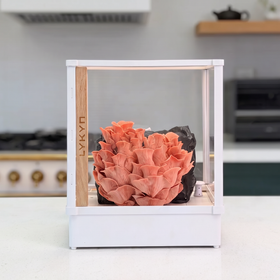
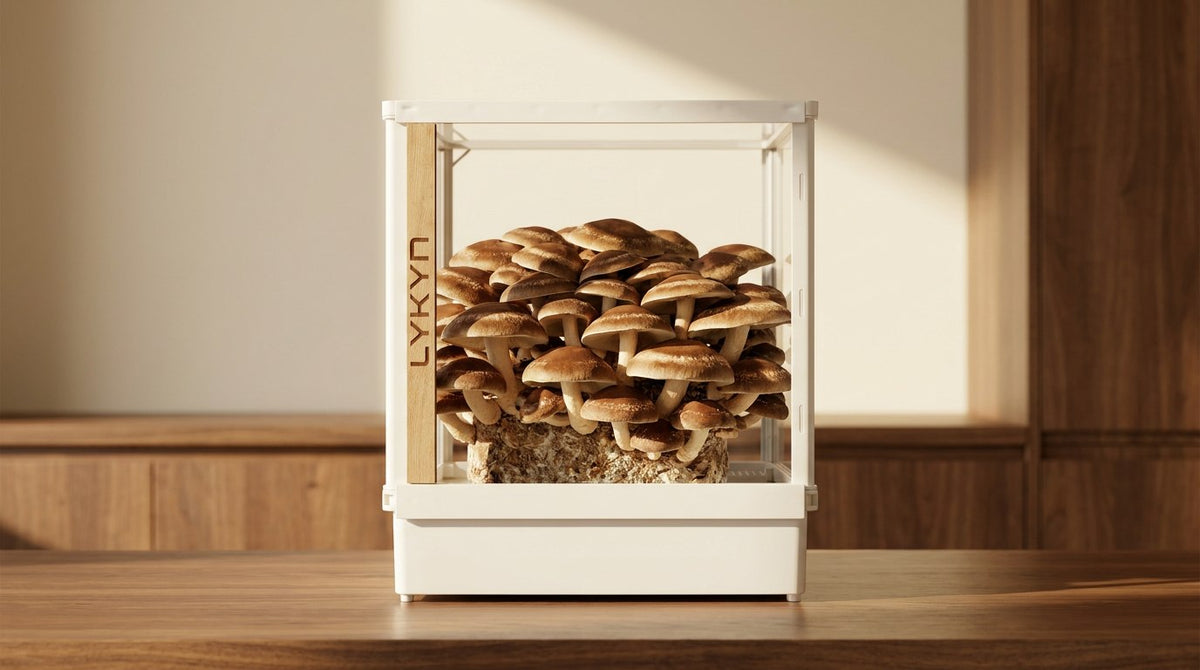
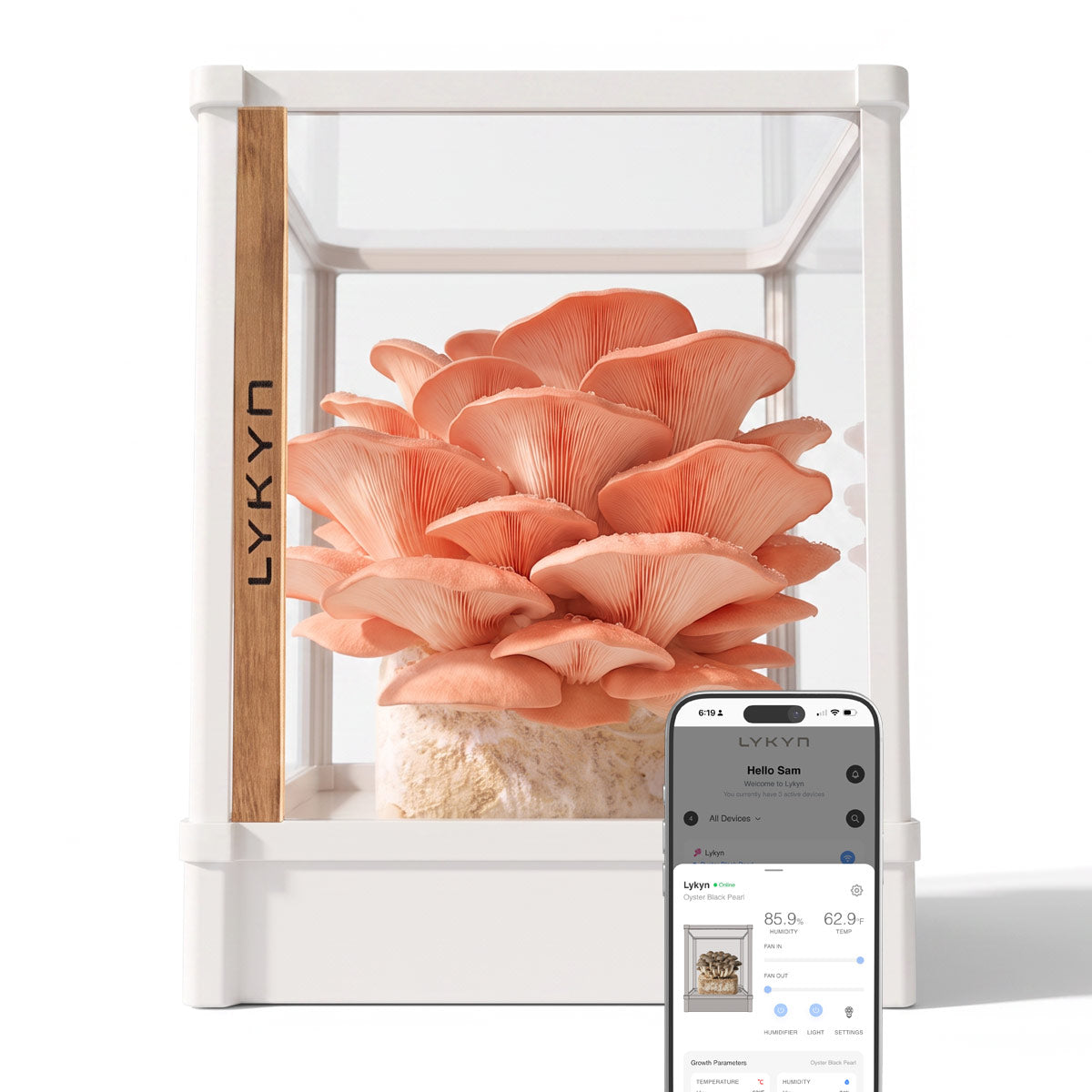
Smart Chamber. Bone White Single
- 2.8L tank, 90% humidity automatic
- App-controlled, plug-and-play
- 6 lb block ceiling, in stock

Smart Chamber. Obsidian Black Single
- Same hardware as Bone White
- Matte black premium finish
- Pairs with any kitchen palette

Author note. This guide draws on Lykyn Growing Team observations across 500+ growers (2024 to 2026), peer-reviewed mycology references, and US-published cultivation literature.
Golden Oyster Mushroom: Complete Growing, Cooking, and Identifying Guide
Golden Oyster Mushroom (Direct Answer)
Golden oyster mushroom (Pleurotus citrinopileatus) is an edible gourmet mushroom native to East Asia, where it is known as tamogitake. It produces clusters of bright yellow caps on slender white stems, takes 10 to 14 days from pinning to harvest at 70 to 80°F with 85 to 95% humidity, and tastes best after a dry-sear that concentrates its cashew and white-wine flavor. Easy to grow at home from a pre-colonized block.
Identification: How to Tell Pleurotus citrinopileatus Apart
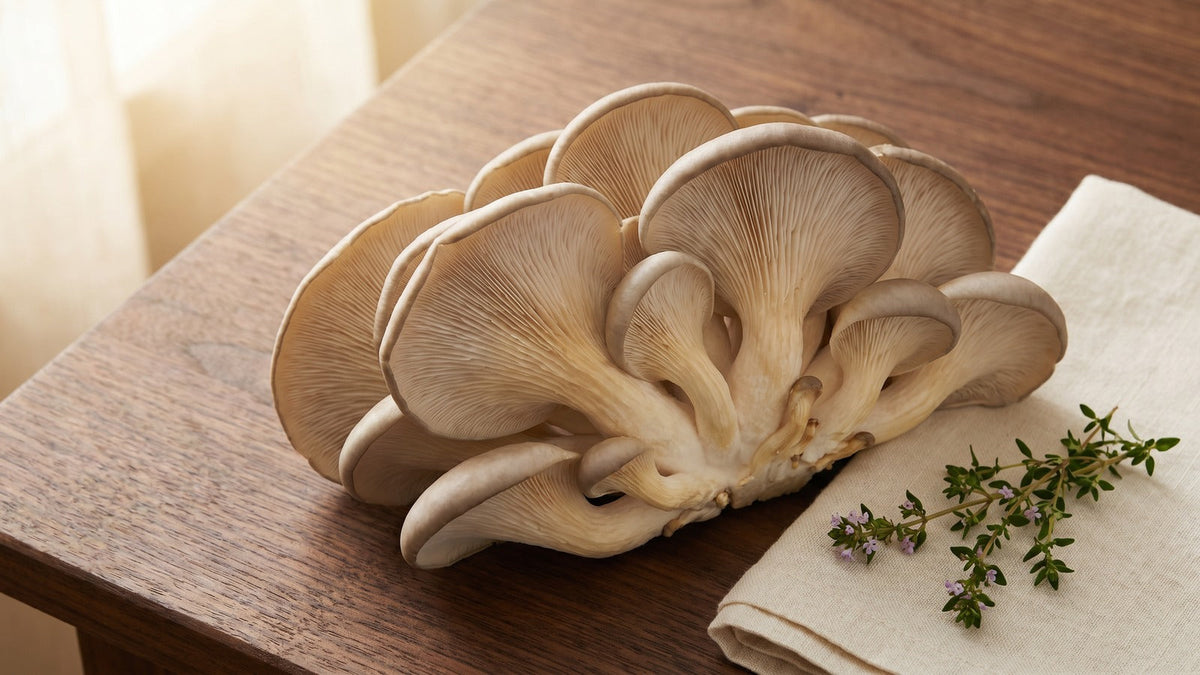
The golden oyster is one of the most visually distinctive mushrooms you can grow. Once you have seen a healthy cluster, you will never mistake it for anything else.
Cap Color and Shape
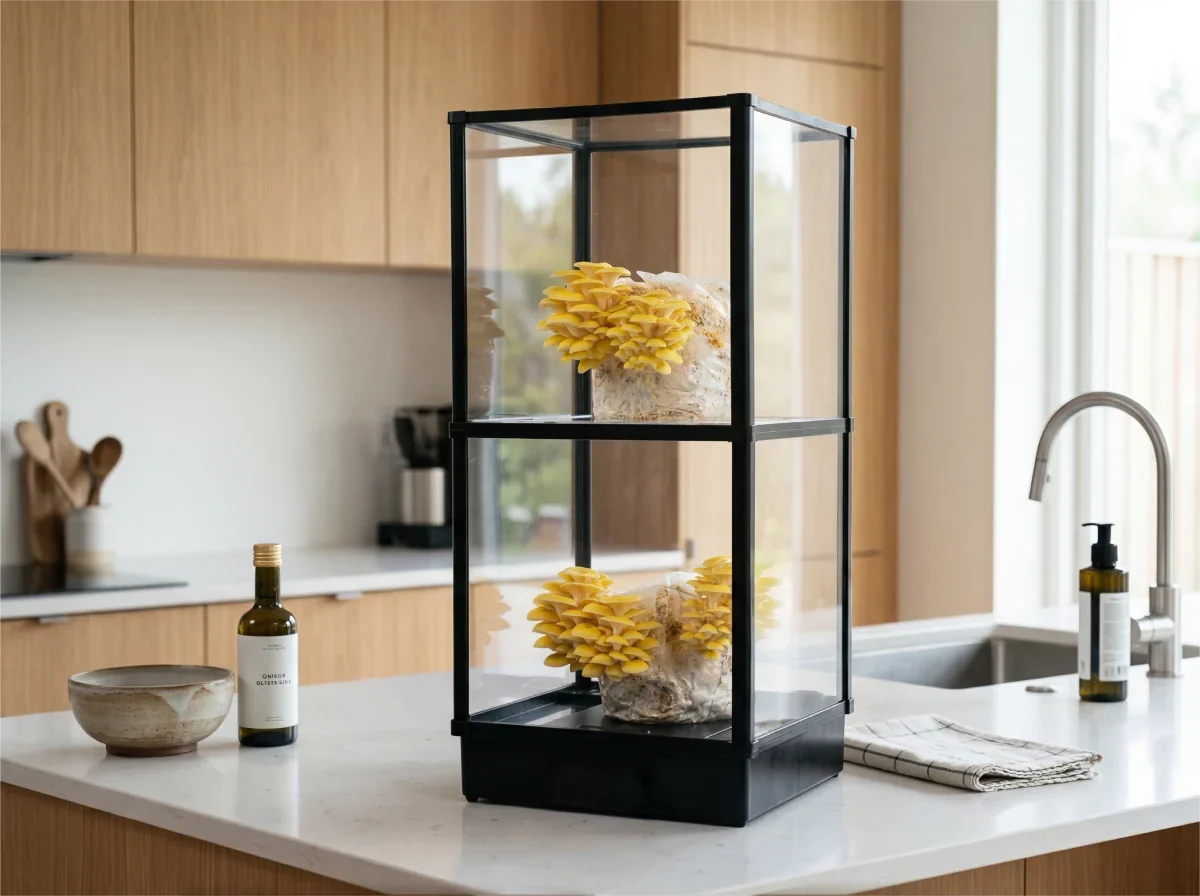
Caps emerge a deep, almost neon yellow when young. Think egg yolk, not lemon. As the fruiting body matures over 24 to 48 hours, the color fades toward a soft buttery cream, and the cap edge curls upward into a shallow funnel. Diameter ranges from 2 to 6 centimeters. Younger caps stay convex; older caps go wavy and slightly translucent at the margin.
Stem and Gill Structure
Stems are off-center (laterally attached), white to pale cream, and bundle together at a shared base. This bundled "bouquet" growth is the trait that separates oysters from most other gilled mushrooms. Gills run down the stem (decurrent), are closely spaced, and stay white throughout the fruiting cycle. A spore print is white to pale lilac.
Smell
Fresh golden oysters smell faintly of anise and watermelon rind. If you smell anything sour, ammonia-like, or musty, the block has bacterial contamination and the cluster should not be eaten.
Lifecycle Clues
Pins start as tiny yellow nubs through the side of a colonized block within 5 to 7 days of fruiting initiation. Those pins double in size every 12 hours until they form recognizable caps. By day 10 to 14 you have full clusters weighing between 200 and 500 grams per flush, depending on block size.
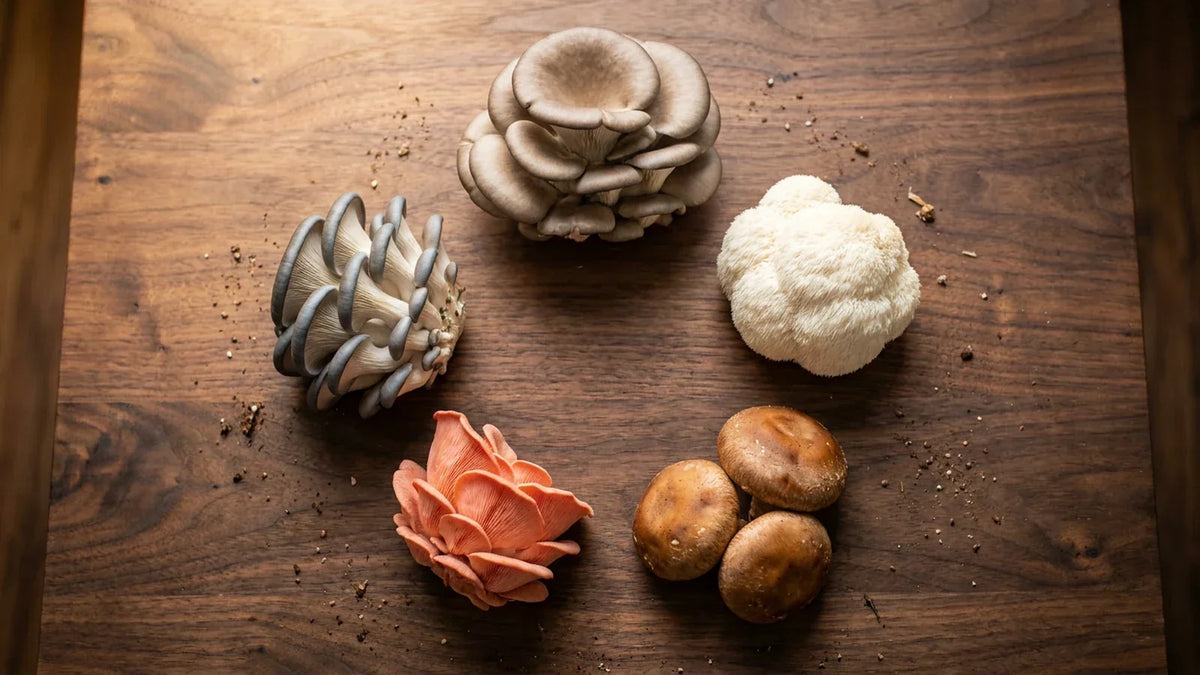
Four Pleurotus Species Compared
Most home growers eventually try more than one oyster. Here is how golden compares to the other three Pleurotus species we recommend for beginners.
| Species | Cap color | Flavor profile | Best growing temp | Days to harvest | Beginner difficulty |
|---|---|---|---|---|---|
| Pearl oyster (P. ostreatus) | Gray to tan | Mild, savory, mushroomy | 55 to 75°F | 10 to 14 | Easy |
| Blue oyster (P. columbinus) | Slate gray to navy | Earthy, briny, slightly seafood-like | 50 to 65°F | 7 to 10 | Easy |
| Pink oyster (P. djamor) | Vivid pink to magenta | Bacon-like when seared, briny when raw | 70 to 85°F | 5 to 7 | Easy (warm rooms) |
| Golden oyster (P. citrinopileatus) | Bright egg-yolk yellow | Cashew, white wine, mild anise | 70 to 80°F | 10 to 14 | Easy (warm rooms) |
The golden oyster pairs especially well with pink in a warm summer kitchen, since both thrive at the same temperature range. Pair golden with blue if you want a cooler-season backup.
How to Grow Golden Oyster at Home
The golden oyster forgives a lot of beginner mistakes, but it has a strict humidity ceiling. Drop below 80% RH and the caps crack within hours. Here is the six-step home grow protocol that consistently delivers 1 pound per 5-pound block.
Step 1: Pick the Right Block
Order a pre-colonized golden oyster block (between 3 and 5 pounds for a single chamber). The block should be fully white with mycelium when it arrives. A few yellow pins on the side of the bag are a good sign, not a bad one. Store at 65 to 75°F until you are ready to start.
Step 2: Set Up Fresh Air Exchange
Golden oysters produce a lot of CO2 during pinning, and elevated CO2 produces leggy stems with tiny caps. Run your chamber with fresh air exchange (FAE) cycled at least every 30 minutes. In a Lykyn chamber, the dual-fan system handles this automatically; in a homemade setup, you will need a small computer fan and a timer.
Step 3: Hold Humidity at 85 to 95%
This is the make-or-break setting. Golden oyster caps desiccate fast at lower humidity, which is why supermarket goldens often look cracked. Use a humidifier with a hygrometer feedback loop, not a passive humidity tray.
Step 4: Hold Temperature at 70 to 80°F
Lower than 65°F and pinning stalls. Higher than 85°F and the caps yellow-out fast and turn leathery. A room at standard summer temperature is perfect. In winter, a seedling heat mat under the chamber maintains the bottom range.
Step 5: Watch for Pinning
After 5 to 7 days of fruiting conditions, you will see small yellow pin clusters break through the side of the block. Do not disturb them. Continue holding humidity and FAE. From the first pin to harvest is typically 5 to 7 more days.
Step 6: Harvest at Cap-Curl
The right moment to harvest is when the cap edge has just started to curl upward and the cap diameter has stopped growing (usually 3 to 5 cm). Twist the entire cluster off at the base with one motion; do not cut individual stems. A clean twist preserves the block for a second flush, which typically arrives 10 to 14 days later at 60 to 80% of the first flush yield.
What Golden Oyster Actually Tastes Like
This is the part most online guides botch. They will tell you golden oysters taste "mild and oyster-like," which is technically true but misses the point.
Fresh golden oysters, cooked correctly, have a distinct cashew note layered over a white-wine acidity. That cashew flavor only emerges when the mushroom is dry-seared (no oil at first, just hot pan and the mushroom's own moisture). If you sauté in butter from the start, the milk solids dominate and the cashew disappears entirely. Heat above roughly 60°C on butter also kills the soft anise note that fresh caps carry.
Texture-wise, the caps stay tender even when fully cooked. Stems get a little chewy, which is why most chefs slice them on a bias.
The one limitation: golden oyster flavor is delicate. It will not stand up to heavy garlic, soy sauce, or chili. Treat them like scallops, not like portobello.
The Invasive Concern in North America
We promised honesty, so here it is. The golden oyster has escaped cultivation in North America. As of recent mycological surveys, it has been documented growing wild on American elm, sugar maple, and yellow birch across the eastern and midwestern United States, with the first wild observations dating to the early 2010s. Mycologists have raised legitimate concerns that it may displace native saprotrophic fungi, particularly in fire-disturbed and elm-dominated forests.
What this means for home growers:
- Do not dump spent blocks outdoors. Bag and trash them, compost them in a closed compost system that hits 60°C, or pasteurize the spent block before disposal.
- Do not release spore prints into the wild. The same rule applies if you are doing genetic work or making slants for hobby cloning.
- Indoor growing is the responsible path. A sealed chamber with passive filtration and controlled airflow keeps spores contained. Lykyn's chamber design vents through a small carbon filter, which captures the bulk of airborne spores; if you grow in an open bag in a basement, expect spore drift.
This is not a reason to skip the golden oyster. It is a reason to handle the spent block thoughtfully. We mention it because most growing guides do not, and an informed grower is a better steward.
Cooking Golden Oyster: Best Methods
The mushroom rewards a few specific techniques and punishes others.
Best: Dry-Sear
Heat a heavy pan (cast iron is ideal) to medium-high without oil. Add torn (not chopped) golden oyster clusters in a single layer. Do not move them for 3 minutes. The mushroom will release its water, then the water evaporates, then the caps brown. At that point, add a knob of butter, a pinch of salt, and a splash of dry white wine. Cook 60 seconds more. The cashew note will hit you.
Good: Tempura
Light, crisp batter highlights the delicate caps. Use cold sparkling water and don't overmix. Fry at 175°C until the batter just barely starts to color (about 90 seconds). Salt immediately.
Good: Pasta Finisher
Sear separately, then fold into a finished pasta with brown butter and lemon zest. Do not boil the mushroom in a pasta sauce; you will lose the cashew note entirely.
Skip: Raw
Pleurotus species can cause mild GI upset when eaten raw. Always cook to at least 60°C internal.
Skip: Heavy Marinades
Anything with soy sauce, fish sauce, or chili paste will steamroll the delicate flavor. Save those for shiitake or king oyster.
For more detailed oyster cooking technique, our cooking oyster mushrooms guide walks through pan temperature, salt timing, and the dry-sear-first rule in depth.
Fuel Your Mushroom Journey
Black Oyster Grow Kit
Hardwood sawdust block colonized with Black Oyster mycelium. Drops straight into your Lykyn chamber and starts pinning within days.
Add to cart $29.95Frequently Asked Questions
Are golden oyster mushrooms edible?
Yes. Pleurotus citrinopileatus is a widely cultivated edible mushroom with a long culinary history in Japan, China, and Russia. It must be cooked before eating, because raw Pleurotus species cause mild gastrointestinal upset in some people. Cook to at least 60°C internal temperature.
What does golden oyster taste like?
A dry-seared golden oyster tastes of cashew, white wine, and a soft anise note. The cashew flavor only emerges when the mushroom is cooked in a hot dry pan first; butter and heavy sauces mask it. Texture is tender at the cap, slightly chewy at the stem.
Are golden oyster mushrooms invasive?
In North America, yes. Wild populations have been documented on American elm and sugar maple in the eastern and midwestern United States since the early 2010s. Indoor growers should not dispose of spent blocks outdoors. Bag and trash spent blocks, or pasteurize them at 60°C before composting. Indoor sealed-chamber cultivation is the responsible approach.
How do you cook golden oyster mushrooms?
The best method is dry-searing. Heat a heavy pan to medium-high without oil, add torn clusters in a single layer, leave them undisturbed for 3 minutes until the water releases and evaporates, then finish with butter, salt, and a splash of dry white wine. Avoid heavy marinades and high-flavor pairings (soy, garlic, chili), which mask the delicate cashew note.
Where do golden oyster mushrooms grow naturally?
Naturally, Pleurotus citrinopileatus grows on hardwood deadwood in temperate forests of East Asia (Japan, China, and far-eastern Russia). It fruits on standing dead and downed elm, oak, and beech in summer and early autumn. Wild populations have also established in North American forests in the past 15 years, where the species is considered non-native.
How fast do golden oysters grow?
From the first pinning to harvest takes 10 to 14 days at 70 to 80°F with 85 to 95% relative humidity. Pins are visible 5 to 7 days after fruiting conditions are introduced. A second flush typically arrives 10 to 14 days after the first harvest, at roughly 60 to 80% of the original yield.
Grow Your Own Golden Oyster
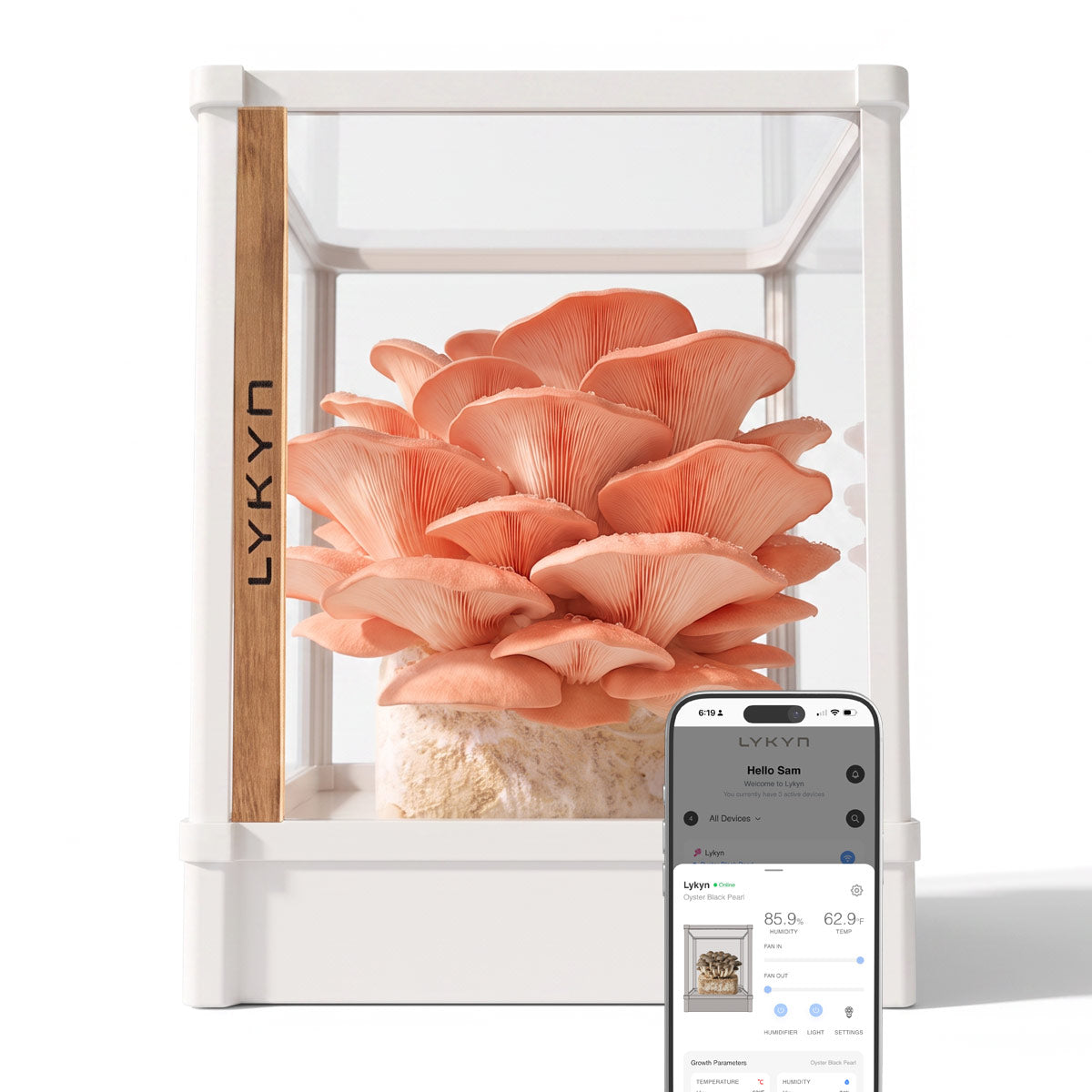
The golden oyster is one of the most beginner-friendly gourmet mushrooms you can grow at home. The single requirement is steady humidity above 85%, which the Lykyn smart chamber maintains automatically with sensor feedback every 30 seconds.
If you want to skip the homemade humidifier-and-hygrometer dance, our golden oyster grow block ships pre-colonized and ready to fruit. Or browse the full collection of grow blocks to mix species in a single chamber. For a cooler-season pairing, the blue oyster mushroom growing guide walks through the same six-step protocol at lower temperatures.
Start growing today. Your first harvest is ten to fourteen days away.



Share:
Are Oyster Mushrooms Good for You? Nutrition Science
How to Cook Oyster Mushrooms (Master Method + 4 Variations)