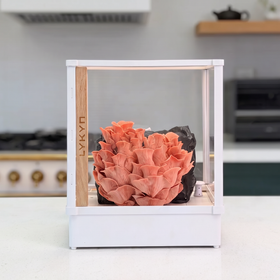



How to Grow Mushrooms at Home: A Beginner's Honest Pillar Guide
There are three honest ways to grow mushrooms at home in 2026, and only one is actually beginner-proof. This guide walks you through all three.
How to Grow Mushrooms at Home (Direct Answer Block)
Quick answer: There are three real paths. (1) Buy a pre-colonized sealed grow block (pearl oyster or lion's mane) and run it inside an automated fruiting chamber holding 85 to 95 percent humidity with fresh air exchange. First harvest in 7 to 14 days. (2) Inoculate a fruiting bag with grain spawn and tent it for humidity. First harvest in 21 to 45 days. (3) Build a sterile lab with a flow hood, pressure cooker, and agar plates. First harvest in 60 to 120 days. For first-time home growers, the sealed block plus chamber path has the highest success rate. Lykyn recommends starting with pearl oyster (Pleurotus ostreatus) because it tolerates a wide humidity range and forgives beginner mistakes.
Three Paths Compared
Every guide treats these three paths like they're interchangeable. They're not. Here's the honest breakdown of what each costs in dollars, hours, and frustration.
| Path | Cost to Start | Skill Required | Time to First Harvest | Yield per Cycle | Failure Rate (Beginner) |
|---|---|---|---|---|---|
| Sealed Grow Block + Smart Chamber | $299 chamber + $15 to $40 per block | Almost none. App-controlled, no daily misting | 7 to 14 days | 1.0 to 1.5 lb (pearl oyster), 0.6 to 0.9 lb (lion's mane) | Under 5% |
| DIY Fruiting Bag (no chamber) | $40 to $80 (bag kit + spawn + humidity tent) | Moderate. Daily misting, contamination risk, manual FAE | 21 to 45 days | 0.4 to 1.0 lb | 20 to 40% |
| Full Sterile Lab (agar, spawn, bulk substrate) | $400 to $1,200+ | High. Sterilization, inoculation under flow hood, multi-week colonization | 60 to 120 days | 1 to 5 lb (varies by tek and substrate) | 50 to 70% on first attempt |
Why the sealed block plus chamber path wins for beginners
The three biggest killers of home grows are contamination, low humidity, and stale air. A pre-colonized sealed block hands you a substrate that has already won the race against mold. A smart chamber handles humidity and air exchange on a schedule your phone controls. You remove the failure modes that doom most first-time grows.
DIY fruiting bags fail at roughly 1 in 3 attempts for beginners (community data from Shroomery and Reddit r/MushroomGrowers). If you want to learn the biology, run a bag. If you want to eat mushrooms next week, run a block. A full sterile lab is overkill for a first cluster on the kitchen counter.
What You Actually Need (Equipment Checklist)
Forget the 40-item Amazon lists. Here is what the sealed block plus chamber path actually requires:
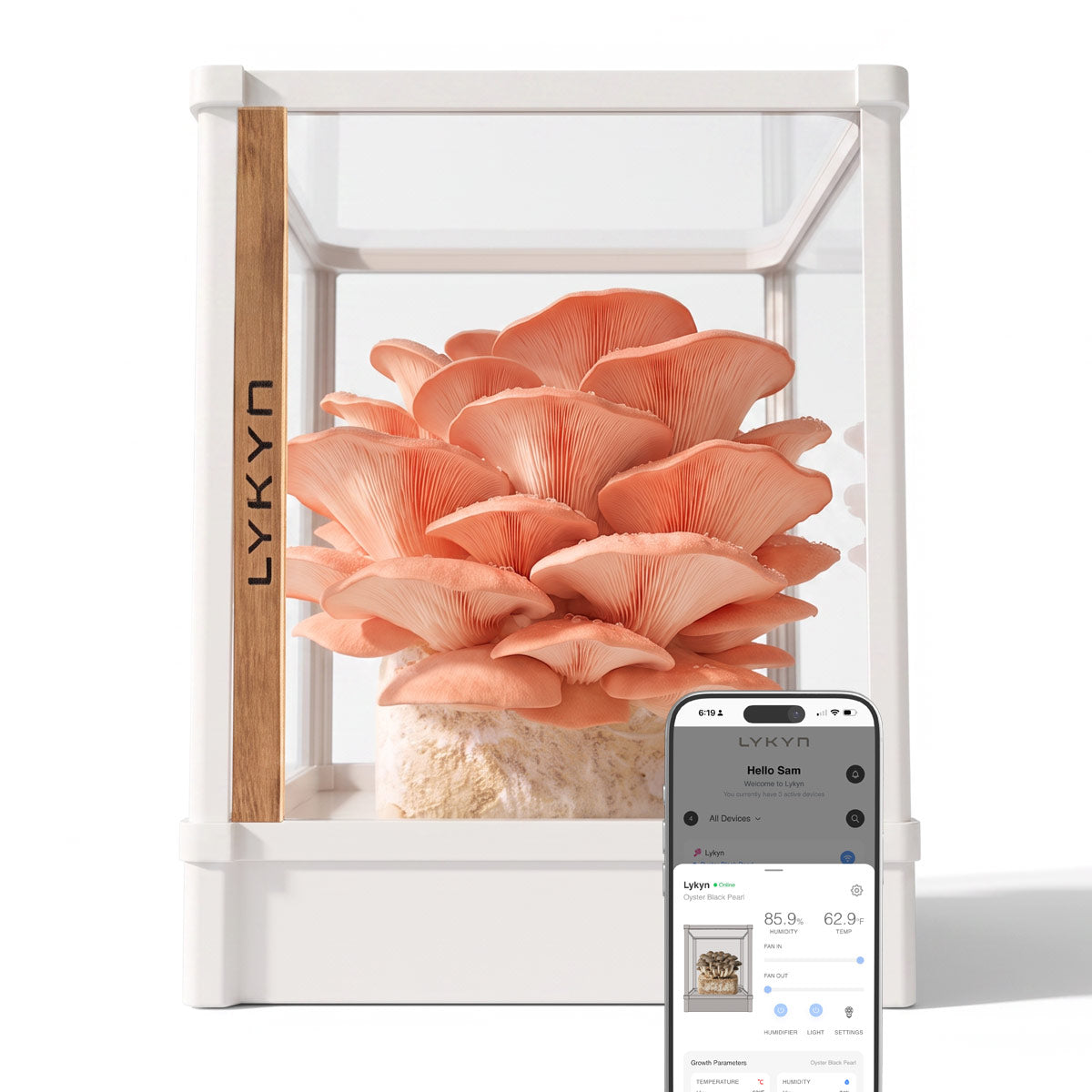
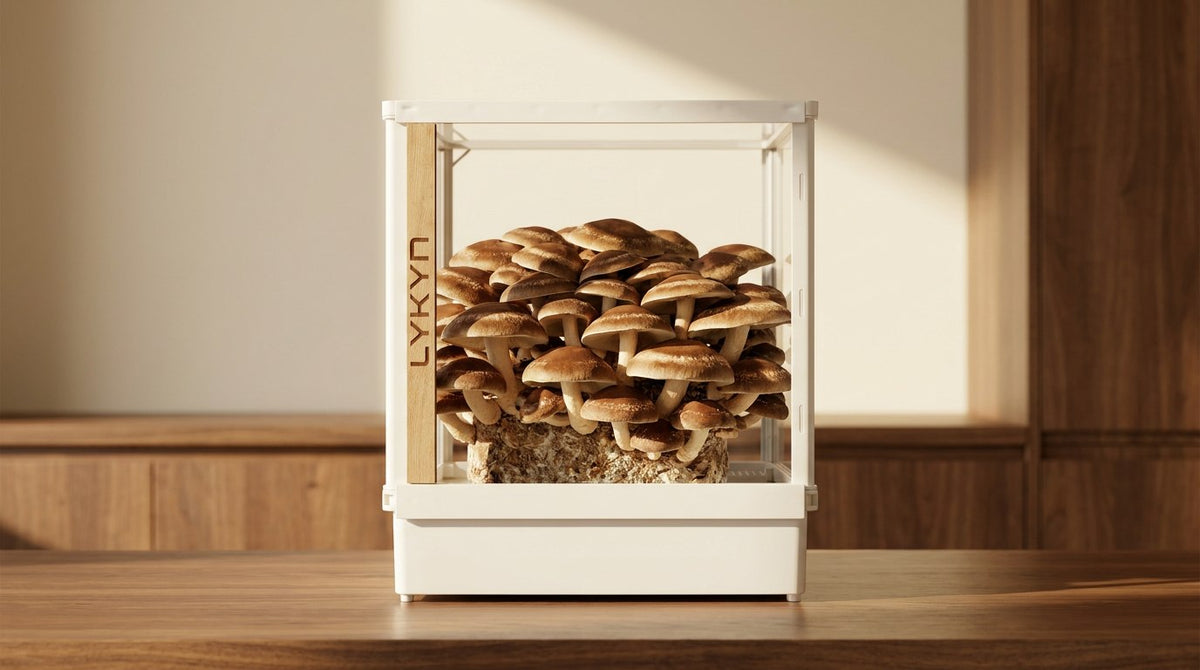
Required: - One automated fruiting chamber with humidity sensor and ultrasonic humidifier (Lykyn chamber at $299, single tier holds blocks up to 6 lb). - One pre-colonized grow block (3 to 6 lb, $15 to $40, from the Lykyn grow block collection or other reputable suppliers). - 2.5 liters of distilled or filtered water (tap chlorine can stress mycelium). - A 5V 1A USB-C power adapter (the Lykyn chamber does not include the adapter in the box). - A sharp utility knife or X-Acto for the fruiting cuts.
Optional: - A seedling heat mat if your room sits below 65°F. - A spray bottle with distilled water for the first 48 hours if humidity is unusually low. - A kitchen scale to weigh your harvest.
Not required, despite what other guides say: a pressure cooker, autoclave, flow hood, or spore syringe (the block is already sterile and colonized). Monotub, Martha tent, and shotgun fruiting chamber are DIY paths; search dedicated tutorials if you want to learn them. We don't tutorialize DIY paths here because they're a different commitment level.
The Easiest Species for First-Time Home Growers
Picking the right species is the most important decision a beginner makes. Here are the gourmet species that consistently produce strong first harvests indoors.
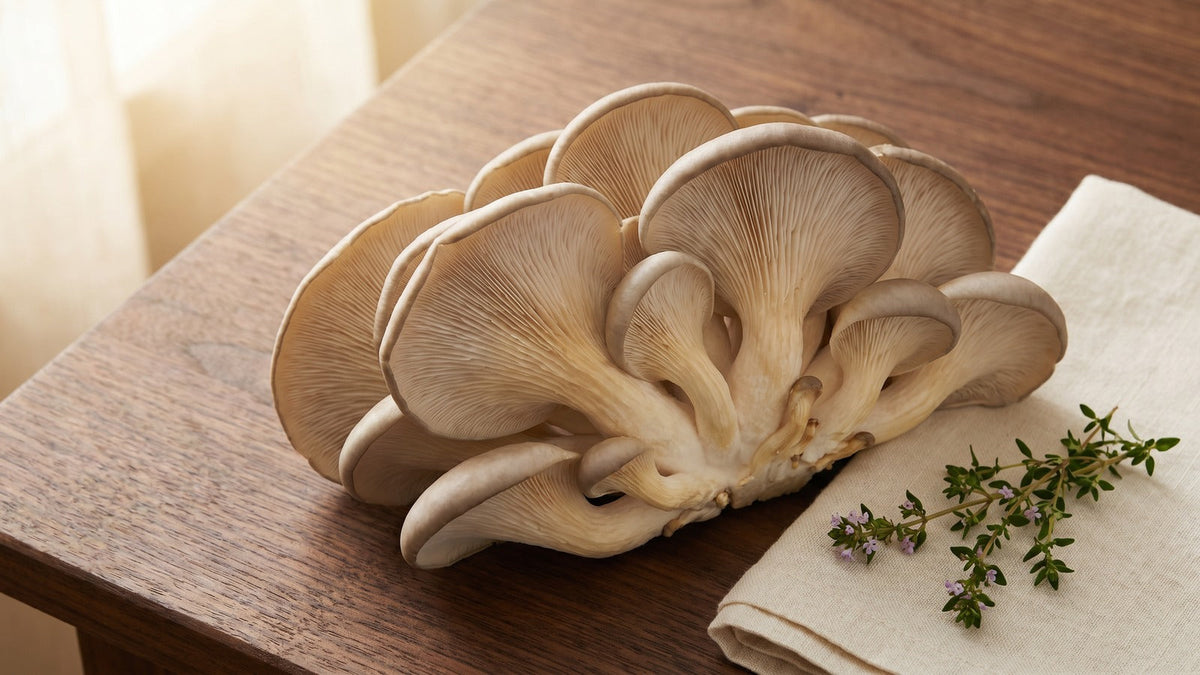
Pearl oyster (Pleurotus ostreatus)
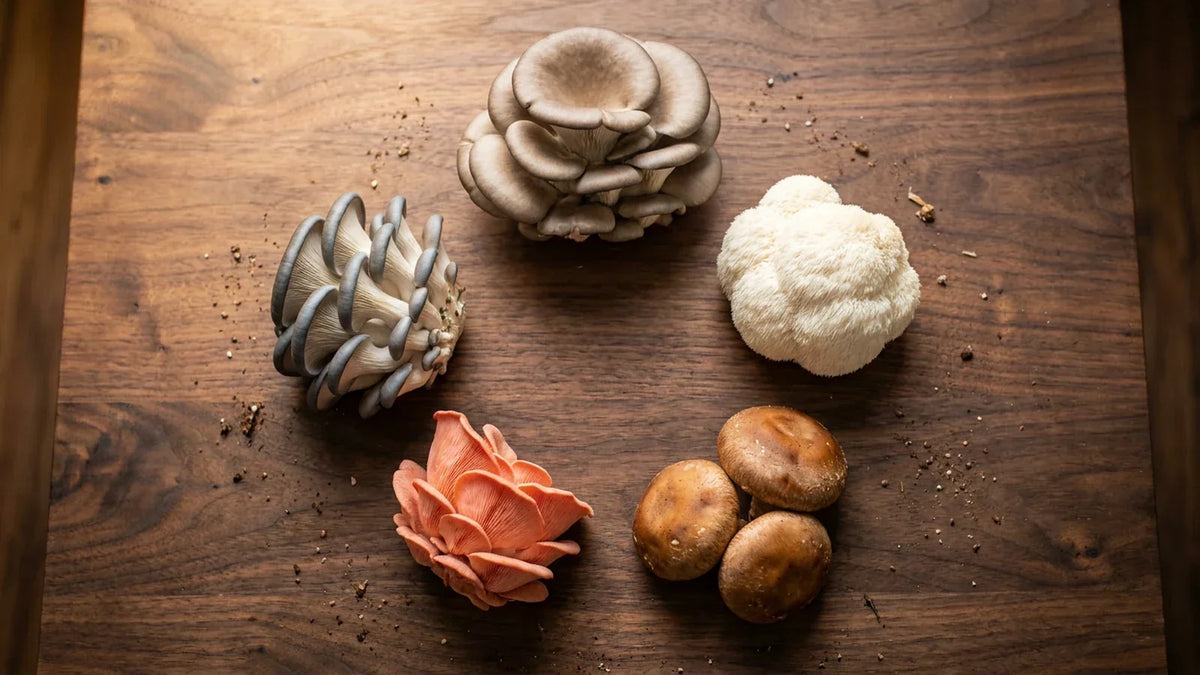
The beginner champion. Tolerates 70 to 95 percent humidity, fruits at room temperature (65 to 75°F), grows fast. A 5 lb block pins within 5 days of opening and harvests within 7 to 10 days. Yields 1.0 to 1.5 lb first flush, often 0.4 to 0.7 lb second flush. Flavor is mild and slightly seafood-like, holds up in stir-fries and pasta. If you're new, start here. See our easiest mushrooms to grow indoors for the full ranking.
Blue oyster (Pleurotus columbinus)
Closely related to pearl, slightly more tolerant of cool temperatures (fruits at 60°F where pearl slows). Caps come in a striking blue-gray that fades to tan as they mature. Flavor is richer than pearl with a stronger umami note. Pick before caps flatten out for best texture.
Lion's mane (Hericium erinaceus)
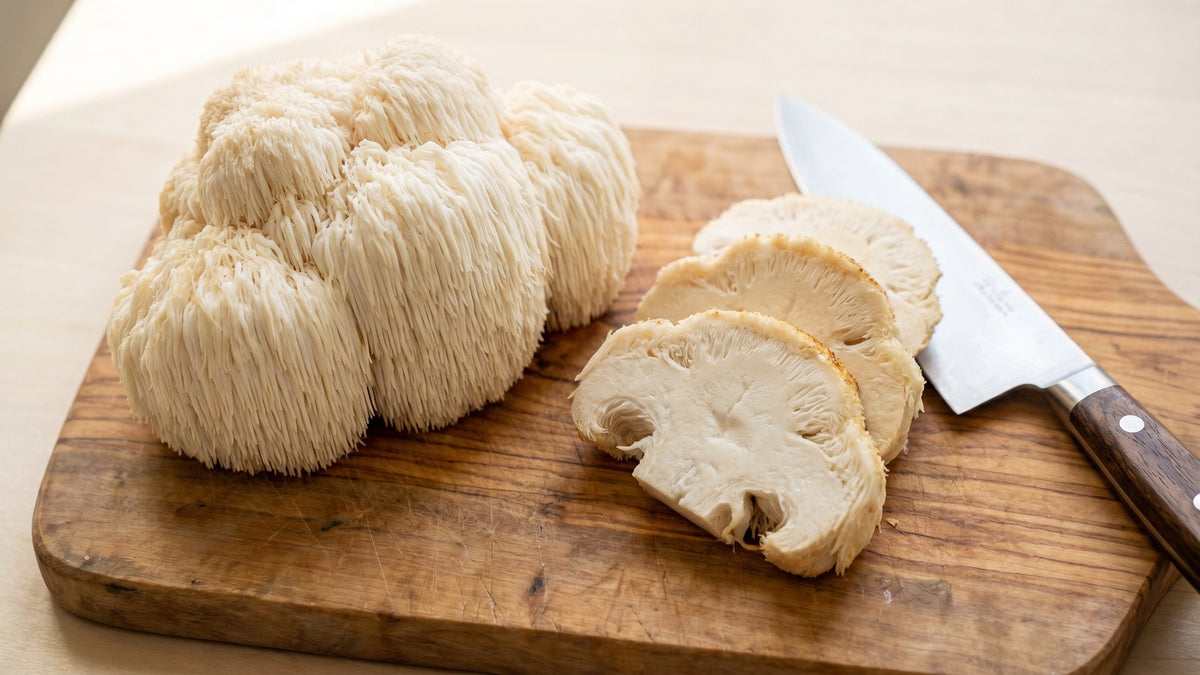
The wellness segment's favorite. A pom-pom shaped mushroom with distinctive white teeth instead of caps and gills. Harvested at 5 to 6 inches across, it has a texture home cooks describe as "lobster-like" sautéed in butter. Yields 0.6 to 0.9 lb on a 5 lb block, 14 to 21 days from opening to first harvest. Wants higher humidity (90 to 95 percent) and lower light. Bioactive compounds (erinacines, hericenones) are documented in peer-reviewed nutraceutical research per Paul Stamets. Lykyn covers lion's mane as a culinary species, not a medical product.
Pink oyster (Pleurotus djamor)
Tropical, fast, dramatic. Wants warm temperatures (75 to 85°F), pins within 3 to 5 days. Caps are vivid pink. Shelf life is short (eat within 2 days) and spore load is high (point a fan away from sleeping areas). Yields 0.8 to 1.2 lb. Great for summer growing in warmer apartments.
Honest acknowledgments
Other guides list shiitake (Lentinula edodes) and reishi (Ganoderma lucidum) as beginner species. They aren't. Shiitake wants hardwood substrate and 60+ days indoors. Reishi is slower still and grown for its dried form, not the kitchen. Start with oyster or lion's mane.
Your First 21 Days (Step-by-Step)
The canonical timeline for a sealed block plus chamber grow.
Day 1: Unbox and prepare
Unbox the chamber, plug in the power adapter, connect to 2.4 GHz Wi-Fi (5 GHz is not supported on most consumer fruiting chambers). Fill the 2.5 to 2.8 L humidifier reservoir with distilled or filtered water. Place the chamber on a flat surface away from direct sunlight and HVAC vents.
Days 2 to 3: Acclimate the block
Pull the grow block from its shipping box and leave it sealed for 24 hours at room temperature (cold-shipped blocks need to wake up). Do not cut the bag yet.
Day 4: Make the fruiting cuts
Cut an X or two parallel slits (each about 2 inches) on opposite faces of the block bag. Place the block inside the chamber, close the door, set the humidifier to 90 percent via the app.
Days 5 to 8: Pinning phase
Tiny mushroom primordia (pins) appear at the cuts. They look like white pinheads at first, then balloon into miniature caps within 24 to 48 hours. Do not touch them. Do not raise humidity above 95 percent. A single light mist of distilled water at the cut sites is fine if your room is unusually dry.
Days 9 to 12: Fruiting
Caps expand 1 to 2 cm per day, color deepens. Fresh air exchange is critical here; oyster mushrooms grow long thin stems with small caps (legginess) when CO2 builds up. Your chamber's fans should cycle on the pinning-to-fruiting preset.
Days 13 to 15: Harvest
Harvest when cap edges begin to flatten but before they curl upward. For lion's mane, harvest when the teeth are 5 to 8 mm long and still white (yellowing means past peak). Twist the cluster gently at the base for a clean break. Eat within 5 days for best texture, or freeze.
Days 16 to 21: Second flush rest
Rest the block in the chamber at 80 percent humidity for 5 to 7 days. Some growers cold-water soak the block (submerged in distilled water in the fridge for 12 hours) before returning it. This triggers a second flush, typically 30 to 50 percent of the first.
Where Most Beginners Fail
Failure modes are predictable. Here's what to watch for.
Low humidity (the #1 killer)
Mushrooms are 85 to 95 percent water. Below 80 percent humidity during pinning, pins abort. They turn yellow, shrivel, and die before reaching harvest size. Fix: a chamber with a real humidifier (not a passive tent) and a calibrated sensor. The Lykyn SHT3x-DIS sensor reads ±1.5 percent RH, the precision tier you want.
Stale air (CO2 buildup)
Mushrooms exhale CO2 as they grow. Without fresh air exchange, the mushrooms grow long spindly stems with tiny caps (legginess). Fix: a chamber with intake and exhaust fans that cycle on a schedule. Variable-speed fans (500 to 6000 RPM on the Lykyn) tune CO2 down without drying the chamber.
Contamination
Green mold (Trichoderma) or black/blue mold can colonize a block if it was opened in a dirty environment or breached before fruiting. Fix: buy from suppliers who pasteurize and inoculate in clean rooms, and don't poke the block before the fruiting cuts.
Temperature drift
Most gourmet species want 65 to 75°F. If your kitchen drops to 60°F at night in winter, fruiting stalls. Fix: a seedling heat mat under the chamber, or move it to a warmer interior wall.
Impatience
Beginners harvest too early (caps not yet flat) or too late (caps curled upward, sporulating). The cap edges flattening out is the visual signal. Visible spores on the chamber wall means you waited too long.
Wi-Fi setup friction
Most growers stumble connecting a chamber to 2.4 GHz Wi-Fi when their router is dual-band and auto-steers to 5 GHz. Fix: disable 5 GHz during setup or create a 2.4 GHz-only guest network. For timing across species, see our mushroom growing time guide.
Is It Legal to Grow Mushrooms at Home in the US?
Yes, for gourmet species. Pearl oyster, blue oyster, pink oyster, lion's mane, shiitake, reishi, chestnut, and all culinary species are legal to cultivate at home in all 50 US states with no federal or state restriction on quantity. You can sell at farmers markets in most states (check local food safety regulations and your state's cottage food law).
Psilocybin-containing species are a separate legal category. Psilocybin mushrooms (Psilocybe cubensis and related) are Schedule I under federal law and remain illegal to cultivate in every US state except where decriminalization or therapeutic-use legislation applies (Oregon and Colorado have frameworks; several cities have deprioritized enforcement). Lykyn is gourmet only. We do not sell, ship, or support psilocybin spores, syringes, or blocks, and this guide does not cover those species.
Citation: USDA Agricultural Marketing Service classifies gourmet mushrooms as "specialty crops" with no cultivation restrictions. Cornell Cooperative Extension publishes home cultivation guides for oyster, shiitake, and lion's mane confirming no permits for personal use.
Cost Reality (Buy vs Grow Math)
The honest math on whether growing mushrooms at home is cheaper than buying them.
Buying at the store
A 4 oz package of fresh oyster mushrooms at Whole Foods runs $4.99 to $6.99 (April 2026 sample pricing). That's $19.96 to $27.96 per pound. Lion's mane is rarer at $12 to $18 per 4 oz, or $48 to $72 per pound.
Growing at home (sealed block path)
One 5 lb pearl oyster block ($30) produces 1.0 to 1.5 lb first flush and 0.4 to 0.7 lb second flush. Total harvest: 1.4 to 2.2 lb per block. Cost per pound of fresh mushrooms grown: $13.60 to $21.40. Add the $299 chamber amortized over 24 blocks per year (typical heavy use) and chamber cost per pound is roughly $7 in year 1. After that, you're at raw block cost.
Growing at home (DIY bag path)
A 5 lb DIY fruiting bag kit ($60 to $80) yields 0.4 to 1.0 lb if everything works. Roughly 1 in 3 fails for beginners, so expected yield is 0.4 to 0.7 lb per attempt. Cost per pound: $85 to $200 for the first 3 attempts, dropping to $20 to $40 after you learn the craft.
Verdict
For pearl oyster, the sealed block plus chamber path beats grocery from attempt 1 and crushes it by year 2. For lion's mane, home-grown runs $30 to $45 per pound against grocery $48 to $72. Home harvests are eaten within 24 hours; store mushrooms are typically 4 to 10 days old on the shelf. See our oyster mushroom kit guide for an oyster-specific breakdown.

Fuel Your Mushroom Journey
Pink Oyster Grow Kit
Hardwood sawdust block colonized with Pink Oyster mycelium. Drops straight into your Lykyn chamber and starts pinning within days.
Add to cart $29.95FAQ
What mushrooms are easiest to grow at home?
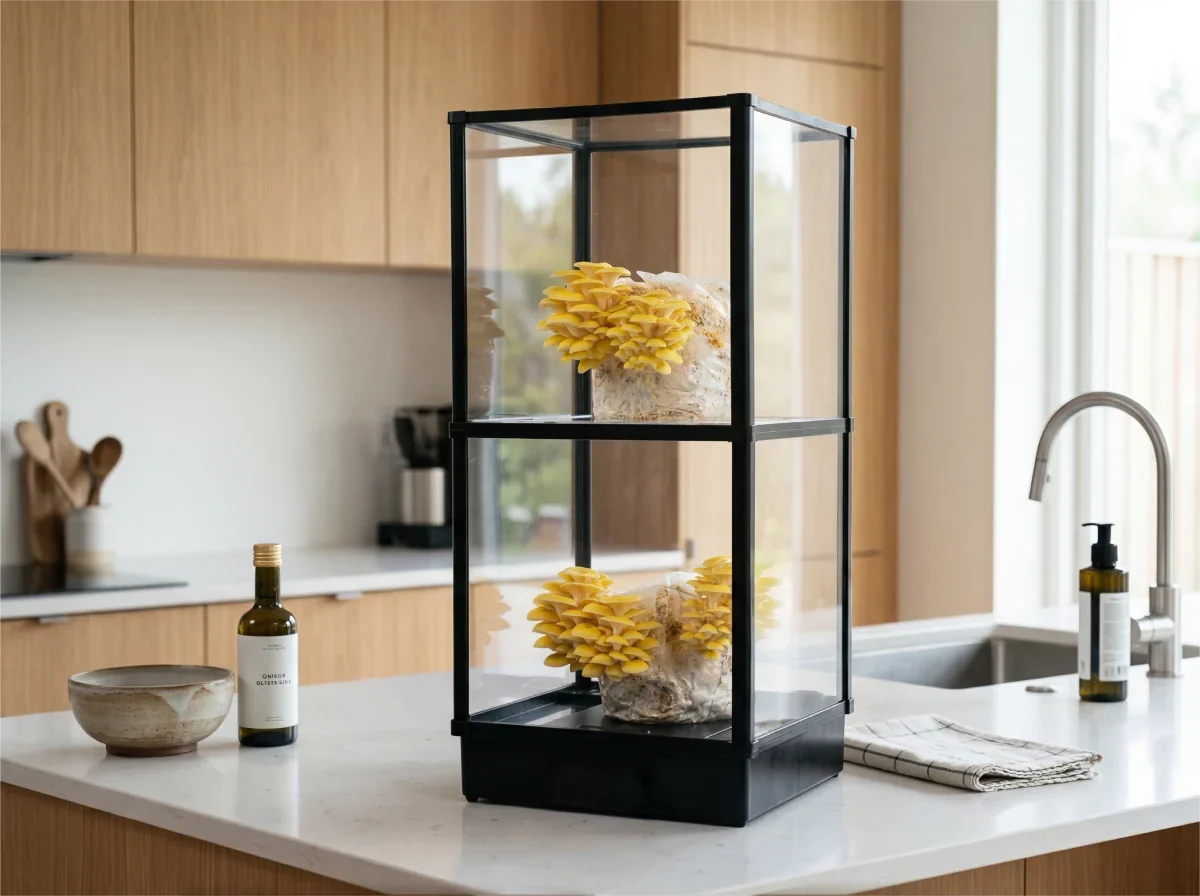
Pearl oyster (Pleurotus ostreatus) is the easiest gourmet mushroom for a first-time home grower. It tolerates 70 to 95 percent humidity, fruits at standard room temperature, and produces a 1.0 to 1.5 lb first flush from a 5 lb block within 7 to 14 days of opening the bag. Lion's mane (Hericium erinaceus) is the second-easiest and the favorite of growers in the wellness segment. Blue oyster, pink oyster, and yellow oyster are also beginner-friendly.
Is it legal to grow mushrooms at home in the US?
Yes, gourmet mushrooms (pearl oyster, blue oyster, pink oyster, lion's mane, shiitake, reishi, chestnut, and all culinary species) are legal to cultivate at home in all 50 US states with no permit required for personal use. Psilocybin-containing species (Psilocybe cubensis) are federally Schedule I and remain illegal except in Oregon and Colorado under specific decriminalization and therapeutic-use frameworks. Lykyn is gourmet only and does not sell psilocybin materials.
How much does it cost to grow mushrooms at home?
The sealed block plus chamber path costs about $315 to start ($299 chamber + $15 to $40 first grow block) and yields roughly $13 to $21 per pound of fresh mushrooms grown, which beats grocery store oyster pricing ($20 to $28 per pound at Whole Foods). DIY fruiting bag kits cost $40 to $80 each but have a 20 to 40 percent first-attempt failure rate for beginners. A full sterile lab setup runs $400 to $1,200 and is only cost-effective if you're running many simultaneous grows.
Do I need a sterile environment to grow mushrooms at home?
No, not if you use a pre-colonized sealed grow block. The block is already inoculated and colonized in a clean-room environment by the supplier, so contamination risk is minimal during the fruiting phase. You only need a sterile lab (flow hood, autoclave, agar plates) if you're inoculating substrates from scratch or cloning wild strains. For 99 percent of home growers, a sealed block plus a clean fruiting chamber is enough.
What's the smallest space I can grow mushrooms in?
A single-tier automated fruiting chamber with an interior volume of roughly 30 × 30 × 30 cm (12 × 12 × 12 inches) fits on a countertop, shelf, or desk and can grow up to a 6 lb block at a time, producing 1.0 to 1.5 lb of fresh mushrooms per cycle. The chamber's external footprint is roughly a 14-inch square. This works in a studio apartment, dorm room, or office. You do not need a basement, garage, or dedicated grow room.
How often can I harvest from one mushroom block?
A typical 5 lb gourmet mushroom block produces 2 to 3 flushes (separate harvest cycles) over 6 to 10 weeks before the substrate is exhausted. The first flush is the largest (1.0 to 1.5 lb for pearl oyster), the second flush is 30 to 50 percent of the first, and the third flush is smaller again. Cold-water soaking the block between flushes (12 hours submerged in distilled water in the fridge) helps trigger the next flush and improves yield.
What goes wrong most often for beginners?
The three most common beginner failures are (1) humidity dropping below 80 percent during pinning, which causes pins to abort; (2) inadequate fresh air exchange, which causes legginess (long thin stems, small caps) from CO2 buildup; and (3) harvesting at the wrong time (too early or too late). A chamber with a calibrated humidity sensor (±1.5 percent RH precision or better) and variable-speed intake/exhaust fans eliminates failures 1 and 2 structurally. Failure 3 is solved by learning the visual harvest signal: cap edges just starting to flatten out but not yet curling upward.
The Lykyn Beginner Path
We built Lykyn because we wanted to grow fresh mushrooms in our apartment kitchen without becoming amateur microbiologists. After two years of R&D, we shipped a chamber that handles the three things home growers fail at: hold humidity precisely (SHT3x-DIS sensor, ±1.5 percent RH), exchange air on a tunable schedule (variable-speed DFH4010S fans, 500 to 6000 RPM), and stay out of the way (Wi-Fi 2.4 GHz, iOS / Android / web app, no daily misting).
Paired with a pre-colonized pearl oyster, blue oyster, or lion's mane grow block, the beginner path is short:
- Plug in the chamber.
- Connect to Wi-Fi.
- Cut the block bag, place inside, close the door.
- Watch your phone for the humidity readout.
- Harvest in 7 to 14 days.
That's it. The chamber runs at ~5W max draw (about 2.2 kWh per month, less than a single LED bulb 24/7) and stays under 35 dB (quieter than a refrigerator). Lykyn ships from a US warehouse for the chamber and from our Istanbul manufacturing facility for replacement grow blocks. Support is a 2-person team at info@lykyn.com or 1-415-869-7955 (1 to 2 business day response).
If you want the easiest, most repeatable path to fresh mushrooms on your counter, start with the Lykyn chamber and a pearl oyster block. You'll be eating your first harvest within two weeks.
Fuel Your Mushroom Journey

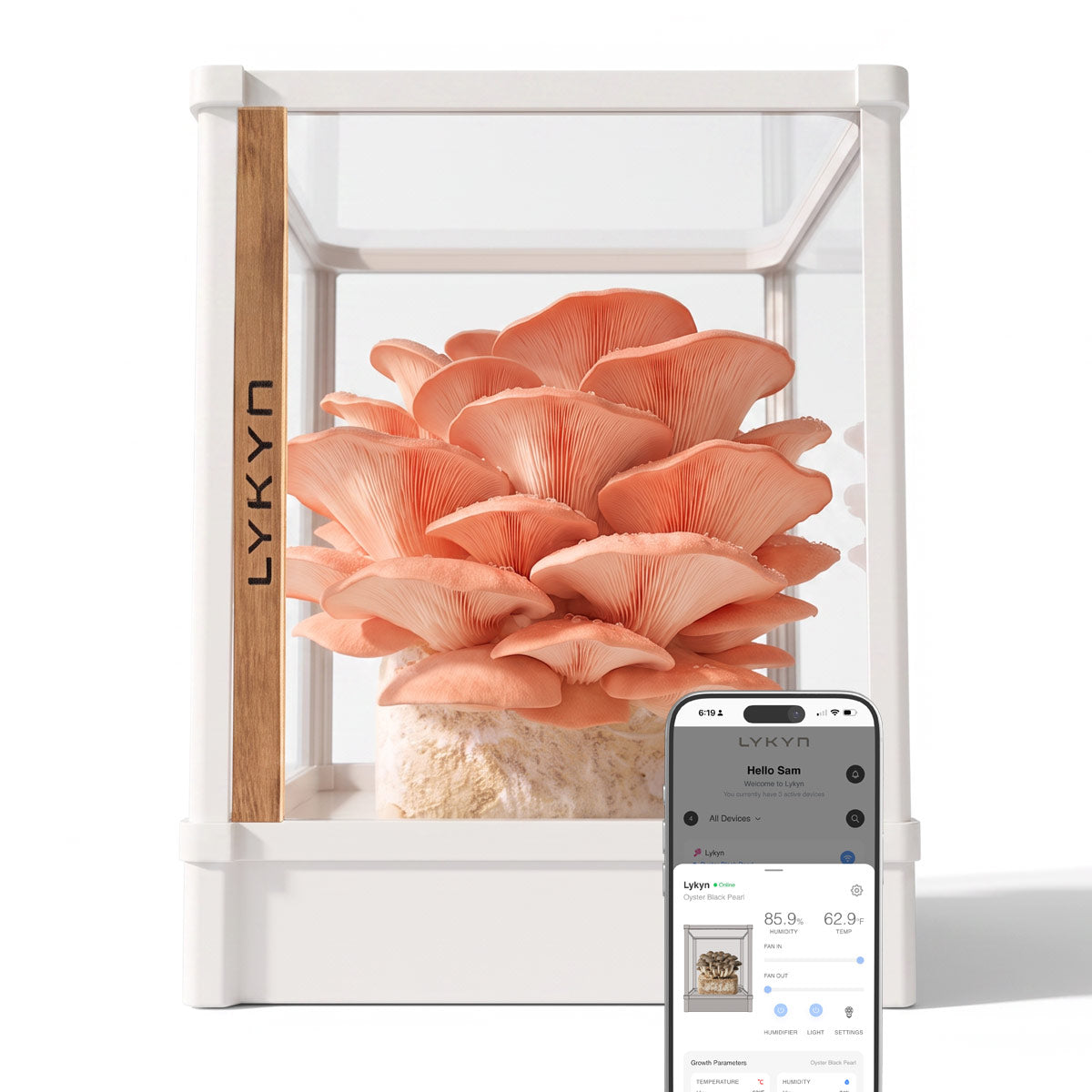
Smart Chamber. Bone White Single
- 2.8L tank, 90% humidity automatic
- App-controlled, plug-and-play
- 6 lb block ceiling, in stock

Smart Chamber. Obsidian Black Single
- Same hardware as Bone White
- Matte black premium finish
- Pairs with any kitchen palette

Sources
- Stamets, P. Growing Gourmet and Medicinal Mushrooms. Ten Speed Press, 3rd ed. Pearl oyster cultivation parameters, lion's mane bioactive compounds (erinacines, hericenones).
- Cornell Cooperative Extension, "Small-Scale Mushroom Cultivation". Oyster, shiitake, and lion's mane home cultivation guides; confirms no permit requirements for personal-use gourmet mushroom growing.
- USDA Agricultural Marketing Service, Specialty Crops classification of gourmet mushrooms.
- Hericium erinaceus bioactive research summary, peer-reviewed nutraceutical literature.
- US Drug Enforcement Administration, Schedule I controlled substances list (psilocybin and psilocyn).
- Oregon Measure 109 (2020) and Colorado Proposition 122 (2022), therapeutic and decriminalization frameworks for psilocybin.
- Lykyn Growing Team observations across 500+ growers, 2024 to 2026.
Meta
- SEO Title: How to Grow Mushrooms at Home: 3 Paths, 21 Days | Lykyn (58 chars)
- Meta Description: Grow mushrooms at home in 21 days using a sealed grow block plus chamber, a DIY fruiting bag, or a sterile lab. Pearl oyster, lion's mane, blue oyster covered. (155 chars)
Suggested Featured Image Prompt (for image-generator)
A bright, warm-lit kitchen counter scene. A single-tier Lykyn fruiting chamber (Bone White finish) is positioned at center on a clean light-wood countertop. Through the chamber's clear front door, a cluster of fresh pearl oyster mushrooms in mid-fruit is visible (caps 4-5 cm, soft tan-gray color, on a visible cream-tan colonized substrate block). Natural daylight from a window at left, soft and aspirational. No text overlay. Photorealistic, editorial home-magazine feel. Aspect ratio: 16:9 for blog hero.



Share:
How Long Does It Take to Grow Mushrooms? Honest Timeline
How to Prepare Lion's Mane Mushrooms in 5 Minutes | Lykyn