


Quick answer: An automated mushroom grow box is a self-contained appliance that holds a pre-colonized fruiting block and runs the four conditions mushrooms actually need: 85 to 95 percent humidity, fresh-air exchange on a timed cycle, species-specific LED light, and steady temperature. The good ones do this without daily misting, contamination drama, or guesswork. The category went from Kickstarter promises in 2019 to real appliances on the kitchen counter in 2026. This review walks through what these chambers actually do, where they are worth the money, where they fall short, and which one we recommend for which kind of buyer.
You are here because you have already done the homework. You have watched the unboxing videos, read the Reddit threads about whether a 400 ml humidifier is enough, and seen the side-by-side spreadsheets growers post in the comments. Instead of writing another 9-best-automated-kits listicle, we are going to write the review the way a friend who builds one of these for a living would write it: with the trade-offs, the failure modes, and a clear pick at the end.
We are Lykyn. We make a smart mushroom grow box. That is a bias you should know about up front. We have worked hard to keep this review honest about where we win, where we do not, and what the category as a whole still does poorly. If you spot a factual error, email info@lykyn.com and we will fix it.
What an automated mushroom grow box actually is
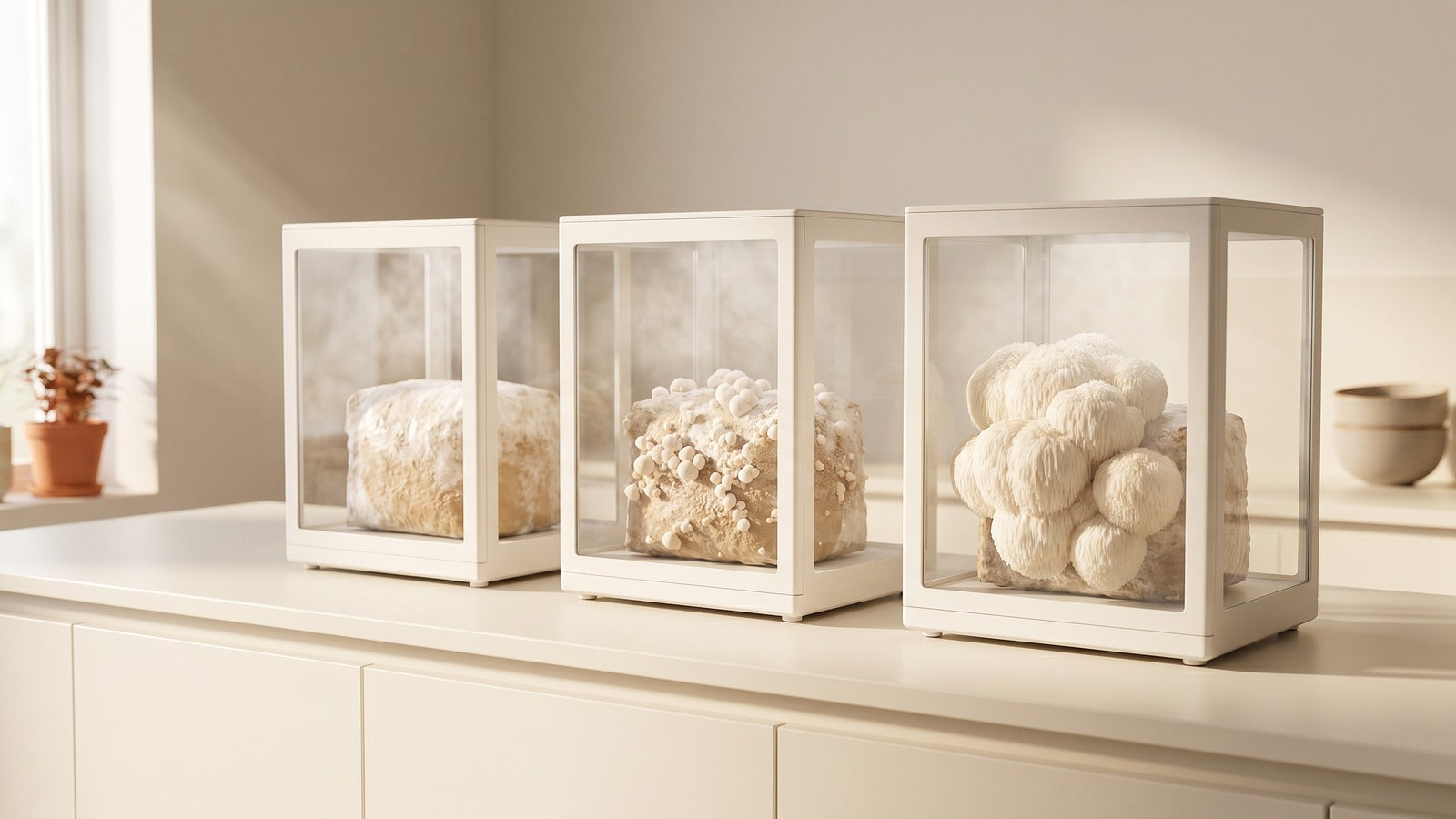
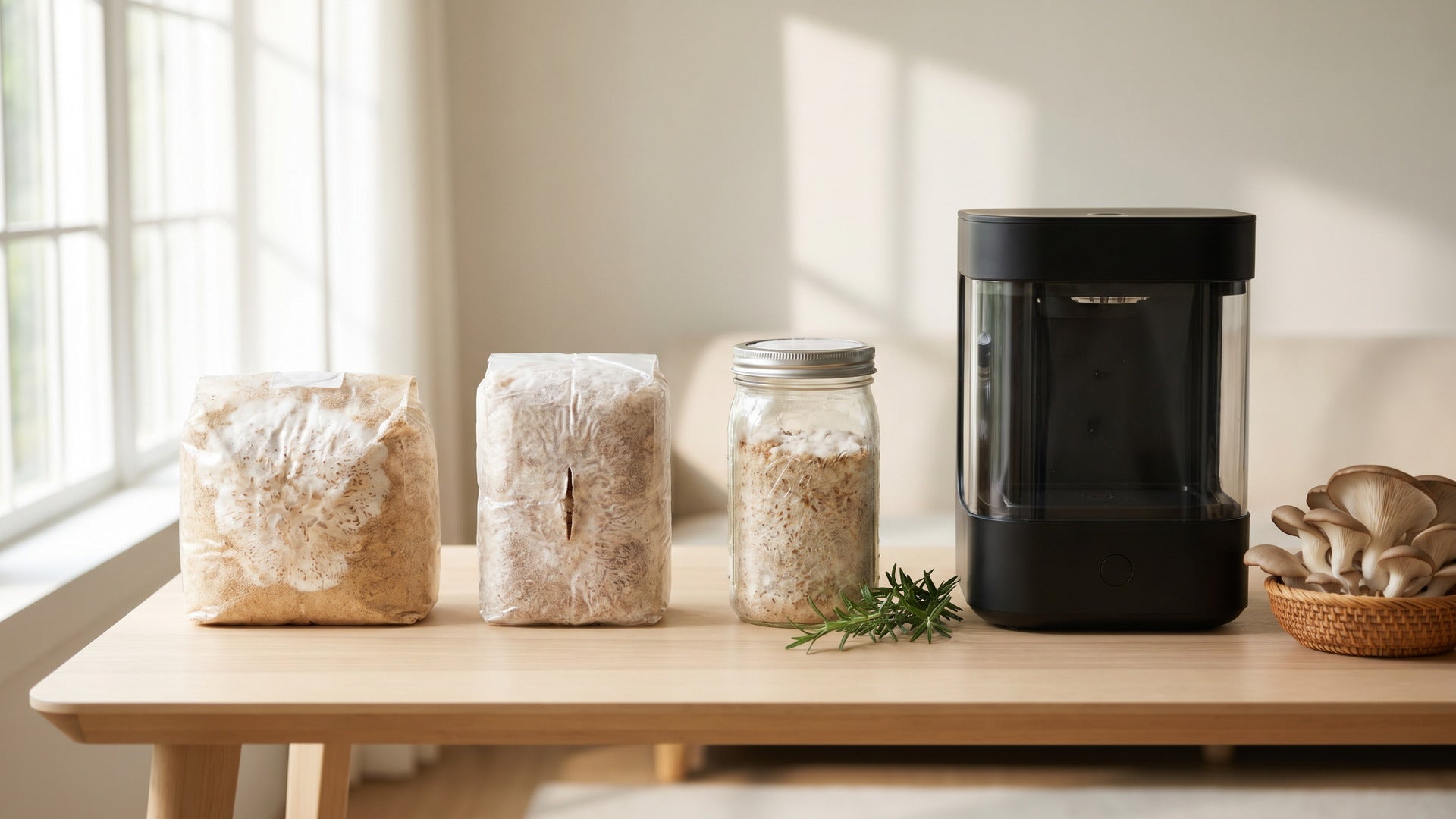
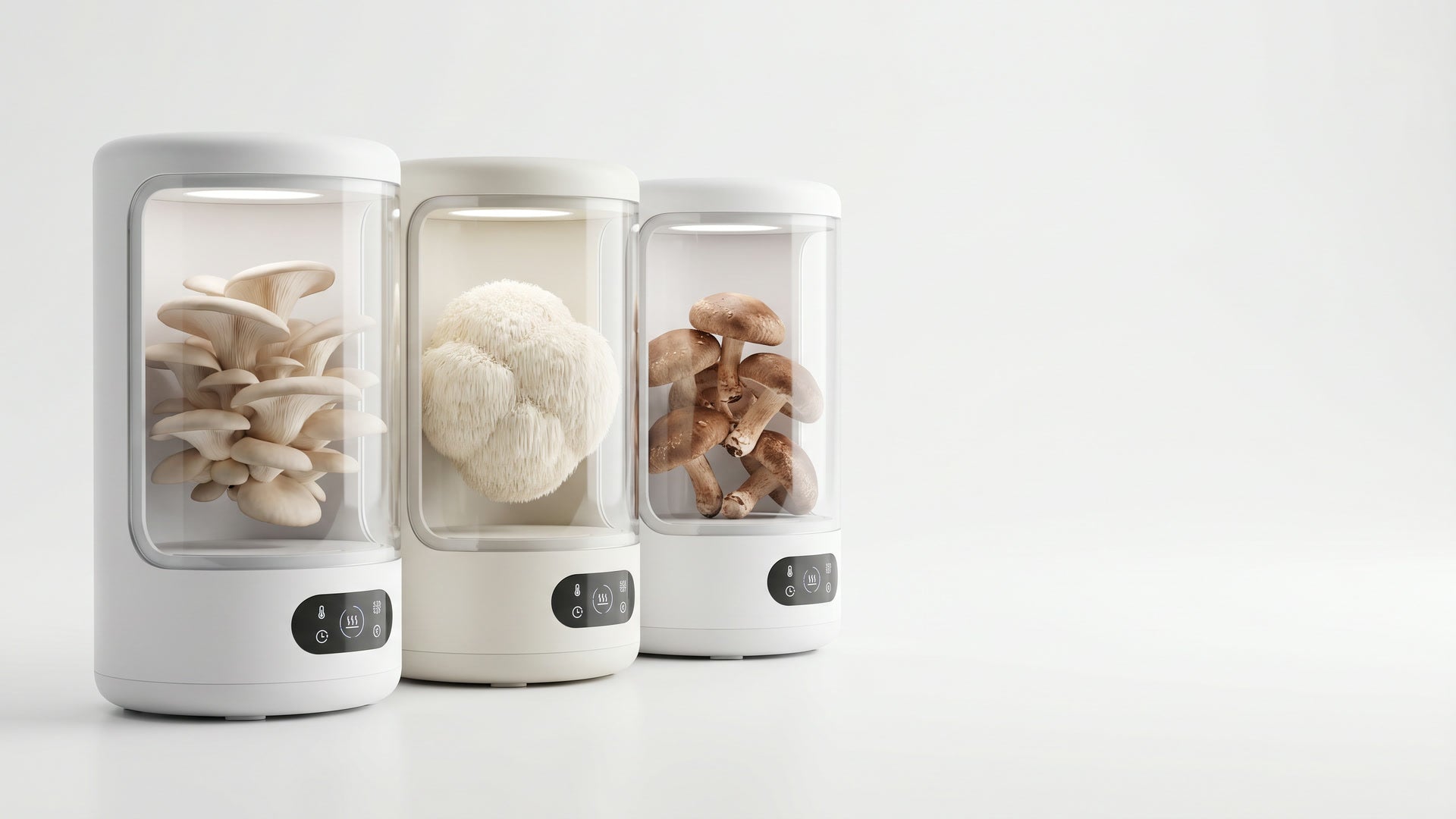
An automated mushroom grow box is a sealed chamber, usually with a transparent glass or acrylic front, that integrates a humidifier, sensors, fans, and LED lighting into one appliance. You drop in a pre-colonized fruiting block, you select a species in the app, and the chamber runs the environmental program calibrated for that species until your mushrooms are ready to harvest. No daily misting. No DIY martha tent. No hygrometer reading at 7 a.m. before work.
The category exists because the three things home growers traditionally got wrong are exactly the three things that destroy a fruiting block:
- Humidity dropping too low (block dries out, pins abort, yield collapses)
- No fresh-air exchange (CO2 builds up, mushrooms stretch into long spindly stems instead of forming proper caps)
- Wrong light cycle for the species (no light at all and oysters never form pins, too much direct sunlight and the block dries out)
A smart chamber automates all three. Add a clean glass front so you can watch the grow and a phone app so you can monitor it from work, and you have got the category as it exists today.
What an automated mushroom grow box must do
Before you buy any chamber, check that it does all five of these things. A smart grow box must:
- Hold humidity in the 85 to 95 percent RH range without manual intervention.
- Run a fresh-air exchange cycle on a schedule (typically 6 to 12 times per day, 60 to 120 seconds per cycle).
- Provide species-specific lighting (LEDs in the visible spectrum, not UV, on a programmable schedule of roughly 12 hours on, 12 hours off).
- Maintain temperature stability at the room ambient (most home chambers do not actively heat or cool, but they should not add heat either).
- Make fruiting-block replacement a simple drop-in operation that takes under two minutes.
That is the spec sheet to print before you shop. If a chamber does not do all five, it is not a true automated grow box. It is a sealed plastic tub with marketing.
The 4 key automated functions, explained
This is where the cheap smart kits and the real ones diverge. Every category lives or dies by how well the appliance handles these four jobs.
1. Humidity automation
Mushrooms fruit when the relative humidity stays between 85 and 95 percent. Drop below 80 percent for more than a few hours and pins (the tiny baby mushrooms) abort. Run above 95 percent for too long and you invite contamination.
What automated actually means: an ultrasonic piezo humidifier, a real humidity sensor (the SHT3x-DIS, accuracy plus or minus 1.5 percent RH, is industry standard), and a control loop that runs the humidifier in short pulses when the reading drops. Bad implementations use a single threshold (humidifier on at 80 percent, off at 90 percent) and oscillate wildly. Good implementations ramp the humidifier in proportion to the gap, hold the band tight, and stop fogging the chamber unnecessarily.
Tank size matters more than people expect. A 400 ml humidifier on a Pink Oyster grow runs dry in 24 to 36 hours and you are refilling daily. A 2.5 to 3 liter tank lasts most of a grow cycle without intervention. The Lykyn smart mushroom grow box ships with a 2.8 liter tank for exactly this reason. We got tired of customers having to babysit small tanks.
2. Fresh-air exchange (FAE)
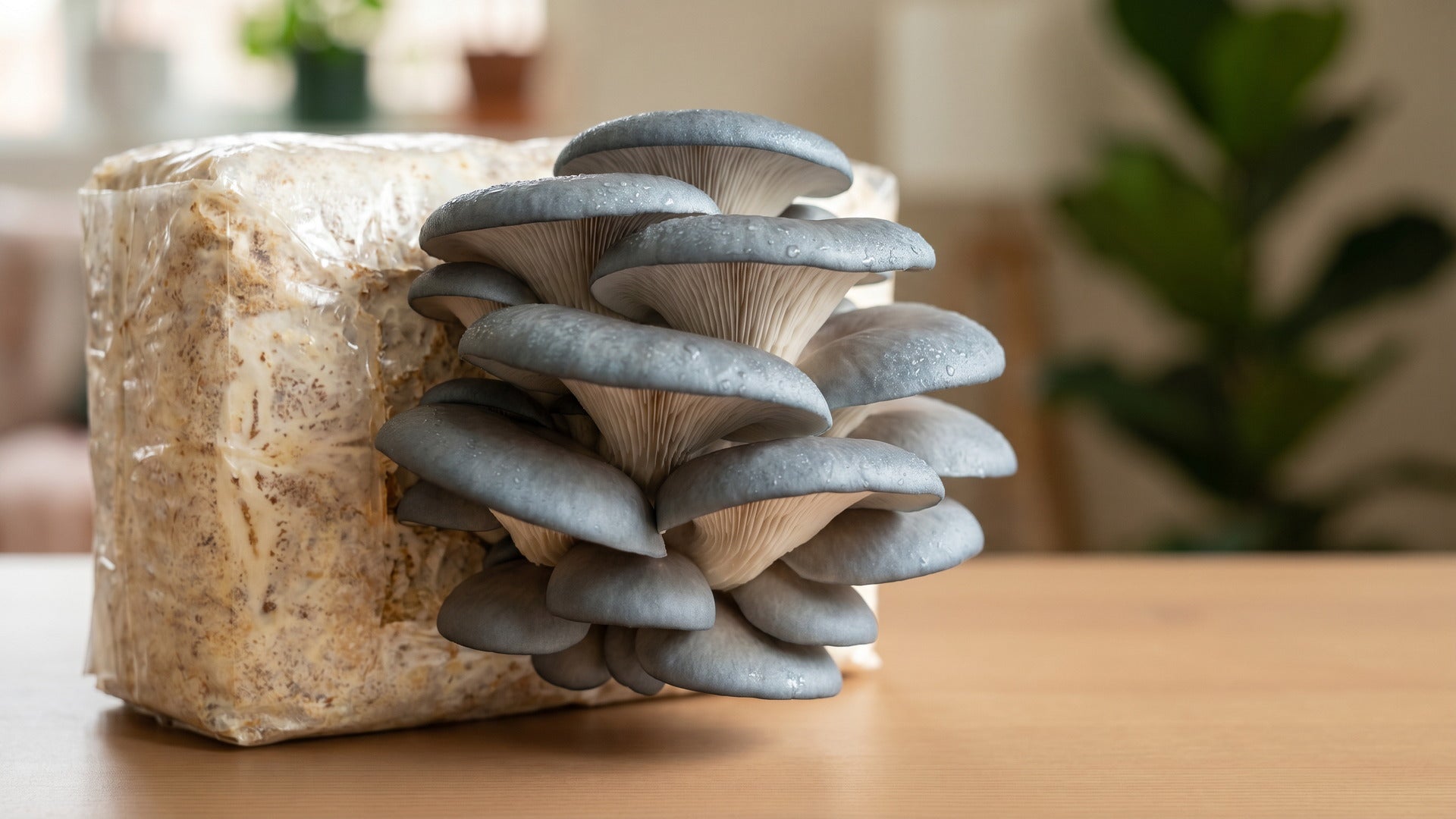
CO2 is the silent killer of home grows. Mushrooms exhale CO2, and in a sealed chamber that gas pools and forces the fruiting bodies to stretch upward looking for fresh air. The classic symptom: tall thin stems, tiny caps, leggy oysters that look nothing like the store-bought version.
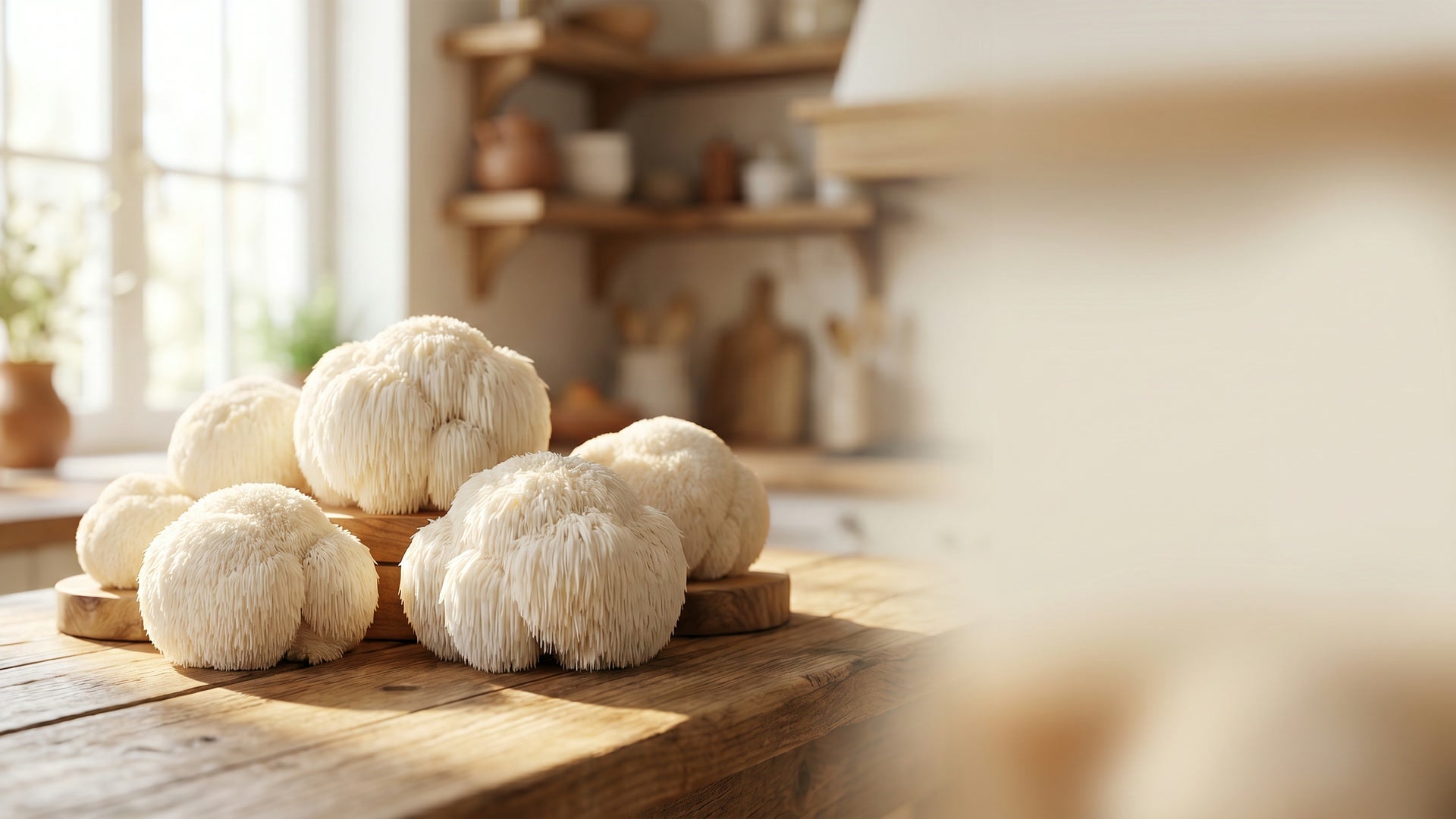
The fix is a programmable fresh-air-exchange cycle. The chamber fans pull room air through a built-in filter (so you are not pulling mold spores in with the air) and push the old humid CO2-rich air out, usually 6 to 12 times per day for 60 to 120 seconds each cycle, calibrated to species. Pink Oysters want more FAE (they are prolific CO2 producers), Lion's Mane wants less (it likes the calm).
Variable-speed fans matter here too. A fixed-speed fan that only runs at one RPM either undershoots or oversleeps the FAE need depending on species. Variable RPM (the Lykyn chamber runs its DFH4010S fans at 500 to 6,000 RPM) lets the same hardware tune itself to whatever is growing.
3. Species-specific LED lighting
Mushrooms are not plants. They do not photosynthesize. So why do they need light at all?
Answer: most cultivated species use light as a signal to start pinning. Without light, the substrate keeps colonizing but never forms fruit bodies. The light spectrum does not need to match daylight, but it does need to include some blue and some red, and it needs to be on a consistent schedule (typically 12 hours on, 12 hours off).
Good automated chambers run three LED channels: blue (around 465 to 475 nm), red (around 620 to 630 nm), and sometimes green (around 515 to 525 nm) for visual appeal. Each species gets a different blend. Lion's Mane prefers a calmer cycle with more red. Pink Oysters tolerate brighter blue. A chamber with one fixed LED color stripe is a chamber that is only really tuned for one species, no matter what its marketing claims.
4. Temperature, the spec that is often missing
Here is a category-wide honest read: most home automated chambers do not actively heat or cool. They run at room temperature. The Lykyn chamber is one of those. We publish this in our spec sheet. The reason is that a home heater or cooler the size of a fruiting chamber would consume 5 to 10 times the energy budget of the rest of the appliance combined, and you would have a unit that costs $800 instead of $299.
For most species in most US homes, this is fine. Oyster species fruit happily between 65 and 75 F, which matches a typical heated home. Lion's Mane prefers 60 to 70 F. Shiitake likes 55 to 65 F. If you live in a tropical climate or your home runs hot in summer, a small under-cabinet seedling heat mat for cold winters or a basement spot for hot summers solves the problem at $25 to $40, not $500.
The chambers that do heat or cool tend to be commercial-scale fruiting rooms, not consumer appliances. Anyone selling you a $299 chamber with full HVAC built in is either lying about one of those specs or about to ship a product that bricks within 6 months. Read the small print.
What manual setups get wrong (and why the category exists)
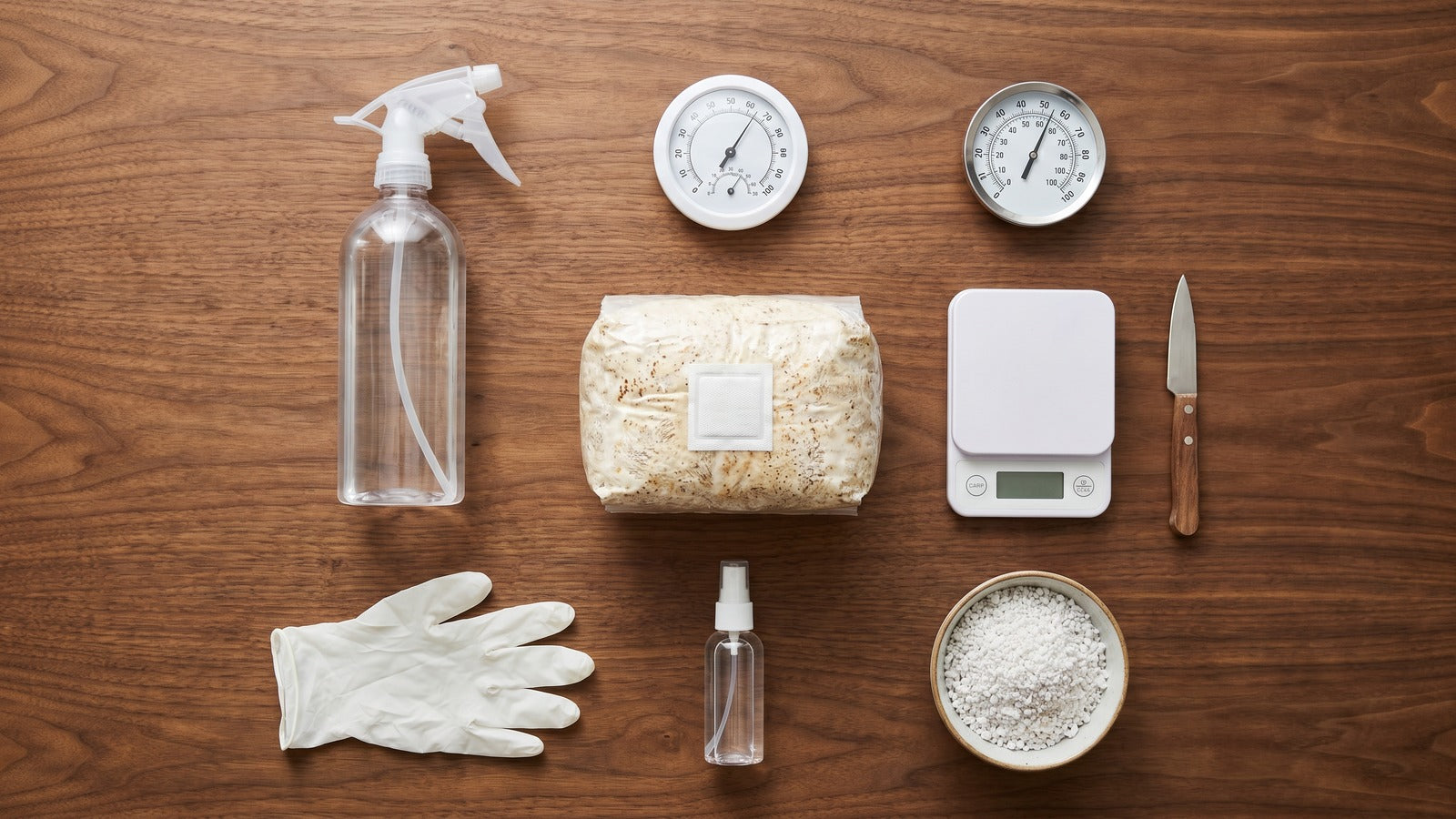
The traditional alternative is a DIY martha tent or shotgun fruiting chamber: a clear plastic tub, perlite layer for humidity, holes drilled for air exchange, a small fan, a hygrometer, and a lot of misting. Real growers built thousands of these between 2010 and 2020, and most of them work.
The reason the automated category exists is that the failure points of a DIY chamber are all human:
- Forgot to mist for 8 hours. Humidity drops to 60 percent. Pins abort. Yield halves.
- Misted too aggressively. Standing water on the substrate. Contamination at week two.
- No accurate hygrometer. The cheap $8 unit on Amazon reads 70 percent when reality is 85 percent. You fix the humidity by misting more, and now you have standing water.
- Inconsistent FAE. Manual fanning twice a day is not equivalent to a programmable 8-cycle-per-day exchange.
- Light forgotten entirely. Most beginners never give the chamber a light cycle and wonder why pinning never starts.
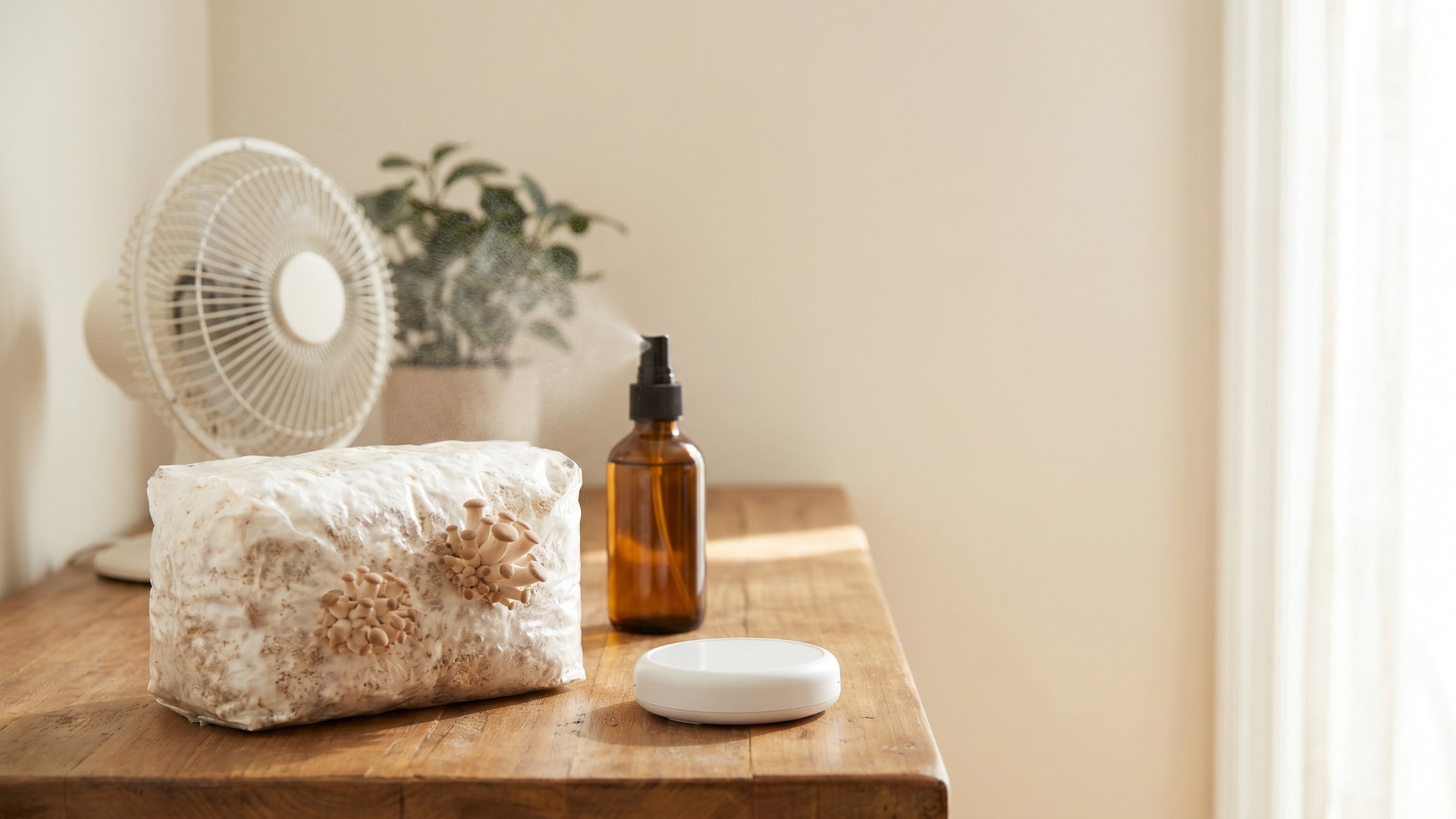
Smart chambers automate these failure points away. That is the entire value proposition. You are not paying $299 for a fancy box. You are paying for sensors that do not lie, a humidifier that does not sleep, and a fan schedule that does not depend on your memory at 11 p.m.
The smart-appliance comparison angle
The honest mental model: an automated mushroom grow box is closer to a Nespresso machine than to a planter. Both replace a high-skill manual ritual (pulling shots vs misting twice a day) with a one-tap operation. Both have a consumable (pods vs fruiting blocks). Both rely on a closed environment to deliver consistent results without you understanding the underlying craft.
The category-defining trade-off is the same too: convenience vs control. The most automated chambers give you no override controls. The most flexible chambers expect you to learn what humidity, FAE, and lighting actually do. The good products in the category sit in the middle.
The Lykyn smart mushroom grow box ships with species presets for 28 plus mushrooms (Lion's Mane, every oyster variant, Shiitake, Pioppino, King Oyster, Reishi, Cordyceps, Pink Oyster, Black Pearl, Cinnamon Cap, Chestnut, and more), and lets you override humidity, fan RPM, and LED color when you want to experiment. That is the philosophy we landed on after 2 years of customer interviews. Other chambers in the category run more locked-down preset systems (closer to the Nespresso end) or more open ones (closer to a research lab terminal).
The Lykyn vs Shrooly comparison goes deeper on this exact axis if you want the head-to-head.
The Lykyn deep review: specs, app, build quality, value
Since we are the brand writing this, here is the full self-disclosure section. Treat it as a reviewer would treat a brand they are covering: with all the warts visible.
Hardware specs
| Item | Spec |
|---|---|
| Internal chamber | 30 x 30 x 30 cm (Single-Tier) |
| Glass front | Tempered glass, transparent, no tint |
| Humidifier | 2.8 L tank, ultrasonic piezo, 0 to 100 percent RH band |
| Sensor | SHT3x-DIS, plus or minus 1.5 percent RH and plus or minus 0.1 C |
| Fans | 2x DFH4010S, variable 500 to 6,000 RPM, filtered |
| LED | Blue 465 to 475 nm, Red 620 to 630 nm, Green 515 to 525 nm, programmable |
| Controller | ESP32-C3-Mini-1 (Wi-Fi 2.4 GHz + Bluetooth) |
| Power | 5V 1A USB-C |
| Noise | Under 35 dB |
| Energy | About 2.2 kWh per month, 5W peak |
App and build quality
The app runs on iOS 12 plus, Android 8 plus, and a web client. Setup is a Bluetooth pairing flow followed by a Wi-Fi handoff (2.4 GHz only, the ESP32-C3 controller does not speak 5 GHz, and the documentation makes this clear). Once paired, the chamber pulls firmware updates over the air. We have shipped four firmware revisions in the last 12 months, including a humidity-ramping curve that improved pin set rates on Lion's Mane and a Wi-Fi auto-reconnect fix that cleaned up an issue several customers reported. See the full smart mushroom grow box spec page for the current firmware version.
The build is what you would expect from a 2-year-old hardware company at $299. The body is Bone White or Obsidian Black molded plastic. The glass is real tempered glass, not acrylic, which matters for cleanability and scratch resistance. There are no physical buttons (factory reset is 5 plug/unplug cycles within 30 seconds, which is a recovery path you will hopefully never need). The interior is matte and easy to wipe.
User experience, day by day
The first grow is the hardest. You unbox the chamber, plug it in, pair it, drop in a block, pick a species in the app, and the chamber starts running its program. Days 1 to 5 are quiet. The humidifier pulses on and off, the fans run their scheduled cycles, the LEDs do their thing. Days 5 to 8 you start to see pins forming on the block. Days 8 to 12, depending on species, you harvest. Then you wait a few days for the second flush. Most blocks give 2 to 3 flushes total.
The points where the chamber is genuinely good: humidity stays in band, no contamination if you keep the chamber clean between blocks, yields are reproducible across grows. The points where the chamber asks something of you: refilling the 2.8 L tank every 4 to 6 days depending on FAE intensity, and remembering to clean the chamber walls between blocks.
Where Lykyn falls short (the honest list)
In the spirit of writing the review as a reviewer rather than a marketer:
- No active temperature control. As covered above, this is a category-wide limitation but it is still a real one.
- Power adapter NOT included. Lykyn $299 price ships without a USB-C power adapter in the box. Any 5V 1A phone charger works, but the surprise on unboxing is not pleasant. This is a documented friction point we hear from customers regularly.
- No 5 GHz Wi-Fi. The ESP32-C3 controller only speaks 2.4 GHz. Some mesh routers default-broadcast 5 GHz only or have band-steering enabled, and the workaround (temporarily disabling band-steering during setup) trips up about 1 in 20 setups.
- Software-inferred water level. There is no physical water-level sensor. The chamber estimates tank level by tracking humidifier runtime, which works but is not perfect. A small overage at refill time is normal.
- 30-day return window. The Lykyn standard return window is 30 days. The hardware warranty is 1 year and we have a V2 upgrade pathway for legitimate hardware issues, but if buyer remorse is your fear, this is shorter than the 90-day money-back guarantees competitors offer.
Value: what $299 actually gets you
Yield economics: a 6 lb Lion's Mane fruiting block ($20 to $25) gives 1.5 to 2.5 lb of fresh mushrooms over 2 to 3 flushes. At retail Lion's Mane prices of $15 to $20 per pound, one block returns $25 to $50 of fresh mushrooms. Three to four blocks (a few months of growing) gets you to break-even on the chamber at the per-gram level. Over a year of growing, the appliance is materially cheaper than the equivalent fresh-supplement spend.
That math is honest for a regular mushroom user. If you grow once and decide it is not your hobby, the chamber does not pay back. The 30-day return window is your friend in that case.
Alternatives to look at
This is a small but real category. The other products worth knowing about as of May 2026:
- Shrooly ($349): smaller, prettier, pod-based ecosystem with 7 species presets. Best fit for apartment first-timers who want a curated experience. The full comparison lives in our Lykyn vs Shrooly review.
- FreshCap chambers (around $400 to $500): higher-end, focuses on the experienced-grower market. Lykyn vs FreshCap breaks it down.
- DIY martha tent: $40 in materials plus a hygrometer plus a small fan. Lower cost, much higher maintenance, slower learning curve.
- Higher-end commercial fruiting chambers: $1,000 to $3,000 plus. Make sense for small farms or restaurants, overkill for home use.
The indoor mushroom growing kit hub page lists more options if you want to scan the whole category at once. The mushroom fruiting chamber page has the technical deep-dive on what fruiting chamber actually means as a piece of equipment.
If you are still deciding whether automation is for you at all, the best mushroom grow kit for beginners guide compares automated vs DIY at the beginner level.
Frequently asked questions
Are automated mushroom grow kits worth it?
Honestly, it depends on how much you would grow. If you go through 4 or more fruiting blocks per year (roughly one every 3 months), an automated chamber pays back at the per-gram level in 6 to 12 months and gets cheaper every year after that. If you grow once or twice and stop, the math does not work and a low-cost DIY tabletop kit is the better starting point. The other worth-it factor is your tolerance for daily misting. If you travel often or forget to water plants, the time savings alone are worth the cost.
Do automated mushroom grow kits work?
Yes, the good ones reliably work. Success rates above 90 percent on first-time grows are typical for quality automated chambers, compared with 40 to 60 percent first-time success rates for DIY martha-tent setups. The reason is that automation removes the three failure modes that kill most beginner grows: forgotten misting, no fresh-air exchange schedule, and no light cycle. The cheap smart kits under 100 dollars generally do not work as advertised because they skip one or more of the four automated functions (humidity, fresh-air exchange, lighting, temperature stability).
How do automated mushroom grow boxes work?
A pre-colonized fruiting block goes into a sealed chamber with a glass front. Sensors measure humidity and temperature. An ultrasonic humidifier pulses on when humidity drops below the target band (typically 85 to 95 percent for fruiting). Fans run a fresh-air exchange cycle on a schedule, pulling room air in through a built-in filter and pushing CO2-rich air out. LEDs run a programmable light cycle to trigger pinning. The app holds species presets so you select Lion's Mane or Pink Oyster and the chamber configures everything for that species. You wait 7 to 14 days, harvest, and refill water as needed.
How much does an automated mushroom grow kit yield?
A 6 lb fruiting block typically yields 1.5 to 3.5 pounds of fresh mushrooms over 2 to 3 flushes. Yield varies by species (Pink Oyster runs higher, Lion's Mane runs lower), block freshness, and how well the chamber holds conditions. Lykyn's published guidance is 1.25 lb on a typical Lion's Mane first flush. Cheaper pod-based systems in the category yield less per grow (3 to 4 servings, roughly 0.25 to 0.4 lb) because the pods are physically smaller.
Can mushroom grow kits be reused?
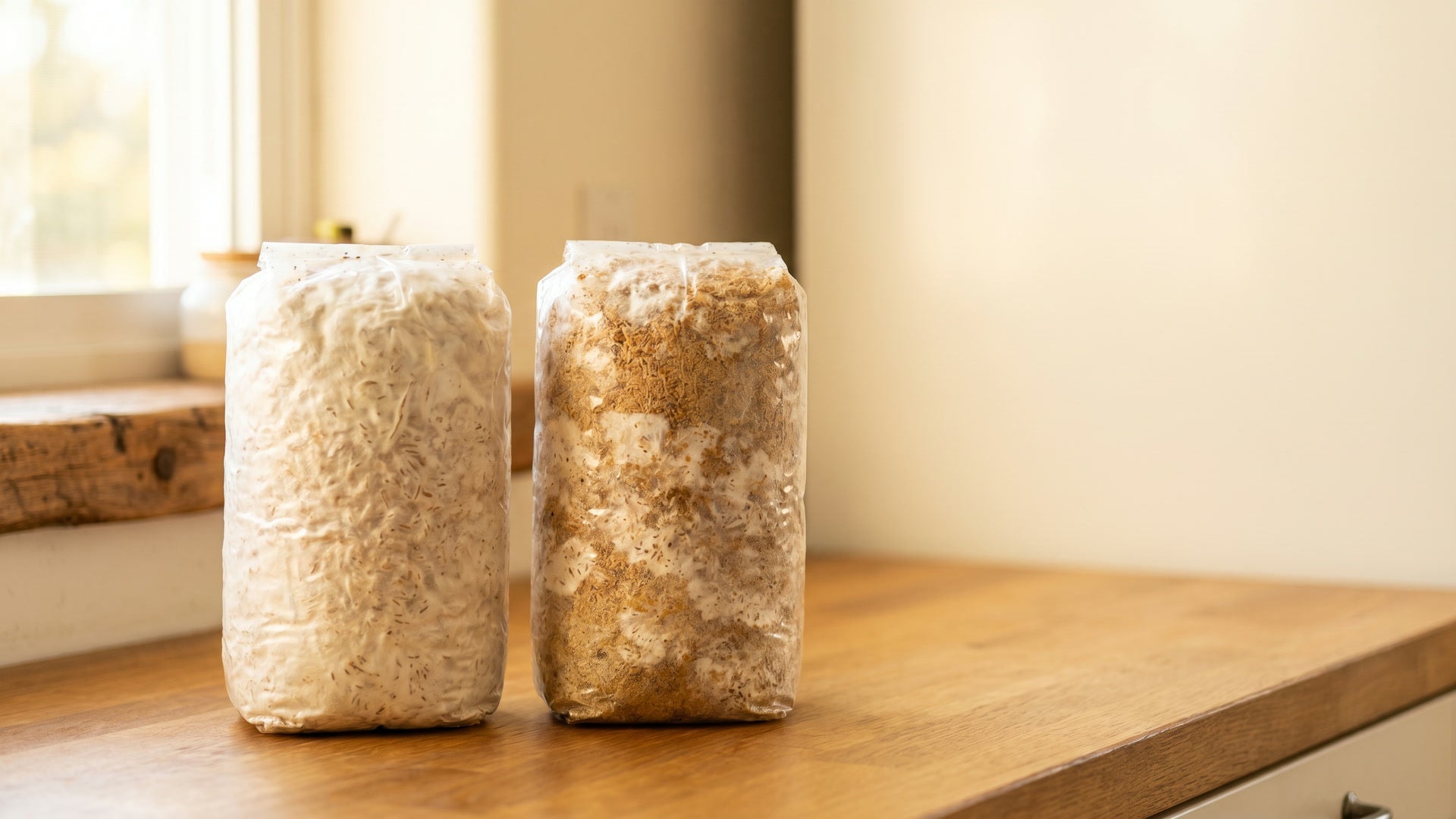
The chamber itself is reused indefinitely with proper cleaning between blocks (wipe interior with food-safe cleaner, run a tank-only humidifier cycle, drop in the next block). The fruiting block is single-use and gives 2 to 3 flushes before the substrate is spent. After the block is done, the spent substrate makes good outdoor garden compost or can be inoculated outdoors as a guerilla-mycology project (it will not fruit indoors anymore). You replace blocks, you do not replace the chamber.
Do mushroom grow kits expire?
Pre-colonized fruiting blocks have a shelf life of roughly 4 to 8 weeks if kept refrigerated at 35 to 45 F (a normal fridge). At room temperature, blocks should be set up to fruit within 2 to 3 weeks of receiving them. The mycelium is alive and consuming nutrients, so a block that sits too long arrives partially colonized through the second flush instead of giving you a full first flush. Buy blocks for grows you will start within a month.
How long do automated mushroom grow kits last?
The chamber hardware itself, well-maintained, lasts 5 to 10 plus years. The wear items are the humidifier (ultrasonic piezos eventually mineralize and need cleaning or replacement every 12 to 24 months), the fan filters (every 6 to 12 months), and the water tank seals. Most quality chambers have a 1-year hardware warranty (Lykyn does), and reputable brands sell replacement parts or upgrade pathways for older units rather than asking you to buy a whole new unit.
Is a smart mushroom grow box better than a DIY chamber?
For a beginner growing 4 or more blocks per year, yes, the smart chamber wins on success rate, time invested per grow, and yield consistency. For an experienced grower with a dedicated grow space who wants total control, a DIY chamber is cheaper and infinitely tunable. The smart-chamber argument is strongest for the segment in between: home cooks, wellness shoppers, and busy professionals who would love fresh mushrooms but will not realistically mist a tub at 7 a.m. every day.
Final verdict
If we had to write one sentence on a Post-it: an automated mushroom grow box is worth it for anyone who plans to grow mushrooms more than four times a year and values consistent results over the cheapest possible startup cost. That is a real, narrower endorsement than "everyone should buy one". For occasional grows or pure curiosity, the low-cost beginner kits are the right entry point.
If you have decided automation is the right path, the choice today is essentially a small set: Lykyn, Shrooly, FreshCap, and a few less-mature contenders. We are biased, obviously, but we built the Lykyn smart mushroom grow box for the buyer who wants the species range, the bigger block format, and the open ecosystem. The 1-year warranty, the V2 upgrade pathway, and the 28 plus species library are the parts of the value proposition we would defend at any review desk.
Ready to try one? The Lykyn Smart Mushroom Grow Box is in stock today. Pair a chamber with a Lion's Mane or Pink Oyster block from the mushroom fruiting chamber page, plug in the USB-C, and you will be harvesting in 7 to 14 days depending on species.
Sources
- USDA Agricultural Marketing Service mushroom production resources
- Cornell University Mushroom Extension controlled environment cultivation guides
- Mycologia, journal of the Mycological Society of America peer-reviewed work on automated fruiting environments
- USDA National Agricultural Statistics Service Mushroom report category trends and yield benchmarks
Methodology note: This review is written from Lykyn perspective as a manufacturer in the category, but follows the consumer-electronics review framework used by independent outlets. Yield figures, species presets, and hardware specs are from published Lykyn documentation as of May 2026. Competitor specs reference the most recent public information from each company website. If you spot a factual error, email info@lykyn.com and
Share:
Elm Oyster Mushroom: The Complete Guide to Nature's Superior Oyster Variety
White Elm Oyster Mushroom: The Complete Guide to Nature's White Gold