




Pioppino (Agrocybe aegerita, also called Black Poplar mushroom, Italian Chestnut, tea tree mushroom, or piopparello) is a gourmet edible cluster-forming mushroom. Pre-colonized hardwood sawdust blocks fruit in 14 to 21 days at cooler temperatures (50 to 65 degrees Fahrenheit) with sustained high humidity (85 to 95 percent). A 5 to 6 pound block produces tight bouquet-like clusters of 20 to 40 slender cream stems with glossy chestnut-brown caps, yielding roughly 0.75 to 1 pound across two flushes. The flavor is earthy, nutty, and slightly peppery, with stems that hold their shape through long cooking. It is not psychoactive.
How to grow pioppino mushrooms in 7 steps
- Acclimate the block at 50 to 65 degrees Fahrenheit for 24 hours. Pioppino is a cool-season species and pinning slows dramatically above 75 degrees.
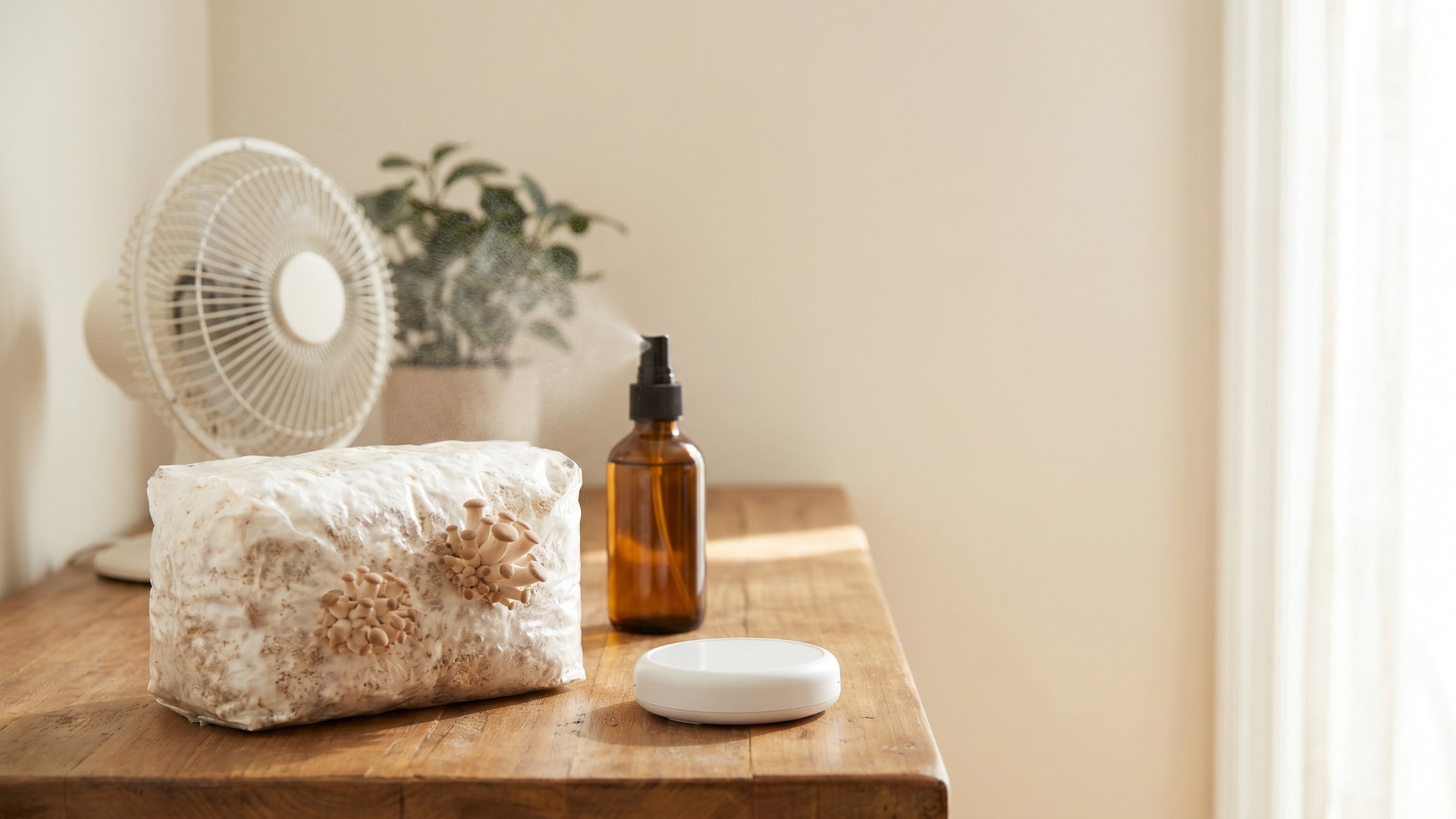
- Open the bag at the top of the colonized hardwood sawdust block, fully if you are fruiting in a chamber, or cut a single 2-inch slit if you are using a humidity tent.
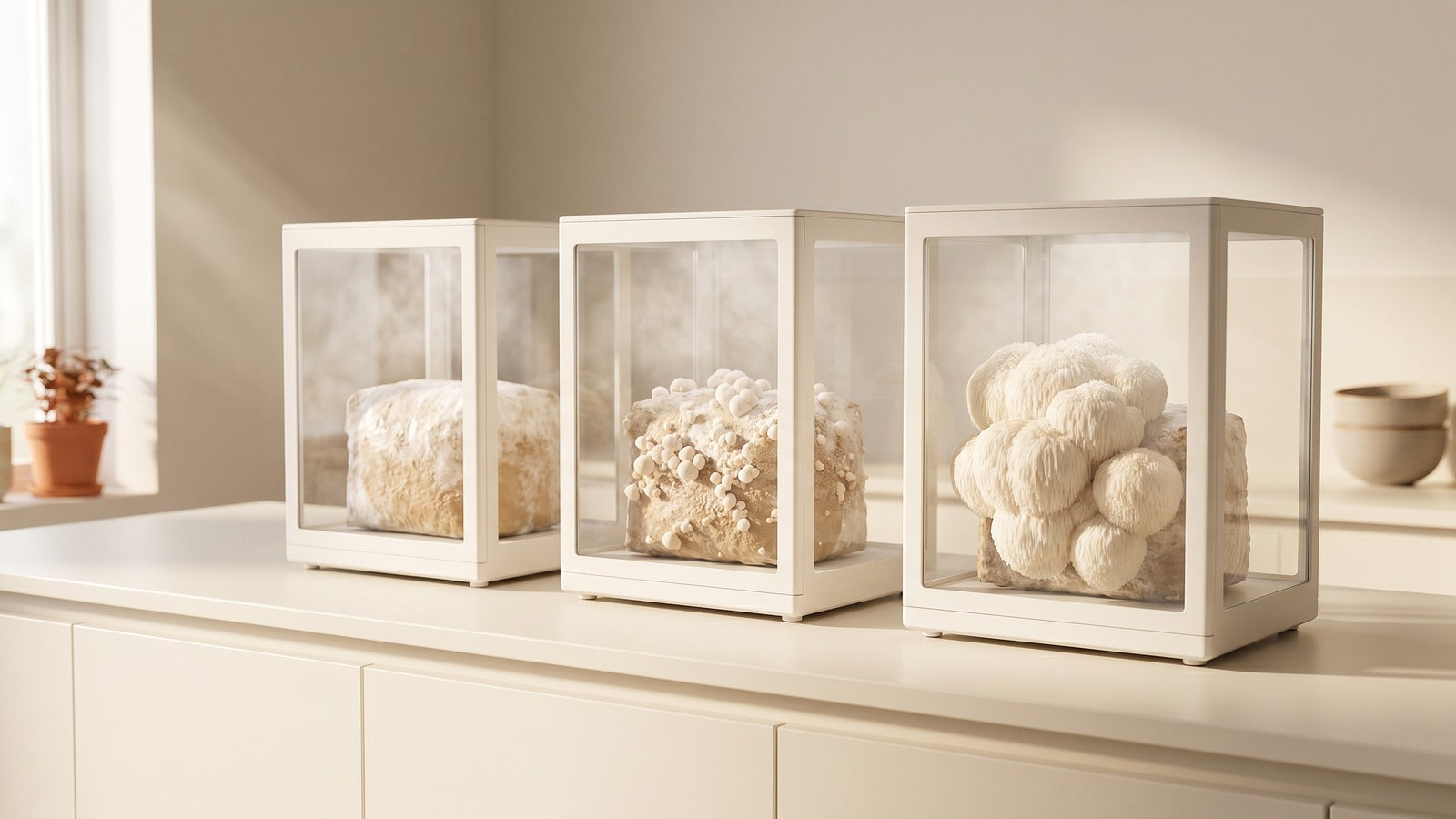
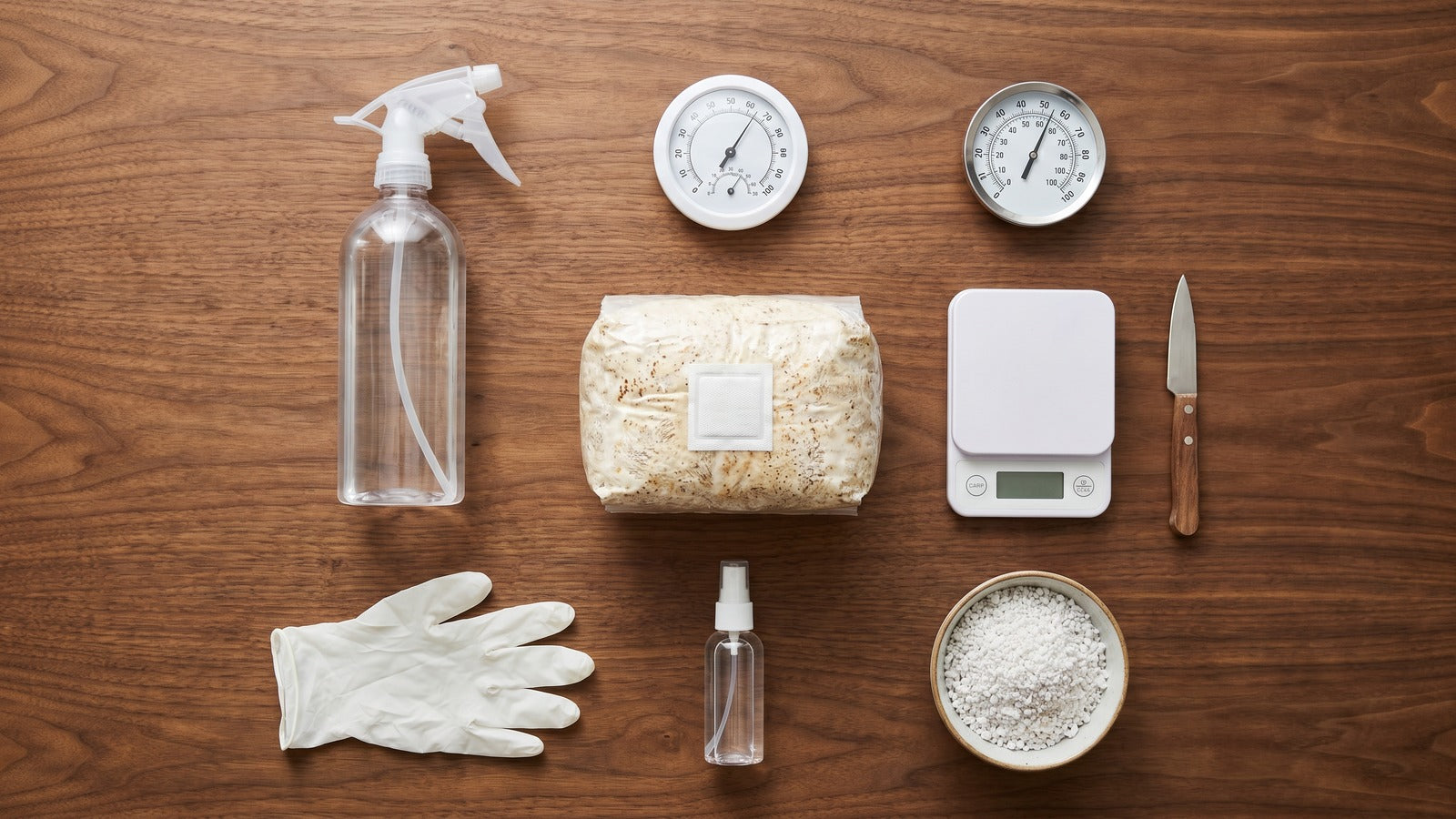
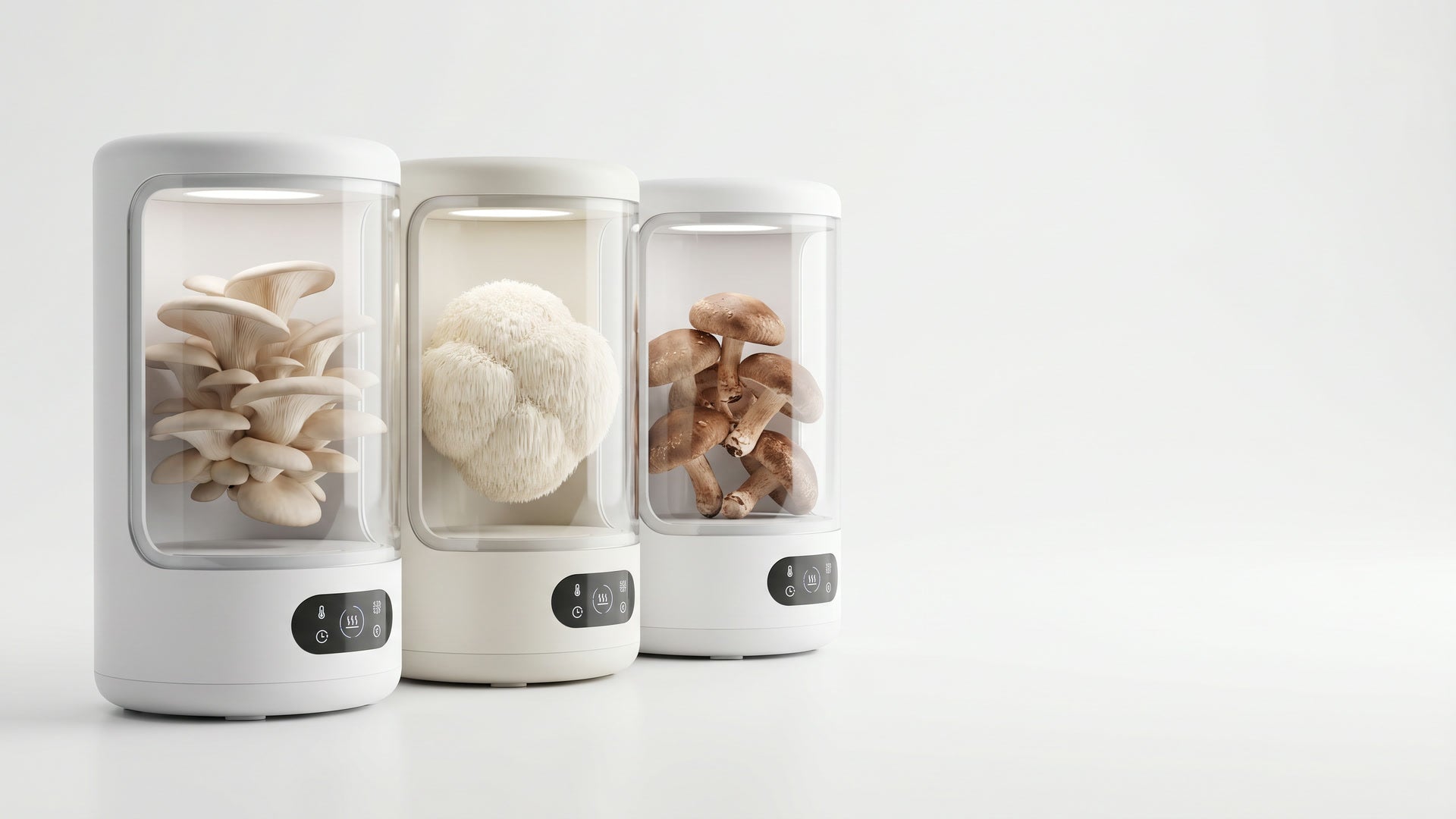
- Place the block in a growing environment that holds 85 to 95 percent relative humidity at 50 to 65 degrees Fahrenheit. A Smart Mushroom Grow Box automates humidity and air exchange; a humidity tent with four-times-daily misting is the manual alternative.
- Run moderate fresh air exchange. Pioppino tolerates a higher CO2 load than oyster, but stagnant air still stunts cluster formation. Aim for two to four air swaps per hour during pinning.
- Wait through 7 to 10 days of visible dormancy. Unlike pink oyster, pioppino does not pin in 48 hours. The mycelium consolidates first. Do not intervene.
- Watch for tight clusters of pins on day 8 to 14. Cream-colored pin bouquets emerge from the block surface and darken to chestnut over four to six days.
- Harvest on day 14 to 21, when caps are glossy chestnut-brown and still hemispheric. Twist the entire cluster off at the base. Rest the block 10 to 14 days for a second flush.
What pioppino mushroom is (and what it is not)

Pioppino is the common Italian name for Agrocybe aegerita, recently reclassified as Cyclocybe aegerita in modern mycological literature. The species has been foraged on dead poplar (Italian: pioppo) and willow stumps in Mediterranean Europe since Roman times. In Italian markets, dried pioppino has been a pantry staple for generations. In Chinese markets, the same species is sold as cha shu gu ("tea tree mushroom") and is one of the most consumed cultivated gourmet mushrooms in East Asia.
The mushroom forms tight, dense bouquet clusters of 20 to 40 slender cream-beige stems fused at the base. Each stem is roughly 3 to 4 inches tall and pencil-thin. The caps are glossy hemispheres of 1 to 1.5 inches across in chestnut to mahogany brown, with a faintly umbrella-shaped profile when young. As the caps mature they flatten slightly and develop a thin annular ring on the stem.
Pioppino is not psychedelic. This is a recurring search query, so worth addressing directly: pioppino (Agrocybe aegerita / Cyclocybe aegerita) is a culinary edible mushroom. It contains no psilocybin, no psilocin, no muscimol, no ibotenic acid, and no other psychoactive compounds. It is in the family Strophariaceae, which does include some psychoactive genera (Psilocybe), but pioppino itself is fully non-psychoactive and is legal everywhere edible mushrooms are sold. The confusion likely comes from the brown-capped silhouette resembling some Psilocybe species at a distance.
What pioppino is known for, nutritionally, is a high protein content for a mushroom (around 25 percent dry weight, per Mycologia research on Agrocybe aegerita cultivation), a notable concentration of beta-glucan polysaccharides studied for immune-modulating activity, and a robust earthy flavor that handles long cooking better than most cultivated species.
Italian culinary heritage

Pioppino has a particular place in Italian autumn cooking. In Tuscany, Umbria, and Piedmont, home cooks have used it the way the French use chanterelle and the Japanese use shimeji: a strongly flavored, structurally robust mushroom that anchors a dish without disappearing into the sauce.
Three classic preparations recur in Italian regional cookbooks:
- Pioppino risotto with arborio, white wine, parmigiano, and a knob of butter at the end. The mushrooms are torn into individual stems and sauteed in olive oil with finely chopped onion before being folded into the rice.
- Pioppino con pasta - usually a long pasta like tagliatelle or pappardelle, with garlic, red pepper flakes, olive oil, pasta water, and aged parmigiano. The mushrooms add a peppery-nutty bite that contrasts the pasta water emulsion.
- Braised pioppino with cannellini - whole clusters braised in tomato passata, white wine, and white beans for 30 to 40 minutes. The clusters hold their shape; the broth becomes deeply earthy.
The species is almost impossible to find fresh in American supermarkets. Specialty Italian markets sometimes stock the dried version. Chinese groceries occasionally have fresh cha shu gu in season. When you do find fresh pioppino at a farmers' market, expect to pay 18 to 30 dollars per pound. Growing your own is the most reliable way to access fresh pioppino in the United States.
What pioppino needs to fruit well

Temperature: 50 to 65 degrees Fahrenheit
This is the single biggest difference between pioppino and the other common home-grown species. Pioppino is a cool-season fruiter. Optimal fruiting temperatures range from 50 to 65 degrees Fahrenheit, with some sources extending to 70 degrees for the upper limit. Above 75 degrees, primordia abort or grow long, thin, and pale. Below 45 degrees, fruiting slows to a halt.
Most American homes run warmer than this in summer. The practical implication: pioppino is a fall, winter, and early spring species at home. A basement, garage, or cool spare room is ideal. If your indoor temperature in winter is 60 to 68 degrees Fahrenheit, pioppino will fruit well in a chamber on a kitchen counter. If your home stays above 72 in summer, time your pioppino grow for the cooler months.
The Lykyn Smart Mushroom Grow Box does not include active cooling. It regulates humidity and air exchange, not temperature. For pioppino, you'll want to position the chamber in the coolest part of your home.
Humidity: 85 to 95 percent relative humidity
Pioppino's signature feature is the tight bouquet cluster, and sustained high humidity is what makes the cluster form. If humidity drops below 80 percent during the primordia phase (days 7 to 14), the cluster fragments into separate small mushrooms instead of fusing into the dense bouquet that the species is famous for. The mushrooms are still edible, but the visual drama and the culinary value of the intact cluster are lost.
An automated chamber holding 90 percent humidity within plus or minus 2 percent removes this failure mode entirely. The manual alternative is misting four times per day in a humidity tent. Which works but is unforgiving of a missed morning.
Fresh air exchange: moderate
Pioppino tolerates more CO2 than oyster mushrooms, but it still wants moving air. Two to four air swaps per hour during pinning and fruiting is the sweet spot. A sealed bag or a stagnant tent causes pins to stretch and the caps to stay small. The Lykyn chamber's variable-speed fans handle this automatically with the Pioppino preset; in a manual tent, fanning the inside for 60 seconds twice a day is enough.
Light: ambient indirect
Pioppino orients its cluster formation toward light, but does not need a grow light. A normal lit room, or 12 hours of soft ambient light per day, is enough. The Lykyn chamber's internal LEDs run a 12-on / 12-off cycle by default, which suits pioppino without tuning.
Substrate: hardwood sawdust
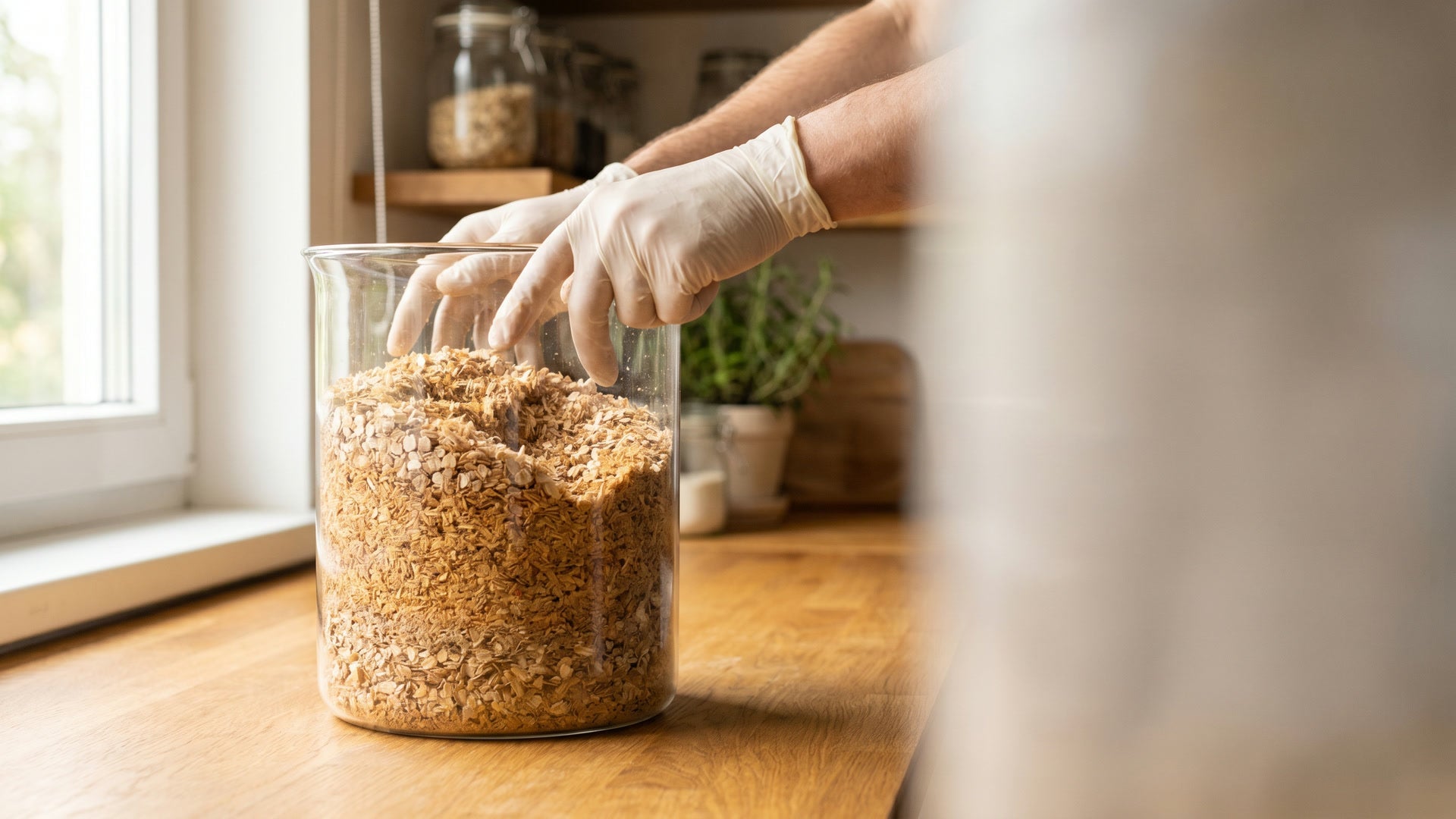
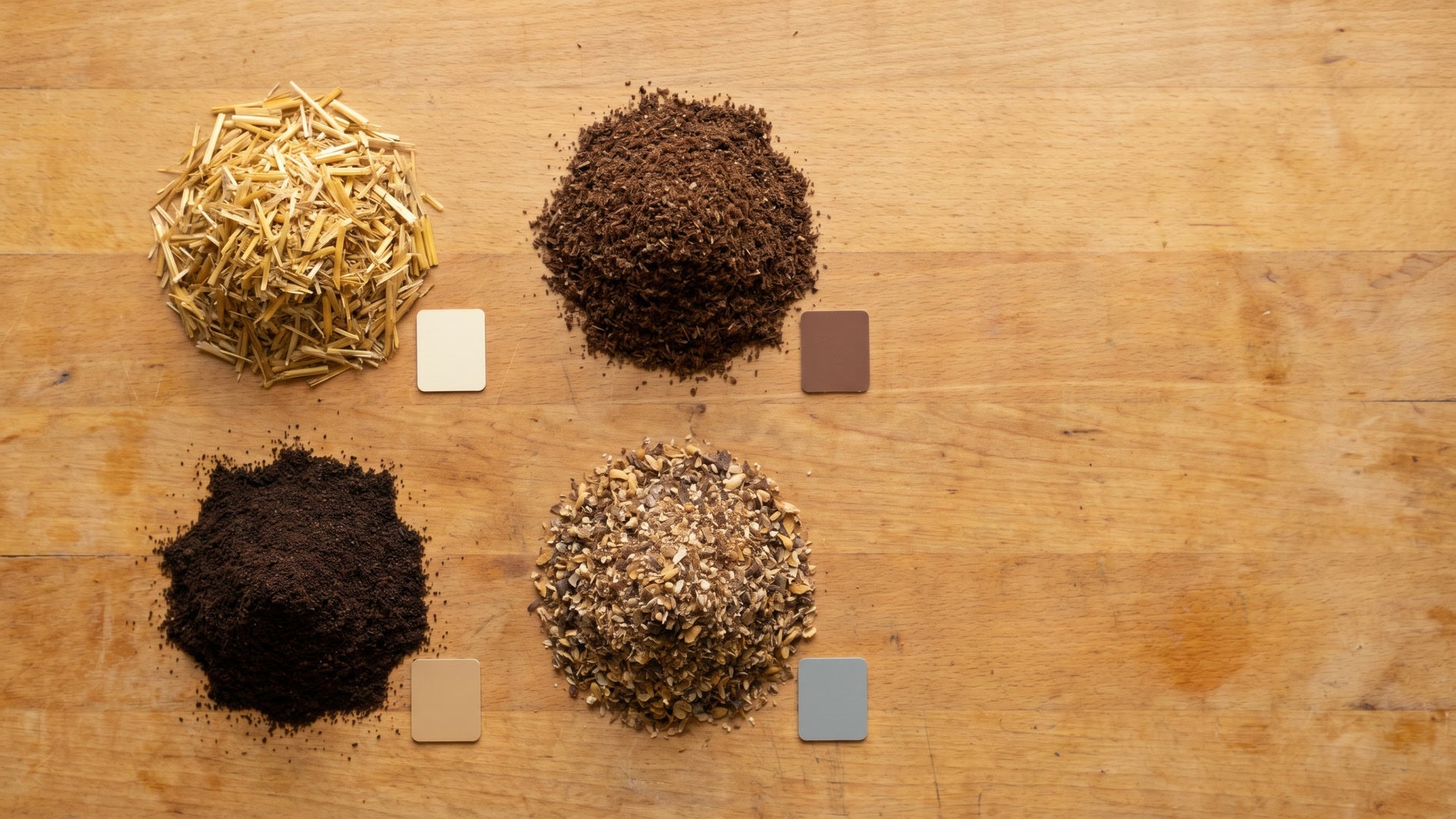
Pioppino is a strong wood decomposer. The most successful home substrate is supplemented hardwood sawdust - oak, beech, alder, or poplar. With 10 to 20 percent wheat bran or soy hull as a nutrient supplement. Cornell University's Small Farms Program lists supplemented sawdust as the dominant commercial substrate for Agrocybe aegerita, and it is what almost every commercial pioppino kit uses.

The fruiting block method (what we recommend)
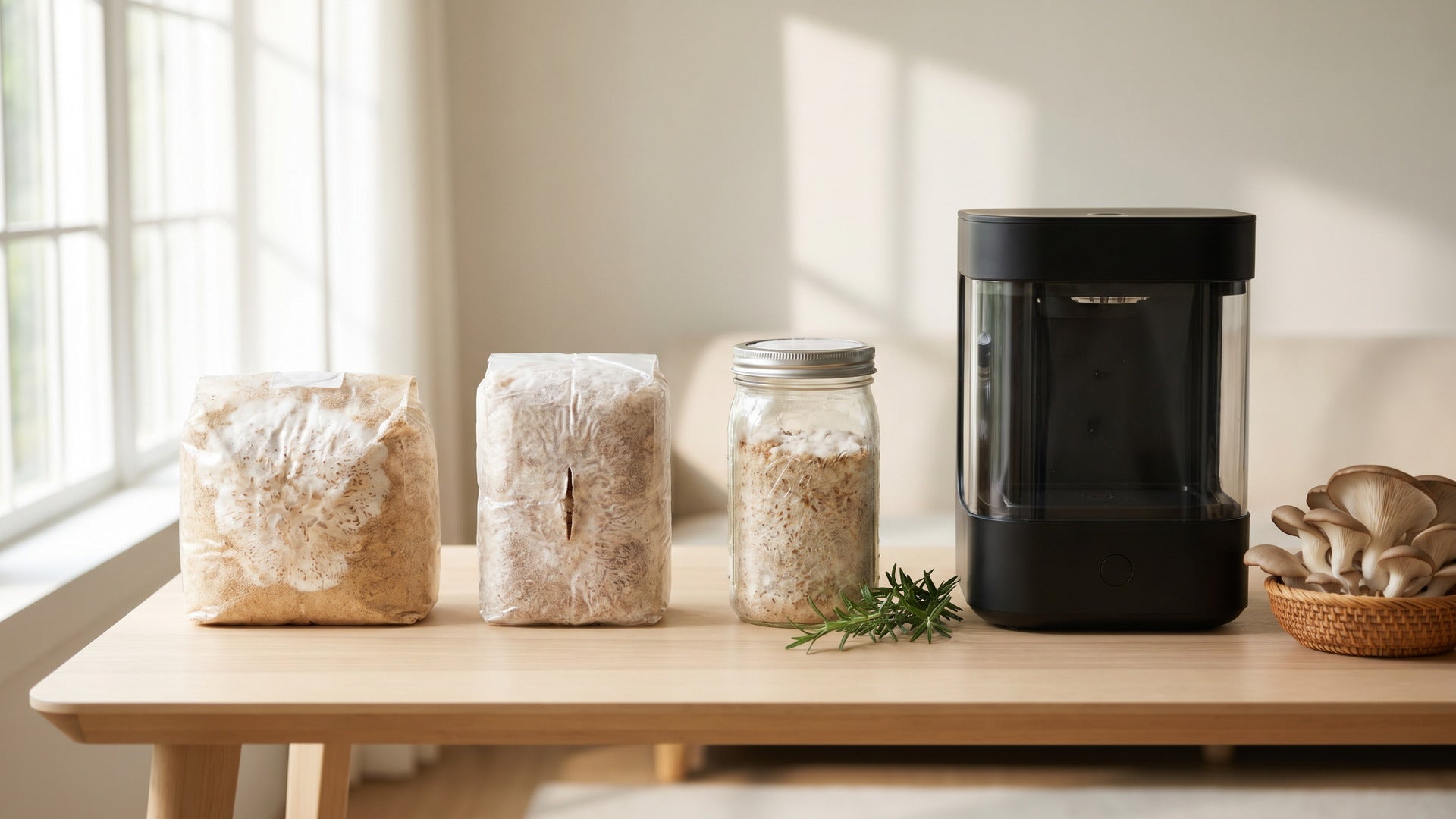
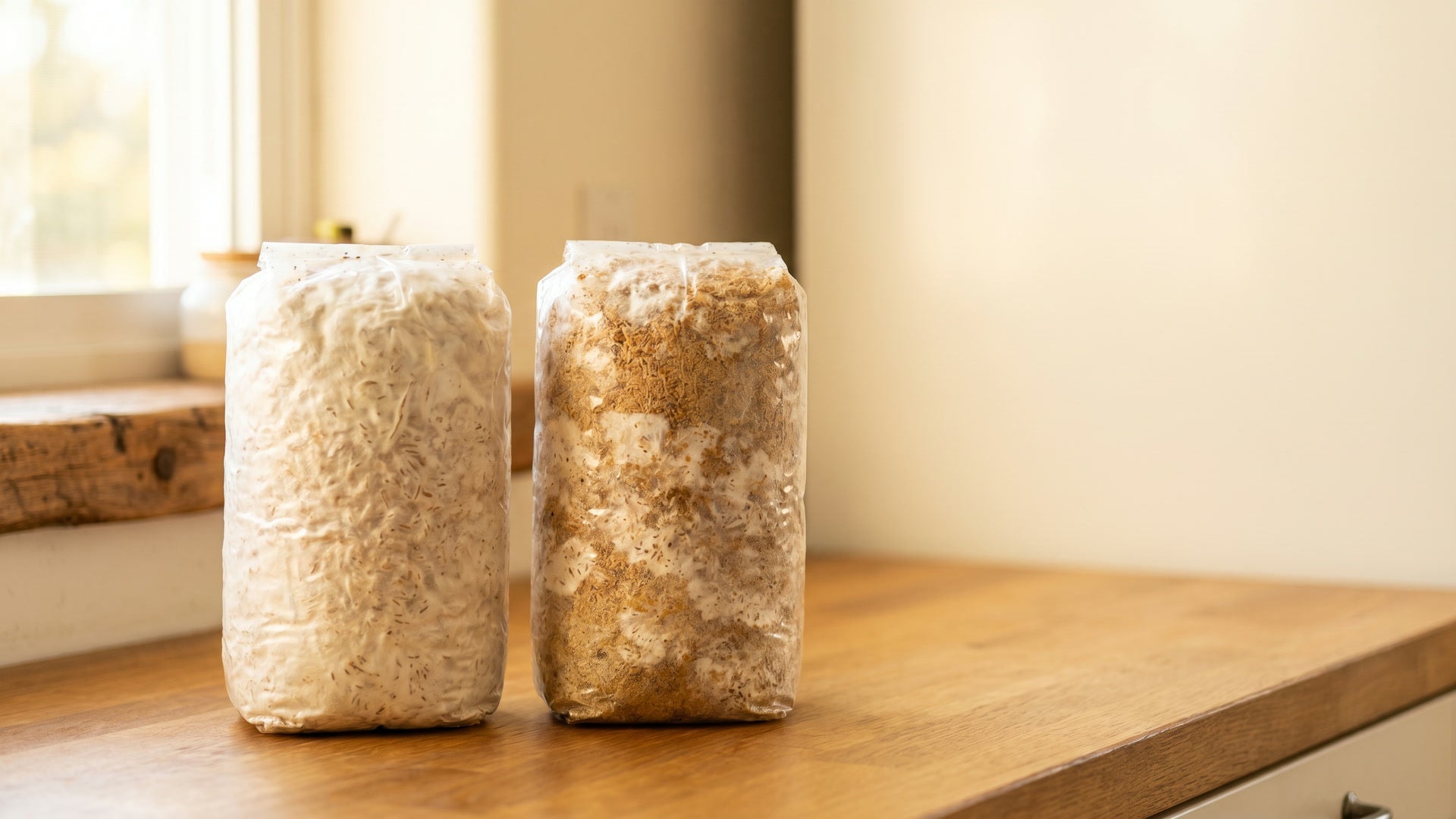
Pre-colonized fruiting blocks are how 95 percent of home pioppino growers should approach this species. The block is a sterilized hardwood sawdust mix that has been inoculated with pioppino mycelium at the producer, given 21 to 28 days to fully colonize, and then shipped at the point where primordia are ready to start forming.
Block size matters more for pioppino than for oyster. A 5 to 6 pound block gives the mycelium enough mass to push tight, dense clusters. Smaller blocks (under 3 pounds) often produce thinner, more fragmented bouquets because the substrate doesn't have the nutrient reserves to support cluster fusion.
This is what the Pioppino Grow Kit guide walks through in detail: a 5 to 6 pound pre-colonized hardwood sawdust block ready to fruit out of the bag, paired with the Smart Mushroom Grow Box for hands-off humidity. The block format works in any reasonably humid environment, but the chamber removes the humidity guesswork that fragments clusters.
If you want to compare pioppino against other species before committing, our mushroom fruiting chamber page covers the species that pair well with the Lykyn chamber side by side.
Timeline: what you should see, day by day
Day 0: Block arrives. Place in a 50 to 65 degree growing environment. Open the top of the bag fully if using a chamber, or cut a 2-inch slit if using a tent. Fill the chamber water reservoir.
Day 1 to 7: Visible dormancy. Nothing appears at the block surface for the first week. This is normal for pioppino and is the main reason the species earns a "not beginner-friendly" reputation. The mycelium is consolidating energy and preparing to fruit. Do not open the bag further, do not soak the block, do not adjust humidity downward. The grower's job is patience.
Day 8 to 12: Primordia formation. Small pale-cream bumps emerge on the block surface. Over four to five days they darken from cream to pale tan. Humidity must hold above 85 percent during this phase. If you see pins drying or cracking, raise humidity by 5 percent.
Lykyn tip: if you see cream pin clusters but they look loose or scattered rather than tight, your humidity is right but your air exchange is too low. Increase fan speed or open the tent for 60 seconds twice a day.
Day 13 to 18: Cluster development. Primordia fuse into tight bouquet-like clusters of 20 to 40 stems. Caps darken from pale tan to glossy chestnut-brown. Stems stay slender and cream-colored, reaching about 3 to 4 inches at maturity.
Day 18 to 21: Harvest window. Harvest when caps are fully chestnut-brown and shiny but still hemispheric (not yet flat). The window is narrow. Caps flatten and start releasing spores within one to two days of full maturity. Twist the entire cluster off at the base in a single motion to keep the bouquet intact for plating.
Day 22 to 35: Rest and second flush. Mist the block lightly once daily. After 10 to 14 days a smaller second flush often appears. Total yield across both flushes for a 5 to 6 pound block is roughly 0.75 to 1 pound fresh.

When to harvest pioppino mushrooms
Harvest at the moment caps are fully chestnut-brown, glossy, and still hemispheric. If the cap edges start to flatten or curl upward, harvest immediately. Flat caps are a sign of full maturation, and within 24 hours the gills will start releasing spores. Sporulation doesn't ruin the mushroom but it does shorten shelf life and dust nearby surfaces with chocolate-brown spore powder.
Twist the entire cluster off at the base in one motion. Do not cut individual stems. Pioppino's appeal is the intact bouquet, both visually on a plate and structurally for storage. If you intend to eat the same day, store stem-down in a paper bag in the refrigerator. The cluster holds 7 to 10 days that way.
For long-term storage, dry the whole cluster at 110 degrees Fahrenheit for 8 hours until brittle, then store in an airtight jar at room temperature. Dried pioppino rehydrates beautifully in warm broth, and the soaking liquid itself becomes a deep, earthy umami stock. Italian home cooks routinely use the rehydration water in risotto and braise broth.

Fuel Your Mushroom Journey
Smart Mushroom Grow Chamber
Plug-and-play smart chamber with humidity, light, and airflow dialed in for every species. Beginners harvest their first flush in days, not months.
Add to cart $299Where to grow pioppino at home
A cool, stable corner of the home is the right location:
- Basement or garage (if temperature-stable between 50 and 65 degrees) is the gold-standard pioppino environment. Most home basements run cool year-round.
- Cool spare room or pantry with the door closed in winter and shaded windows in summer.
- North-facing kitchen counter in fall, winter, and early spring, ideally away from heating vents and the oven.
Avoid: south-facing windows, hot bathrooms, garages in summer (above 75 degrees), heated rooms in winter (above 72 degrees), and anywhere with kitchen ventilation that pushes dry air across the block (over a range hood, near a refrigerator vent).
The chamber sits on any flat surface and runs at less than 35 decibels (about as loud as a quiet refrigerator). At roughly 2.2 kilowatt-hours per month, electricity cost is a few dollars across a full pioppino grow.
Multiple flushes
A 5 to 6 pound pioppino block typically produces two flushes. The first flush represents 60 to 70 percent of total yield, with the second flush adding another 25 to 35 percent. Some blocks produce a small third flush, but the cluster quality and yield drop noticeably by the third round.
To trigger the second flush:
- After the first harvest, mist the block lightly once a day at the cut surface.
- After 10 to 14 days of rest, you'll see fresh primordia start to form.
- If primordia don't appear within 14 days, soak the entire block in cold water for 1 to 2 hours, then return it to the chamber. The cold-water soak rehydrates the substrate and kickstarts secondary fruiting.
Compared to pink oyster (which typically gives 3 to 4 flushes from a single block), pioppino's flush count is modest. The trade-off is denser, more flavorful clusters per flush.
Cooking pioppino
Pioppino is unusual in the cultivated mushroom world: it tastes better after long cooking, not less. The flavor concentrates rather than fading, and the slender stems hold their shape and add textural bite. This makes pioppino a natural fit for stews, braises, and slow risottos where most cultivated mushrooms turn mushy.
Three preparation principles:
- Tear, don't slice. Tear the cluster into individual stems before cooking. This preserves the natural shape of each mushroom and gives more surface area for browning.
- Cook hot and long enough to brown. Pioppino's flavor develops with Maillard browning. A 6 to 8 minute saute in olive oil and butter with a finishing pinch of salt brings out the peppery-nutty character.
- Finish acid late. A small squeeze of lemon at the end of cooking lifts pioppino's earthy note without overpowering it. Add too early and the acid mutes the flavor.
For full recipes, the pioppino mushroom recipe guide covers risotto, pasta, and braise applications in detail. For the broader gourmet cooking context, the gourmet mushroom recipes guide puts pioppino alongside other heritage species in mixed preparations.

Common problems and fixes
Fragmented clusters instead of tight bouquets: Humidity is dropping below 80 percent at some point during days 7 to 14. Move the chamber to a cooler, more humid location, or check the chamber water reservoir level.
No pins after day 12: Temperature is too high. Pioppino stalls above 70 degrees. Move the chamber to a cooler room.
Pins are pale and stretchy: Air exchange is too low. Increase fan speed in the chamber, or fan a manual tent for 60 seconds twice a day.
Caps stay small and don't darken: Light is too low. Move the chamber to a brighter ambient location (no direct sun, just normal room light).
Slimy or bitter mushrooms at harvest: Harvest delayed past full maturity. Sporulation has started. Harvest 24 hours earlier next flush. At the moment caps are glossy and still hemispheric, not flat.
Frequently asked questions
Is pioppino mushroom psychedelic?
No. Pioppino (Agrocybe aegerita / Cyclocybe aegerita) is a non-psychoactive gourmet edible mushroom. It contains no psilocybin, no psilocin, and no other psychoactive compounds. It is legal everywhere edible mushrooms are sold. The brown cap silhouette resembles some psychoactive species at a distance, which likely explains the recurring search query, but pioppino is fully culinary and entirely safe to eat.
How long does it take to grow pioppino at home?
Pioppino takes 14 to 21 days from the day you open the bag to first harvest. The first seven days are visibly dormant. Nothing appears at the block surface. Primordia form between days 8 and 12, clusters develop over days 13 to 18, and the harvest window opens around day 18 to 21. A second flush typically follows 10 to 14 days after the first.
What temperature does pioppino need to grow?
Pioppino fruits best at 50 to 65 degrees Fahrenheit. Above 75 degrees, primordia abort or fruit thin and pale. Below 45 degrees, fruiting slows to a halt. Most American homes are too warm for pioppino in summer; the species fruits well in fall, winter, and early spring on a kitchen counter, or year-round in a cool basement.
Do I need a grow chamber to grow pioppino?
You can grow pioppino in a humidity tent with manual misting, but cluster formation suffers. Pioppino's signature bouquet cluster only forms when humidity stays sustained at 85 to 95 percent during days 7 to 14. Manual misting four times a day achieves this about 40 percent of the time. An automated Smart Mushroom Grow Box holds humidity within plus or minus 2 percent and removes that failure mode.
What does pioppino mushroom taste like?
Pioppino has an earthy, peppery, and nutty flavor. Reminiscent of chestnuts and black pepper with a slight bitter edge. The stems have a pleasant crunch that holds up in long cooking. Italian home cooks compare it to porcini but brighter and less muddy. The flavor concentrates rather than fades during long braises and risottos, which makes pioppino unusually well-suited to slow cooking.
How much pioppino does one block yield?
A 5 to 6 pound pre-colonized hardwood sawdust block yields roughly 0.75 to 1 pound of fresh pioppino across two flushes. The first flush represents 60 to 70 percent of total yield. This is lower than oyster or shiitake (1 to 1.5 pounds per equivalent block) but reflects the species' biology. Pioppino spends more energy on cluster fusion than on raw mass.
Is pioppino the same as tea tree mushroom?
Yes. Pioppino, tea tree mushroom (Chinese: cha shu gu), black poplar mushroom, piopparello, and willow agrocybe are all common names for the same species: Agrocybe aegerita (also classified as Cyclocybe aegerita). Italian markets sell it as pioppino. Chinese markets sell it as tea tree mushroom. The species is the same, the cultivation method is the same, and the culinary uses overlap considerably.
Can I grow pioppino from spores or grain spawn?
Yes, but the timeline doubles. From spores or grain spawn, pioppino takes 21 to 35 days to colonize a fresh substrate, then another 14 to 21 days to fruit. Call it 35 to 56 days total, with a meaningful contamination risk in the colonization phase. Pre-colonized fruiting blocks compress that into 14 to 21 days with the colonization done in a sterile lab. For home growers, blocks are the practical choice.
Bottom line
Pioppino (Agrocybe aegerita) is a heritage Italian gourmet mushroom that almost never appears fresh in American supermarkets. The 14 to 21 day timeline is slow, the yield is modest, and the cool-temperature requirement makes it a fall-through-spring species at home. But the reward is a mushroom with a peppery-nutty flavor and crunchy-stem texture that holds its own in long cooking. Autumn risotto with home-grown pioppino is genuinely something you cannot replicate from a supermarket ingredient.
Pair a single pioppino block with a Smart Mushroom Grow Box for hands-off humidity. Rotate species across the year. Pink oyster in summer when your kitchen is warm, pioppino in fall and winter when it cools down. Cluster the harvest into a Sunday risotto, dry the rest, and you'll have homegrown pioppino in your pantry through the winter.
We are a small California team. We answer our own email. If your first pioppino cluster fragments or your timeline runs long, write to us and we'll help you dial in humidity or send a replacement block. That is the deal.
References
- USDA Specialty Mushroom Industry, NASS production reports (Agrocybe aegerita / specialty fungi).
- Cornell University Small Farms Program. Specialty Mushroom Cultivation guide (supplemented hardwood sawdust as commercial substrate for pioppino).
- Mycologia - peer-reviewed research on Agrocybe aegerita (Cyclocybe aegerita) substrate, yield, and nutritional profile.
Fuel Your Mushroom Journey

Smart Chamber. Bone White Single
- 2.8L tank, 90% humidity automatic
- App-controlled, plug-and-play
- 6 lb block ceiling, in stock

Smart Chamber. Obsidian Black Single
- Same hardware as Bone White
- Matte black premium finish
- Pairs with any kitchen palette
Share:
How to Grow Pink Oyster Mushrooms at Home (2026 Guide)
How to Grow Pink Oyster Mushrooms at Home (2026 Guide)